Pag. 36 / 57 0MNMPMK10NPENUB 00
4. UPS in parallel configuration
4.1 Introduction
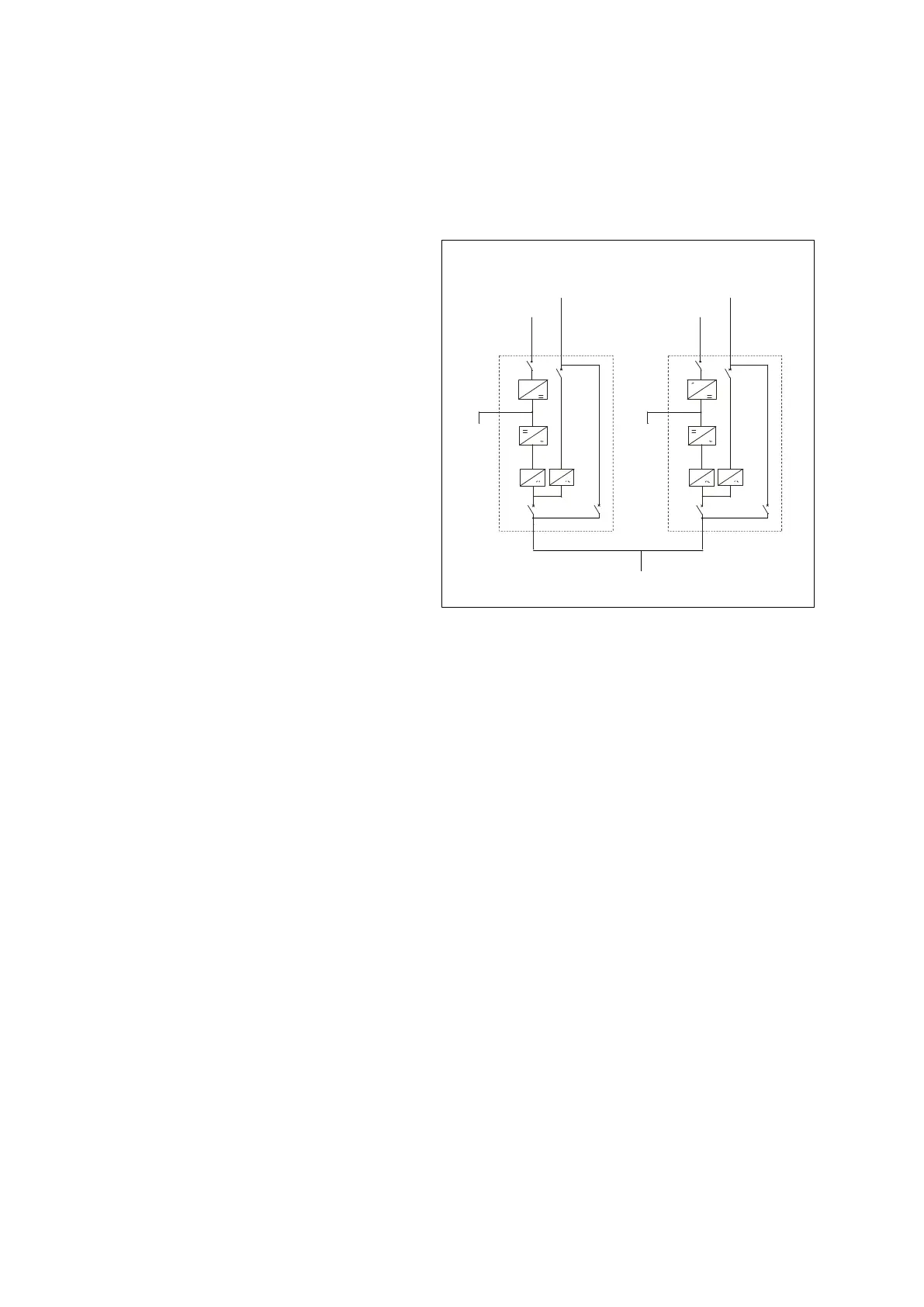
UPS may be connected in a parallel configuration to increase both the reliability of the power supply to the load and
the power available in output. Up to 8 UPSs can be parallel-connected. It is recommended to connect units of the
same power.
The load that can be applied to a system with several
units connected in parallel may be greater than the
load that can be supported by each individual unit,
thanks to automatic power sharing.
The reliability is only increased provided that the
total power of the system with one unit deactivated
remains greater than the required power. This
condition can be achieved by always adding a
redundant unit.
Having a redundant unit means having one more UPS
than the minimum number of elements required to
power the load, so that if a faulty unit is automatically
excluded, power is still supplied correctly. The UPSs
connected in parallel are coordinated by a card which
ensures the interchange of information.
The information is exchanged between the UPSs via
a cable connecting them in a loop. The loop
connection provides redundancy in the connection cable (communication in the cables between the individual units).
This is the most reliable means of connecting the UPS and also allows the hot insertion or disconnection of a UPS.
Each UPS has its own controller that continuously communicates with the whole system so as to guarantee the
operation of the system.
The cable transmits the signals from a “Master” UPS to the other “Slaves” using an opto-isolated system in order to
keep the control systems electrically isolated from each other. The operating logic envisages that the first unit that is
activated becomes the “Master” and takes control of the other “Slaves”. In the event of a fault in the “Master” unit,
control is immediately switched to a “Slave” which then becomes the “Master”. The current system provides basic
operation, each unit having its own battery. The system may be personalized (by means of a code inserted on the
display panel) with all the units connected to a single battery.
Battery
by-pass
line
load
mains
mains
Battery
by-pass
line



 To Next Page