Technical Manual VERSION 2.0 -10-18-2018
64
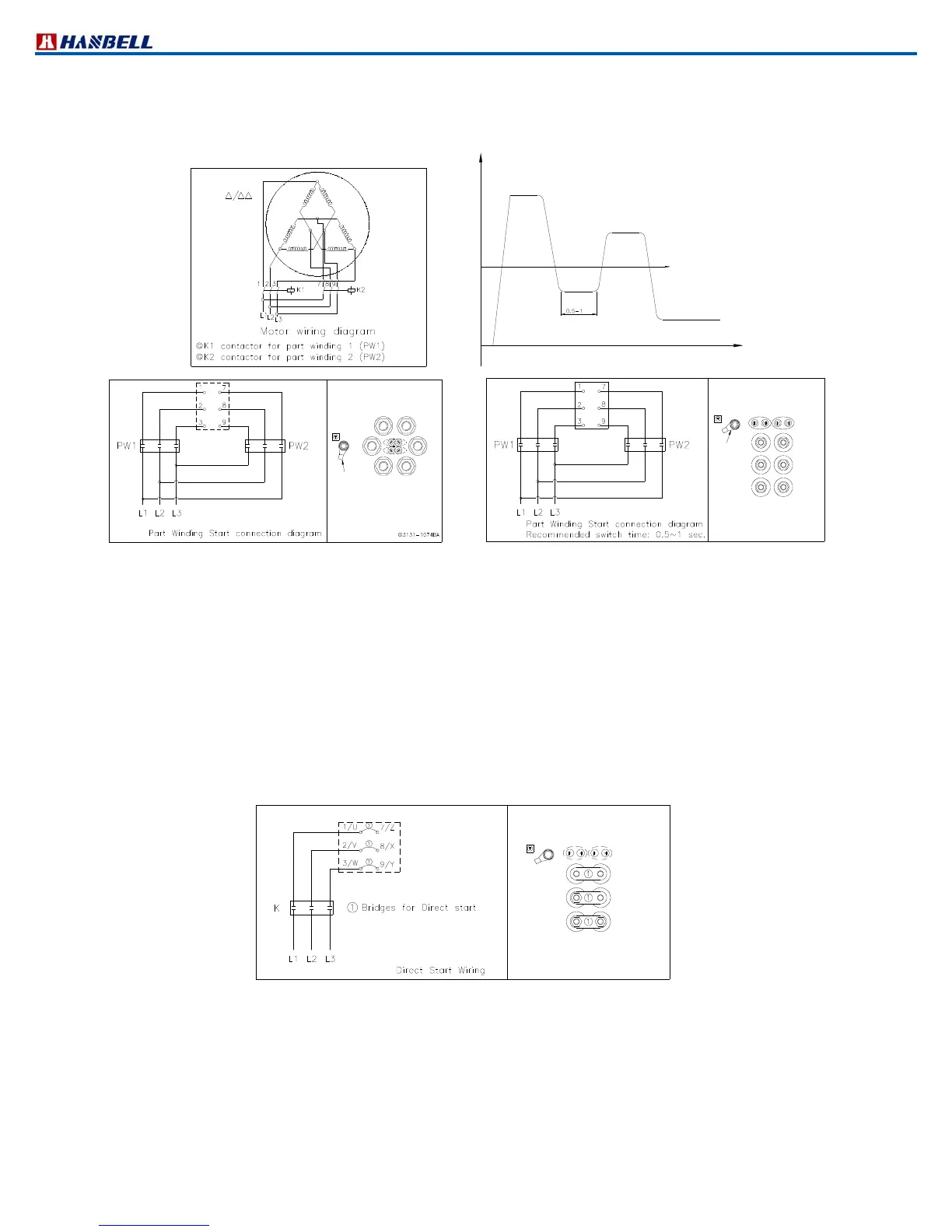
∆/∆∆ (PW) starting
RC2100A ~ RC2580A & RC2100B ~ RC2580B are available to be fitted with PWS motor for customer’s application
as an optional accessory. Please refer to the follow diagram for the wiring of PWS motor.
Full load Amper
Starting Current
Time
(AMP)
sec
PW2:7,8,9
B:Pt100 / Pt1000
(Option)
PW1:1,2,3
9
3
A:PTC
28
Earth Bolt
71
A
B
Figure 55 ∆/∆∆ (PW) starting diagram
The selection of both of the motor contactors (k1 / k2) is each for approx. 60% of the max. running current. The
recommended time delay of the switching relay k1 is to be set at 0.5 second and not more than 1 second.
PWS Starting features
The starting current is around 40% ~ 70% of fullwinding Locked Rotor Current. It depends on the design and motor
size, and low starting torque.
Direct on line features
The starting equipment consists of only a main contactor and thermal or electronic overload relay. During a directon
line start, the starting torque is very high, and is higher than necessary for most applications. The disadvantage with
this method is that it gives the highest possible starting current. Please refer to the follow diagram for the wiring of DOL
starting
B:Pt100 / Pt1000
2/V
3/W
A:PTC
(Option)
8/X
9/Y
Earth Bolt
1/U
A
B
7/Z
Figure 56 DOL starting diagram
Soft starting features
A soft starter is different from other starting methods in characteristics. It has thyristors in the main circuit, and the
motor voltage is regulated with a printed circuit board. The soft starter’s advantage is that when the motor voltage is
low during start, the starting current and starting torque is also low. Please refer to the following diagram for wiring of
soft starting.
PW2:7,8,9
PW1:1,2,3
(Option)
A:PTC
B:Pt100 / Pt1000
A
Earth Bolt
B
3
9
71
2
8



 To Next Page