75
Charge both the transmitter and receiver pack for your
airplane. Use the recommended charger supplied with
your particular radio system, following the instructions
provided with the radio. In most cases, the radio should
be charged the night before going out flying.
Check the radio installation and make sure all the
control surfaces are moving correctly (i.e. the correct
direction and with the recommended throws). Test run
the engine and make sure it transitions smoothly from
idle to full throttle and back. Also ensure the engine is
tuned according to the manufacturer’s instructions,
and it will run consistently and constantly at full throttle
when adjusted.
Check all the control horns, servo horns and clevises to
make sure they are secure and in good condition. Replace
any items that would be considered questionable. Failure
of any of these components in flight would mean the loss
of your aircraft.
The importance of having both engines run through the
entire flight is typically the most important aspect of flying
a twin engine model. We strongly recommend following
these pre flight engine break-in and tuning instructions.
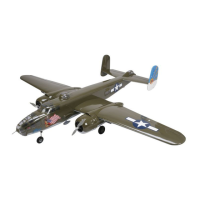
1) Before you attempt to fly your B-25 Mitchell
we suggest that you do a proper and thorough
break-in of your engines. Start by removing the
fiberglass cowls to allow easy adjustment of the
engine carburetors. We suggest running 1–2 tanks
of fuel through each engine separately following
the engine manufacturer's break-in procedure. It
is important that the engines each have a reliable
idle and a smooth transition thru the mid range
up to full throttle. Adjust the low & high speed
needles as necessary following the instructions
that came with your engine.
2) When you are satisfied with the idle and the
transition from idle to full throttle of both engines
you are now ready to start and run both engines
simultaneously. Start both engines and let them
idle for a few seconds allowing the idle to stabilize
on both engines. Using a tachometer to check the
rpm of both engines is recommended.
The two engines should have rpm readings
within a couple hundred rpm of each other,
but not necessarily identical. Do not change
any of your low speed needle settings to try
and obtain identical idle rpm readings for both
engines. Advance the engines to full throttle
paying attention to the transition. Both engines
should transition in a similar pattern and once
they reach full throttle should have the same or
similar Rpm reading. Again both engines should
be within a couple hundred Rpm of each other.
If the rpm readings are not with in a couple of
hundred rpm, then do not try to lean or richen
the high speed needle. We would recommend
that you either electronically or mechanically
adjust the throttle linkage to bring the higher
rpm engine down to match the other engine.
The majority of your flight will take place with
the engines at or near half power.
3) Once you are satisfied with the idle, transition,
and full powers settings of your engine you need
to replace the cowls and again run the engines.
A fully cowled engine can run at a higher
temperature than an un-cowled engine so it is
important to again check these parameters with
the engine cowls installed. Remember that it is
better to run the engines slightly rich for better
cooling. Never run the engines at peak rpm, but
rather a couple hundred rpm below maximum.
Pre-Flight
Engine Run-In Instructions



 To Next Page