EasyManua.ls Logo

Heathkit TA-16 - Operation; In Case of Difficulty

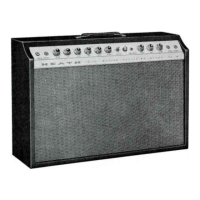
Heathkit TA-16
50 pages
Print Icon
To Next Page IconTo Next Page
To Previous Page IconTo Previous Page
Loading...
Page
30
OPERATION
Refer
to
Figure
1
for
a
description
of
the
various
control
functions.
CAUTION
The
loudspeakers
used
in
this
Guitar
Amplifier
have been
selected
to
handle
ade-
quately
all
the
power
that
the
amplifier
circuit
can
produce.
However,
prolonged
usage
under
conditions
of
maximum
power,
full
bass
boost,
and
overload
distortion,
may
result
in
torn
or
ruptured
cones.
OPERATING
PROCEDURE
1.
Turn
all
the
controls
to
their
"0"
position
and
turn
the
LINE
REVERSE
switch
to
OFF.
2.
Plug
the
line
cord
of
the
Amplifier
into
an
AC
outlet.
3.
Plug
the
instrument
into
the
desired
input
of
the
Amplifier.
4.
Place
the
LINE
REVERSE
switch
in
the
ON
position
that
gives
the
least
amount
of
hum.
5.
Now
increase
the
VOLUME
control
(of
the
channel being
used)
in
small
amounts
while
alternately
playing
the
instrument,
until
the
desired
volume
level
is
obtained.
6.
Next,
set
the
BASS
and
TREBLE
controls
of this
channel
to
obtain
the
tone
desired.
7.
If
the
Reverb
channel
is
being
used,
you
should
set
the
REVERB,
TREMOLO
RATE
and
DEPTH
controls
as
desired.
NOTE:
The
delayed
reverb
and
tremolo
circuits
are
always
in
operation
unless
the
foot
switch
is
plugged
into
the
Amplifier
and
the
switches
turned
off,
or
the
REVERB
and
TREMOLO
controls
are
set
at
zero.
ACOUSTIC
FEEDBACK
Acoustic
feedback
occurs
when
vibrations
(sound
waves)
from
the
speakers
are picked
up
by
the
Guitar
or
microphone,
or
by
the
delay
springs
in
the
reverberation
unit.
These
vibrations
are
converted
into
electrical
signals
and
reamplified;
the
result
is
a
loud,
continuous
squeal or
hum.
Acoustic
feedback
is
more
likely to
occur
when
using
the
Guitar
Amplifier
in
rooms
that
are
small, with
a
low
ceiling,
and
hard
walls.
Another
condition
that
causes
acoustic
feedback
is
plac-
ing
the
guitar
or
microphone
directly
in
front
of
or behind
the
speakers
in
the
Guitar
Amplifier.
Usually,
acoustic
feedback
can
be
corrected
by
using
lower
Volume
and/or
Reverb
settings.
At
high
Reverb
settings
you
may
also
encounter
mechanical
feedback
directly
from
the
speak-
ers,
through
the
cabinet,
to
the
springs
in
the
re-
verberation
unit.
If
this
occurs,
use
a
lower
setting
of
the
Reverb
control.
There
are
two
possible
hookups
that
can
be
used
when
two
Heathkit
Guitar
Amplifiers
are
available.
See
Page
41.
One
hookup
willproduce
greater
output
power,
and
the
other
is
for
special
reverberation
effects.
IN
CASE
OF
DIFFICULTY
NOTE:
Refer
to
the
Kit
Builders
Guide
for
Serv-
ice
and
Warranty
information.
Refer
to
the
X-Ray
View
and
the
Chassis
Photographs
(fold-out
from
Page
38)
for
the
physical
location
of
parts.
This
section
of
the
Manual
is
divided
into
the
following
six
sections:
General
Checks,
Test-
ing
Precautions,
The
Circuit
Breakers,
Trouble-
shooting
Chart,
Point-To-Point
Hum
Test,
and
Signal
Tracing.
The
General
Checks
describe
what
you
could
do
about
the
type
of
difficulty
that
may
occur
right after
the
amplifier
is
as-
sembled.
The
next section
describes
some
pre-
cautions
to
observe
when
making
tests,
and
the
Circuit
Breaker
section
tell
you what
to
do
if
a
circuit
breaker
opens.
The
Troubleshooting
Chart
lists
some
actual
difficulties
that
could
occur,
and
tells
what
could
cause
these
difficulties.
The
Point-To-Point
Hum

Related product manuals