EasyManua.ls Logo

Heathkit TA-16 - Page 36

Heathkit TA-16
50 pages
Print Icon
To Next Page IconTo Next Page
To Previous Page IconTo Previous Page
Loading...
Page
32
Tests and
the
Signal
Tracing
sections
tell
how
to
search
through
the
amplifier
to
find
a
dif-
ficulty.
The
Hum
Tests
use
a
method
that
does
not
require
electronic
test
equipment.
The
Sig-
nal
Tracing
section
requires
the
use
of
a
signal
tracer
or
an
oscilloscope.
Before
you
try
to
locate
the
cause
of
a
diffi-
culty,
be
sure
you
are
operating
the
controls
correctly.
See
the
Operation
section
on
Page
30.
CAUTION:
The
power
transformer,
AC
socket,
primary
circuit
breaker,
and
the
On-Off-On
switch
all
have
AC
line
voltage
applied
to
them.
Use
caution
when
testing
to
avoid
electrical
shock.
GENERAL
CHECKS
The
following
general
checks
should be
made
if
the
amplifier
does
not
operate
properly
after
the
kit
is
assembled.
1.
Recheck
the
wiring.
Trace
each
lead
in
colored
pencil
on
the
Pictorials
as
it
is
checked.
It
is
frequently
helpful
to
have
a
friend
check
your
work.
Someone
who
is
not
familiar
with
the
unit
may
notice
some-
thing
consistently
overlooked
by
the
builder.
2.
About
90%
of
the
kits
that
are
returned
for
repair
do
not
function
properly
due
to
poor
connections
and
soldering.
Therefore,
many
troubles
can
be
eliminated
by
reheat-
ing
all
connections
to
make
sure
that
they
are
soldered
as
described
in
the
Soldering
section
of
the Kit
Builders
Guide.
3.
Check
to
be
sure
that
all
transistors
are
in
their
proper
locations.
Make
sure
the
pilot
lamp
lights
up.
4.
Check
the
values
of
the
parts.
Be
sure
that
the
proper
part
has
been
wired
into
the
circuit,
as
shown
in
the
Pictorial
diagrams
and
called
out
in
the
wiring
instructions.
It
is
sometimes
easy
to
misread
the
third
color
band
on
a
resistor.
For
example,
if
a
3300
n
(orange-orange-red)
resistor
were
installed
instead
of
a
33
KS/
(orange-
orange-orange)
resistor,
the
circuit
would
not
operate
properly.
5.
Check
for
bits
of
solder,
wire ends
or
other
foreign
matter
which
may
be
lodged
in
the
wiring
and
for
solder
that
may
be
bridged
across
the
circuit
board
foils.
6.
If,
after
visual
checks,
the
trouble
is
still
not
located
and
a
voltmeter
is
available,
check
voltage
readings
against
those
shown
on
the
Voltage
Chart
(fold-out
from
Page
28)
and
the
Schematic
Diagram
(fold-out
from
Page
41).
NOTE:
All
voltage
readings
were
taken
with
an
11
megohm
input
vacuum
tube
voltmeter.
Voltages
may
vary
as
much
as
±20%.
7.
A
review
of
the
Circuit
Description
will
prove
helpful
in
indicating
where
to
look
for
trouble.
TESTING
PRECAUTIONS
When
testing the
amplifier,
make
certain
the
speaker
leads
are
not
short
circuited,
as
this
could
damage
the
output
transistors
or
other
circuit
components
in
the
amplifier.
When
making
voltage
measurements,
be
careful
that
you
do
not
short
across
adjacent
foils
on
the
circuit
board,
or
between
two
terminals,
or
from
a
terminal
to
ground.
For
instance,
if
the
voltmeter
test
probe
should
slip
and
short
out
a
bias
or
supply
point
in
the
power
output
stage,
it
is
almost
certain
to
damage
one or
more
transistors
or
diodes.
Never
remove
or
install
transistors
while
the
amplifier
is
turned
on
or
you
may
damage
some
of
the
other
transistors.
Although
transistors
have
almost
unlimited
life
when
they
are
used
properly,
they
are
much
more
vulnerable
to
damage
than
vacuum
tubes.
A
vacuum
tube,
for
instance,
may
be
operated
under
shorted,
zero-bias,
excessive
voltage,
or
high-current
conditions
for
at
least
short
periods
of
time
without
materially
damaging
the
tube;
but
any
one
of
these
same
conditions
can
completely
destroy
a
transistor
instantaneously.
THE
CIRCUIT
BREAKERS
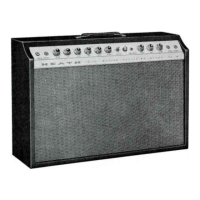
The
circuit
of
your
Guitar
Amplifier
is
pro-
tected
by two
circuit
breakers, one
in
the
pri-
mary
winding
and
the
other
in
the
secondary
winding
of
the
power
transformer.
If
your
amplifier
should
ever go
completely
dead
and
the
pilot
lamp
goes
out,
there
may
be
a
short
circuit
somewhere
that
has
caused
a
circuit
breaker
to
open
up.
Use
the
following
pro-
cedure
if
you
suspect
that
one
of
the
circuit
breakers
has
opened.

Related product manuals