EasyManua.ls Logo

Heathkit TA-16 - Page 42

Heathkit TA-16
50 pages
Print Icon
To Next Page IconTo Next Page
To Previous Page IconTo Previous Page
Loading...
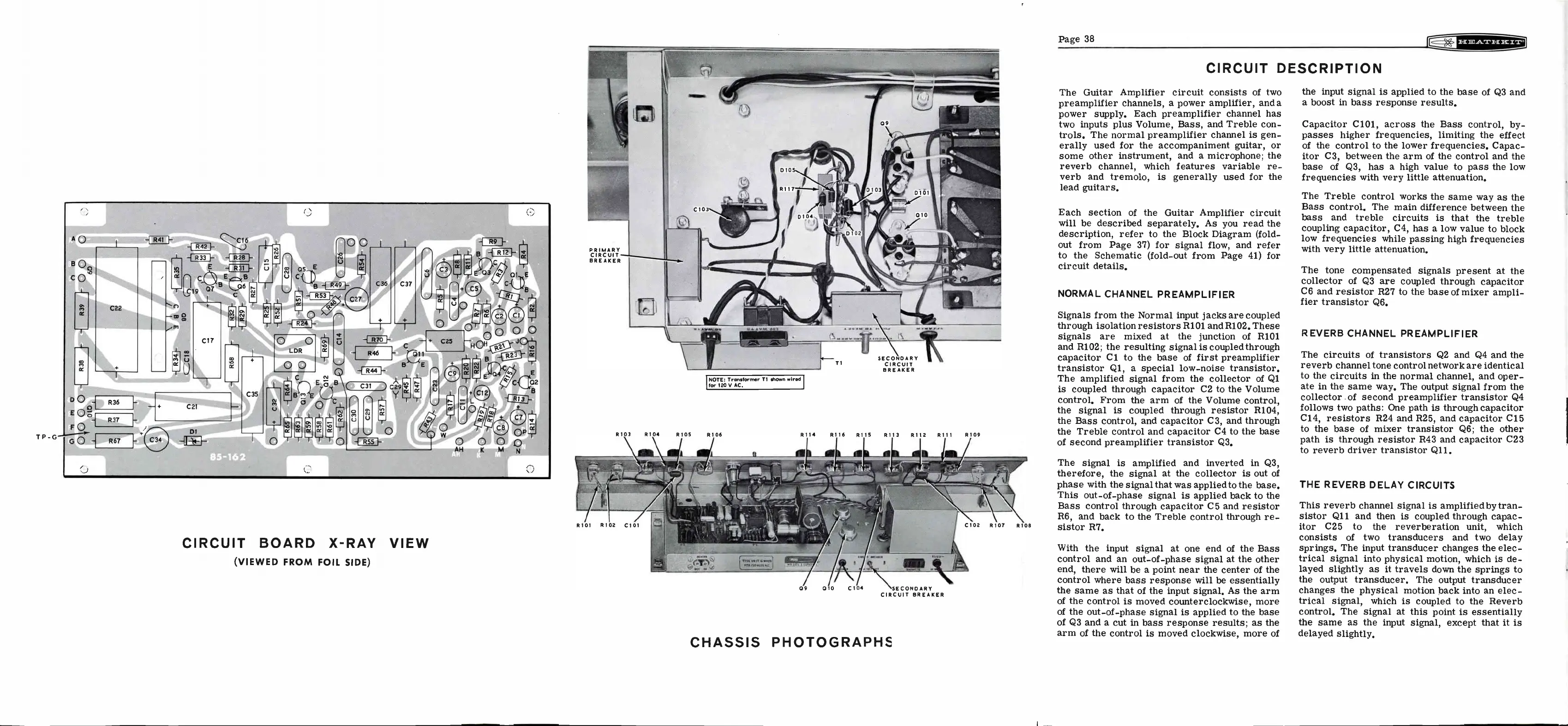
Page
38
CIRCUIT
BOARD
X-RAY
VIEW
(VIEWED
FROM
FOIL
SIDE)
PRIMARY
CIRCUIT
BREAKER
R101
R102
C101
CIRCUIT
BREAKER
NOTE:
Transformer
T1
shown
wired
for
120
V
AC.
R105
R106
SECONDARY
CIRCUIT
BREAKER
R114
R116 RI15
R113 R112
R111
R109
CHASSIS
PHOTOGRAPH5
C102 R107
R108
CIRCUIT
DESCRIPTION
The
Guitar
Amplifier
circuit
consists
of
two
preamplifier
channels,
a
power
amplifier,
and
a
power
supply.
Each
preamplifier
channel
has
two
inputs
plus
Volume,
Bass,
and
Treble
con-
trols.
The
normal
preamplifier
channel
is
gen-
erally
used
for the
accompaniment
guitar,
or
some
other
instrument,
and
a
microphone;
the
reverb
channel,
which
features
variable
re-
verb
and
tremolo,
is
generally
used
for
the
lead
guitars.
Each
section
of
the
Guitar
Amplifier
circuit
will
be
described
separately.
As
you
read
the
description,
refer
to
the
Block
Diagram
(fold-
out
from
Page
37)
for
signal
flow,
and
refer
to
the
Schematic
(fold-out
from
Page
41)
for
circuit
details.
NORMAL
CHANNEL
PREAMPLIFIER
Signals
from
the
Normal
input
jacks
are
coupled
through
isolation
resistors
R101
and
R102.
These
signals
are
mixed
at
the
junction
of
R101
and
R102;
the
resulting
signal
is
coupled through
capacitor
Cl
to
the
base
of
first
preamplifier
transistor
Ql,
a
special
low-noise
transistor.
The
amplified
signal
from
the
collector
of
Q1
is
coupled through
capacitor
C2
to
the
Volume
control.
From
the
arm
of
the
Volume
control,
the signal
is
coupled
through
resistor
R104,
the
Bass
control,
and
capacitor C3,
and
through
the
Treble
control
and
capacitor
C4
to
the
base
of
second
preamplifier
transistor
Q3.
The
signal
is
amplified
and
inverted
in
Q3,
therefore,
the
signal
at
the
collector
is
out
of
phase
with
the
signal
that
was
applied
to
the
base.
This
out-of-phase
signal
is
applied
back
to
the
Bass
control
through
capacitor
C5
and
resistor
R6,
and back
to
the
Treble
control
through
re-
sistor
R7.
With
the
input
signal
at
one
end
of
the
Bass
control
and
an
out-of-phase
signal
at
the
other
end,
there
will
be
a
point
near
the
center
of
the
control
where
bass
response
will
be
essentially
the
same
as
that
of
the
input
signal.
As
the
arm
of
the
control
is
moved
counterclockwise,
more
of
the
out-of-phase
signal
is
applied
to
the
base
of
Q3
and
a
cut
in
bass
response
results;
as
the
arm
of
the
control
is
moved
clockwise,
more
of
the
input
signal
is
applied
to
the
base
of
Q3
and
a
boost
in
bass
response
results.
Capacitor
C101,
across
the
Bass
control,
by-
passes
higher
frequencies,
limiting
the
effect
of
the
control
to
the
lower
frequencies.
Capac-
itor
C3,
between
the
arm
of
the
control
and
the
base
of
Q3,
has
a
high
value
to
pass
the
low
frequencies
with
very
little
attenuation.
The
Treble
control
works
the
same
way
as
the
Bass
control.
The main
difference
between
the
bass
and
treble
circuits
is
that
the
treble
coupling
capacitor,
C4,
has
a
low
value
to
block
low
frequencies
while
passing
high
frequencies
with
very
little
attenuation.
The
tone
compensated
signals
present
at
the
collector
of
Q3
are
coupled
through
capacitor
C6
and
resistor
R27
to
the
base
of
mixer
ampli-
fier
transistor
Q6.
REVERB
CHANNEL
PREAMPLIFIER
The
circuits
of
transistors
Q2
and
Q4
and
the
reverb
channel
tone
control
network
are
identical
to
the
circuits
in
the
normal
channel,
and
oper-
ate
in
the
same
way.
The
output
signal
from
the
collector
of
second
preamplifier
transistor
Q4
follows
two
paths:
One
path
is
through
capacitor
C14,
resistors
R24
and
R25,
and
capacitor
C15
to
the
base
of
mixer
transistor
Q6;
the
other
path
is
through
resistor
R43
and
capacitor
C23
to
reverb
driver
transistor
Q11.
THE
REVERB
DELAY
CIRCUITS
This
reverb
channel
signal
is
amplified
by
tran-
sistor
Q11
and
then
is
coupled
through
capac-
itor
C25
to
the
reverberation
unit,
which
consists
of
two
transducers
and two
delay
springs.
The
input
transducer
changes
the
elec-
trical
signal
into
physical
motion,
which
is
de-
layed
slightly
as
it
travels
down
the
springs
to
the
output
transducer.
The
output
transducer
changes
the
physical
motion
back
into
an
elec-
trical
signal,
which
is
coupled
to
the
Reverb
control.
The
signal
at
this
point
is
essentially
the
same
as
the
input
signal,
except
that
it
is
delayed
slightly.

Related product manuals