Page 3
GENERAL
Tube Complement:
1 - 6BA8:
Oscillator/Tripler (Pentode Section)
Tripler (Triode Section)
1 - 6BA8: Doubler (Triode Section)
Final RF Amplifier (Pentode Section)
1 - 6BS8:
Receiver Preamplifier and Detector.
1 - 12AX7: Speech Amplifier and First Audio
Amplifier.
1 - 6AQ5:
Audio Output and Modulator
Cabinet Dimensions:
8" high (including handle).
6" deep (including knobs).
9-3/4" wide (including license holder).
Net Weight:
6-1/2 lbs.
Minor variations from these specifications may
be encountered in kit -assembled equipment. Such
factors
as exact lead placement, component
variations and normal variations in tube char-
acteristics are possible sources of deviations.
Such variables will ordinarily have no significant
effect on overall performance.
INTRODUCTION
The
HEATHKIT
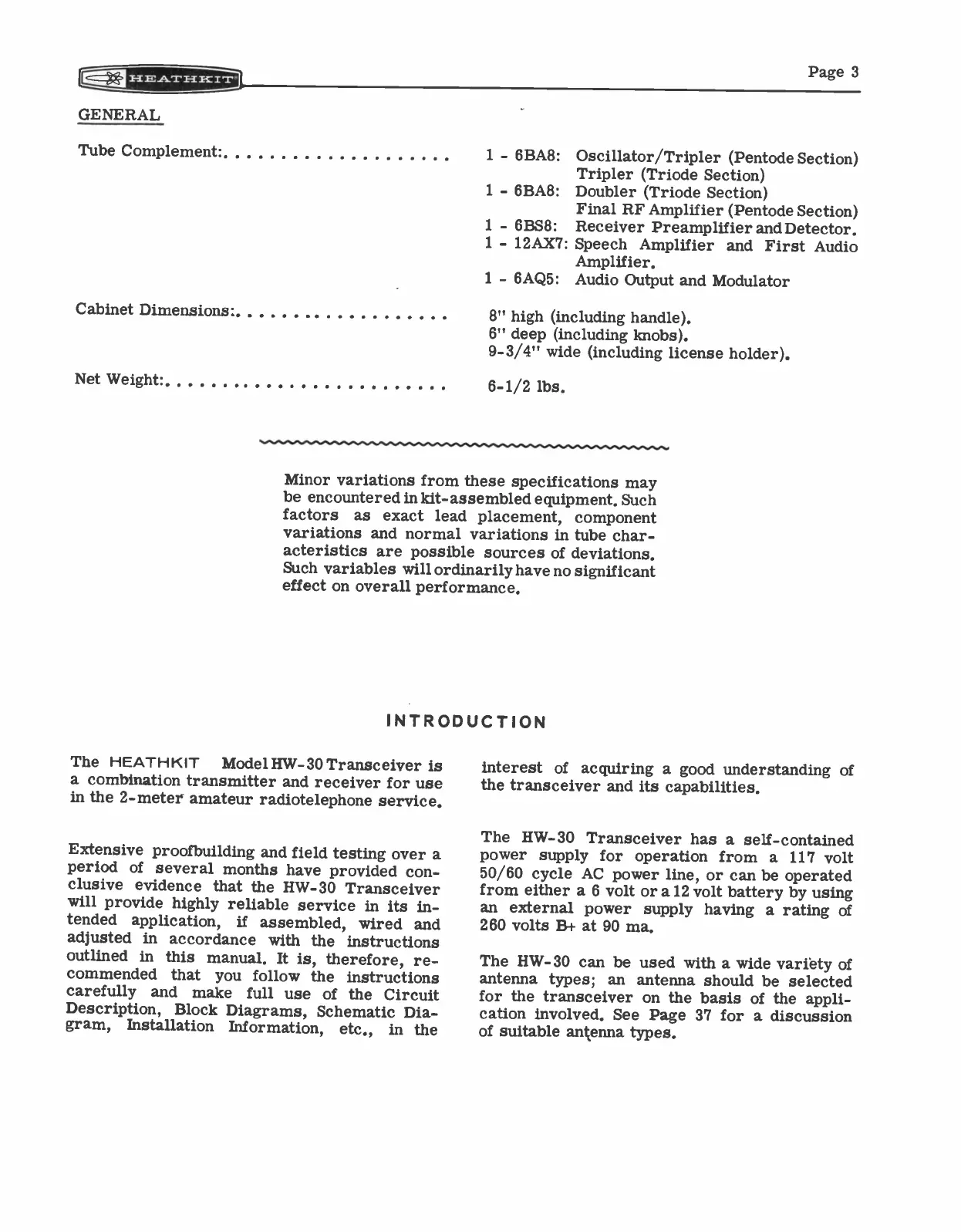
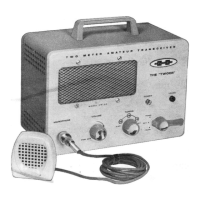
Model HW- 30 Transceiver is
a combination transmitter and receiver for use
in the 2 -meter amateur radiotelephone service.
Extensive proofbuilding and field testing
over a
period of several months have provided
con-
clusive evidence that the HW-30
Transceiver
will provide highly reliable service
in its in-
tended
application,
if
assembled, wired and
adjusted in accordance with the
instructions
outlined in this manual. It is, therefore,
re-
commended that
you follow the instructions
carefully
and make
full use of the Circuit
Description, Block Diagrams, Schematic Dia-
gram,
Installation
Information,
etc.,
in the
interest of acquiring a good understanding of
the transceiver and its capabilities.
The HW-30 Transceiver has a self-contained
power supply for operation from a 117 volt
50/60 cycle AC power line, or can be operated
from either a 6 volt or a 12 volt battery by using
an external power supply having a rating of
260 volts B+ at 90 ma.
The HW-30 can be used with a wide variety of
antenna types; an antenna should be selected
for the transceiver on the basis of the appli-
cation involved. See Page 37 for a discussion
of suitable antenna types.


 To Next Page