Page 40
be given to the physical position of the unit with
respect to the operator. Obviously, only those
locations within easy reach of the operator should
be considered, but usually in any given situation
more than one such location exists. Try to pick
the location which offers the best compromise of
these requirements.
After this location has been chosen, the unit
should be securely fastened to some solid sur-
face. Simple sheet metal brackets, fashioned to
fit your particular requirements, should suffice.
Engine ignition interference may be a problem.
Actual field tests in a variety of vehicles have
indicated no suppression is required (in the
average vehicle) beyond that normally provided
for a vehicle with a "factory equipped" standard
broadcast band radio receiver. If an ignition
interference problem is present, nearly any
radio service shop, skilled in auto radio repair,
should be able to help you locate and correct the
difficulty. One possible cause of such interfer-
ence can be the exhaust system. The muffler
and tail pipe are frequently mounted with rubber
insulated mounting clamps to reduce vibration,
and thus the muffler and tail pipe are electri-
cally grounded at the engine end only. This
problem is more likely to be present if a bumper
mount type antenna is employed, and can usually
be solved by electrically grounding the tail pipe
to the vehicle frame at one or more points. Many
other possibilities could be mentioned here, but
the many variables between vehicles and in-
stallations make this somewhat impractical.
Generator interference may also be a problem
as
evidenced by a generator "whine".
It is
recommended in these cases a coaxial capac-
itor of .5 pld value with a current rating exceed-
ing the generator output (similar to Sprague
48P18 rated at 40 amperes) be used to replace
the usual bypass capacitor. The insertion of a
coaxial capacitor in the armature winding lead
will require a short additional connecting lead
of #10 gauge wire. The capacitor case is grounded
using the same screw which held the old capac-
itor in place.
IN CASE OF DIFFICULTY
1. Recheck the wiring. Trace each lead in colored pencil
on the Pictorial as it is checked. It is frequently helpful
to have a friend check your work. Someone who is not
familiar with the unit may notice something
consistently overlooked by the constructor.
2.
It is interesting to note that about 90% of the kits that
are returned for repair, malfunction due to poor
connections and soldering. Therefore, many troubles
can be eliminated by reheating all connections to make
sure that they are soldered as illustrated in the Figures
found in the SOLDERING TECHNIQUES section of
this manual.
3.
Check to be sure that all tubes are in their proper
locations. Make sure that all tubes light up properly.
4.
Check the tubes with a tube tester or by substitution of
tubes of the same types and known to be good.
5.
Check the values of the component parts. Be sure that
the proper part has been wired into the circuit, as
shown in the pictorial diagrams and as called out in the
wiring instructions.
6.
Check for bits of solder, wire ends or other foreign
matter which may be lodged in the wiring beneath the
chassis.
7.
If, after careful checks, the trouble is still not located
and a voltmeter is available, check voltage readings
against those found on the Schematic Diagram. NOTE:
All voltage readings were taken with a
HEATHKJT®
Vacuum Tube Voltmeter. Voltages may vary 10% due
to line voltage variations.
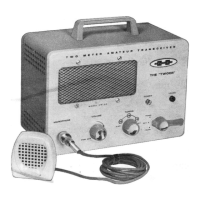
8. Listed
on the following page
are some possible
difficulties which might arise in the construction and
operation of your HW-30 Transceiver. The su:ested
corrective measures given definitely DO NOT RULE
OUT all other possibilities, but are given primarily to
direct your attention to the areas most likely to be
faulty.
NOTE: In an extreme case where you are unable to resolve a
difficulty, refer to the Service and Warranty section of the
"Kit Builders Guide," and to the "Factory Repair Service"
information on Page 43 of this Manual.


 To Next Page