19
5.2 Explanation
What are wood pellets?
Wood pellets is made of sawdust or shavings.
The used material must not contain foreign
elements, such as glue or varnish, which are
synthetic substances. Under high temperatures
the tree is pressed through a die with holes.
Due to the strong pressure, the chips become
overheated and activate the natural binders of
the wood.
In this way, the pellets maintain their shape
without the addition of any form of binder. The
density of the pellets varies depending on the
type of tree, and it may be 1.5 - 2 times larger
than natural wood.
The cylindrical wood pellets have a diameter
of 6 - 8 mm and a variable length between 10
and 40 mm. Their weight is about 650 kg / m3
because of the low water content (8-10%) they
have a high amount of energy.
Heta A/S recommends using ENplus -A1 quality pellets to get the most out of their pellet stove.
The pellets must be transported unconditionally
and stored dry. If they come into contact with
moisture, they swell very much and thus become
useless. Therefore, they must be protected
against moisture during transport and storage.
Quality Classes:
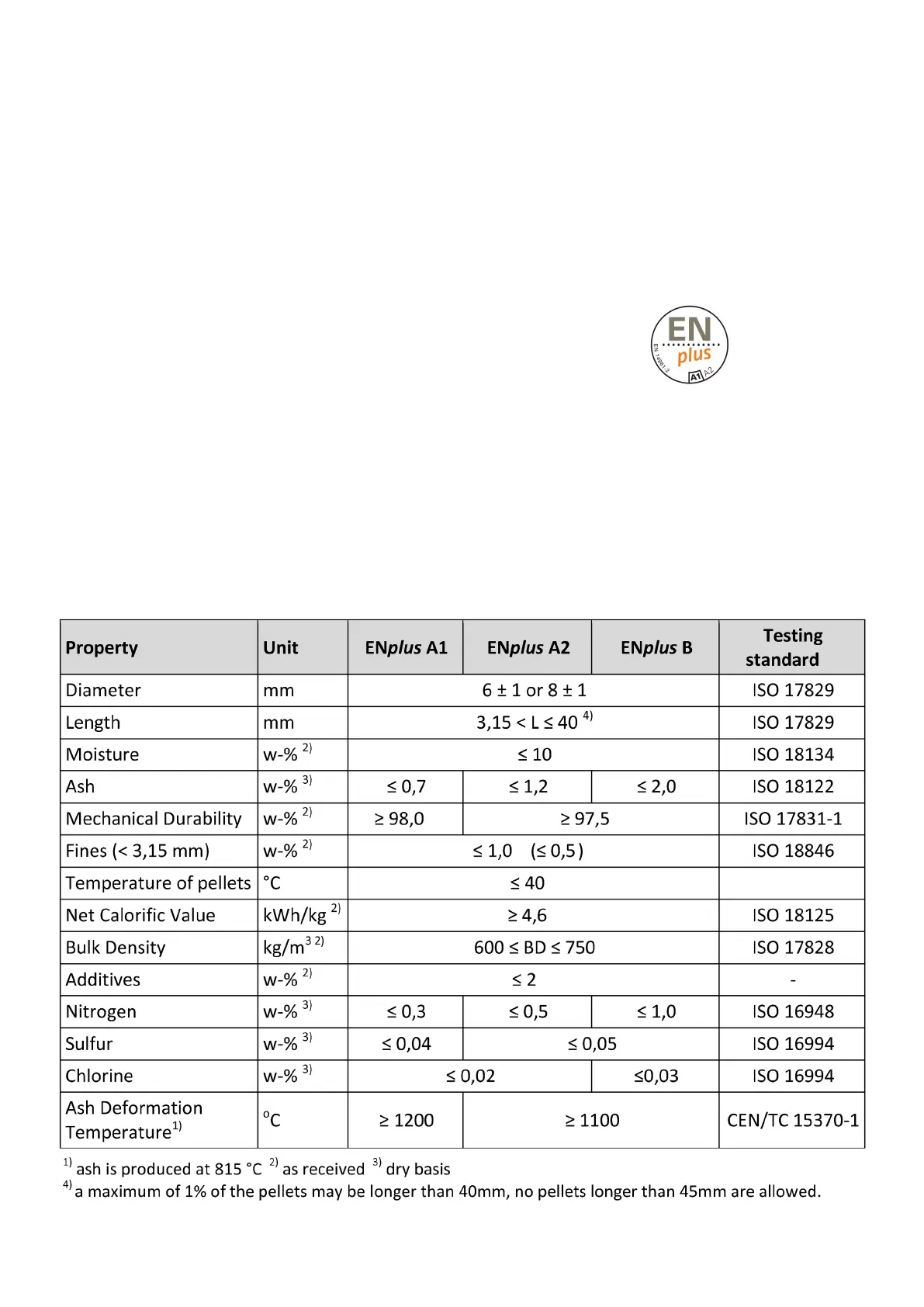
The ENplus certification scheme defines three
pellet quality classes. They are based on the
classes of ISO 17225-2 and are named:
a. ENplus -A1
b. ENplus -A2
c. EN -B
The types of wood indicated in Table 2 can be
used according to the standard ISO 17225-2 as
raw material for the production of wood pellets.
The raw material assortments are defined in
ISO 17225-1.
The table below provides an overview of pellet
properties and the related threshold values


 To Next Page