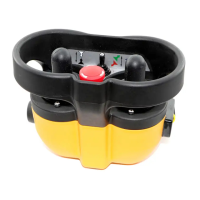
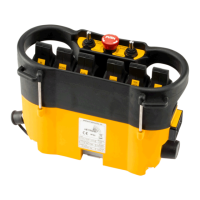
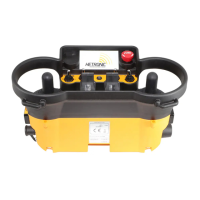
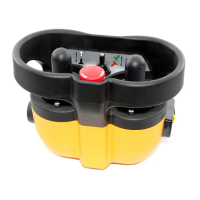
USER MANUAL | NOVA OCUs
18
6.
OCU Functional Description
6.1 “START” Function
The start function, typically associated with a green quadratic button positioned near the key switch, is essential for initializing the
radio remote control system. For safety compliance, the "Start" command must be activated to grant machine control whenever
interruptions to the wireless communication link occur. Often, this switch is paired with the machine horn function /.
To start up the radio remote control system from the OCU, ensure that the stop button is released and all control levers are in the
neutral position. Turn the key switch on the OCU to the “ON” position (I), then activate the “Start” command.
6.2 “STOP” Function
The pivotal feature of the radio remote control system is the STOP function. The OCU transmits the stop status signal alongside
other commands in the wireless telegram, ensuring the safety of ongoing operations. When the stop pushbutton is pressed (Active
STOP), the stop circuitry in the MCU halts all machinery functions, and the remote MCU transitions into a safe state.
The Stop command logic responds faster than any other control logic. When the Stop button is pressed, the OCU logic
automatically blocks any other command logic from the operator.
The Stop function is supported by self-monitoring redundant hardware and logic on both the OCU and the MCU. The system
Automated self-test are constantly running in the background to ensure the stop circuit is always in good working order. If an
error is detected, the whole radio remote control system is automatically put in a safe state.
When the OCU powered ON, it performs a self-test to ensure that all control logic is within the designated parameters. If an error is
detected, the OCU is forced into a safe stop state. No control command transmission occurs in this state. When the safe stop
state is active without the STOP button being pressed, the system enters Passive STOP mode. In this state, although the stop
button remains disengaged, the relays in the MCU open to prevent any operations from taking place. Possible triggers for Passive
STOP (Safe Stop state) are:
1.
OCU auto shutdown is engaged after a period of inactivity.
2.
Interference to the wireless communication link.
3.
OCU and MCU out of transmission range.
4.
Low battery state of charge.
Although it's effectively safeguarded against accidental activation, the STOP button remains easily accessible, allowing for swift
operation with top priority.
The STOP button on the OCU is compliant to EN62745 and functions solely as a generic safe stop. Unlike a fixed
Emergency STOP installation on the controlled machinery, it only operates when the OCU is powered up.
Pressing the STOP pushbutton does not guarantee that the machine will come to a complete stop. The functionality of
the STOP button depends on how the MCU STOP relays are wired to the machine's emergency stop circuit and
controlled machine logic.
Always test the STOP function at the beginning of every remote control session or when there is change of work-shift.
6.3 Digital and Proportional Control
Two types of control are available for operation from the OCU: digital and proportional functions.
Digital control (ON-OFF) dictates the opening or closing of potential-free relays or switching of solid-state circuits on the MCU
when the associated functions are activated on the OCU. These commands are typically associated with simple push buttons,
toggle switches, selector switches, or digital/gray-code joysticks.
Proportional control determines a variable output, either in current or voltage, directly proportional to the position variation of an
analog actuator on the OCU. This actuator can be a cross joystick, a paddle lever or a linear potentiometer. .Cross joysticks
operate on one, two, or three axes (X, Y, and Z respectively), depending on the application. Depending on the OCU configuration,
the X and Y axes can have up to six mechanical detents in each direction, while the Z axis involves the rotation of the joystick
lever on its own axis. When smooth, stepless proportional control is required, the initial mechanical movement of the joystick or
paddle lever activates the safety monitoring before any machine control is granted.
In all scenarios where start-interlocking is programmed or configured, it's imperative that all control elements remain in
the neutral position for the system to initiate. Ensure to consult your Hetronic dealer to confirm the availability of
adequate start-interlocking safety features on your OCU, tailored to ensure the safe operation of your remote-controlled
machinery.



 To Next Page