EasyManua.ls Logo

HP 3465B - Page 15

HP 3465B
58 pages
Print Icon
To Next Page IconTo Next Page
To Previous Page IconTo Previous Page
Loading...
Model
3465B
Section
IV
The
reference
supply
is
+
10
V
for
all
ranges
except
the
20
M
range.
For
this
range
the
reference
supply
is
+
1
V.
The
full-scale
output
of
the
ohms
converter
is
2
V
dc.
On
the
20
M
range
with
a
Rx
of
20
MFi
(full-scale),
an
output
of
2
V
dc
is
needed.
From
the
formula
for
the
ohms
output,
it
can
be
seen
that
10"
would
have
to
equal
100
Mf2.
Since
the
range
of
10"
is
10
kfi
to
10
Mf2,
a
10"
of
10Mf2
combined
with
a
reference
supply
of
IV
provides
the
desired
1
V
dc
full-scale
ohms
converter
output.
4-15.
AC—DC
Converter.
The
ac—dc
converter
is
an
average
responding
ac
converter.
It
measures
the
average
value
of
a
sine
wave
and
multiplies
this
by
a
fixed
scale
factor
to
convert
it
to
an
rms
value.
The
output
of
the
converter
is
a
dc
voltage
equal
to
the
rms
value
of
the
sine
wave.
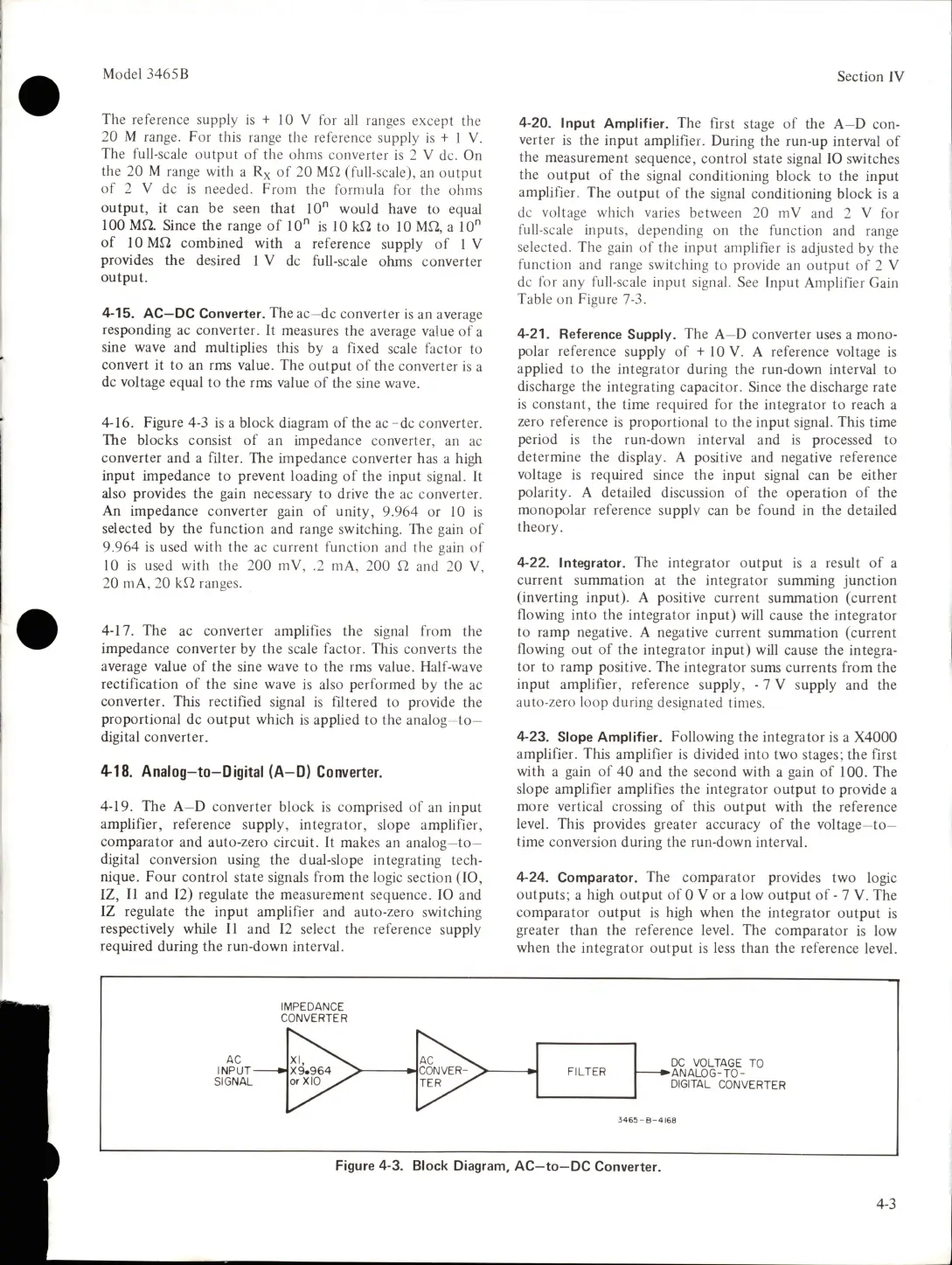
4-16.
Figure
4-3
is
a
block
diagram
of
the
ac
-dc
converter.
The
blocks
consist
of
an
impedance
converter,
an
ac
converter
and
a
filter.
The
impedance
converter
has
a
high
input
impedance
to
prevent
loading
of
the
input
signal.
It
also
provides
the
gain
necessary
to
drive
the
ac
converter.
An
impedance
converter
gain
of
unity,
9.964
or
10
is
selected
by
the
function
and
range
switching.
The
gain
of
9.964
is
used
with
the
ac
current
function
and
the
gain
of
10
is
used
with
the
200
mV,
.2
mA,
200
and
20
V,
20
mA,
20
kfl
ranges.
4-17.
The
ac
converter
amplifies
the
signal
from
the
impedance
converter
by
the
scale
factor.
This
converts
the
average
value
of
the
sine
wave
to
the
rms
value.
Half-wave
rectification
of
the
sine
wave
is
also
performed
by
the
ac
converter.
This
rectified
signal
is
filtered
to
provide
the
proportional
dc
output
which
is
applied
to
the
analog—to-
digital
converter.
4-18.
Analog-to-Digital
(A-D)
Converter.
4-19.
The
A—D
converter
block
is
comprised
of
an
input
amplifier,
reference
supply,
integrator,
slope
amplifier,
comparator
and
auto-zero
circuit.
It
makes
an
analog—to-
digital
conversion
using
the
dual-slope
integrating
tech
nique.
Four
control
state
signals
from
the
logic
section
(10,
IZ,
II
and
12)
regulate
the
measurement
sequence.
10
and
IZ
regulate
the
input
amplifier
and
auto-zero
switching
respectively
while
11
and
12
select
the
reference
supply
required
during
the
run-down
interval.
4-20.
Input
Amplifier.
The
first
stage
of
the
A—D
con
verter
is
the
input
amplifier.
During
the
run-up
interval
of
the
measurement
sequence,
control
state
signal
10
switches
the
output
of
the
signal
conditioning
block
to
the
input
amplifier.
The
output
of
the
signal
conditioning
block
is
a
dc
voltage
which
varies
between
20
mV
and
2
V
for
full-scale
inputs,
depending
on
the
function
and
range
selected.
The
gain
of
the
input
amplifier
is
adjusted
by
the
function
and
range
switching
to
provide
an
output
of
2
V
dc
for
any
full-scale
input
signal.
See
Input
Amplifier
Gain
Table
on
Figure
7-3.
4-21.
Reference
Supply.
The
A—D
converter
uses
a
mono-
polar
reference
supply
of
-tlOV.
A
reference
voltage
is
applied
to
the
integrator
during
the
run-down
interval
to
discharge
the
integrating
capacitor.
Since
the
discharge
rate
is
constant,
the
time
required
for
the
integrator
to
reach
a
zero
reference
is
proportional
to
the
input
signal.
This
time
period
is
the
run-down
interval
and
is
processed
to
determine
the
display.
A
positive
and
negative
reference
voltage
is
required
since
the
input
signal
can
be
either
polarity.
A
detailed
discussion
of
the
operation
of
the
monopolar
reference
supply
can
be
found
in
the
detailed
theory.
4-22.
Integrator.
The
integrator
output
is
a
result
of
a
current
summation
at
the
integrator
summing
junction
(inverting
input).
A
positive
current
summation
(current
flowing
into
the
integrator
input)
will
cause
the
integrator
to
ramp
negative.
A
negative
current
summation
(current
fl
owing
out
of
the
integrator
input)
will
cause
the
integra
tor
to
ramp
positive.
The
integrator
sums
currents
from
the
input
amplifier,
reference
supply,
-
7
V
supply
and
the
auto-zero
loop
during
designated
times.
4-23.
Slope
Amplifier.
Following
the
integrator
is
a
X4000
amplifier.
This
amplifier
is
divided
into
two
stages;
the
first
with
a
gain
of
40
and
the
second
with
a
gain
of
100.
The
slope
amplifier
amplifies
the
integrator
output
to
provide
a
more
vertical
crossing
of
this
output
with
the
reference
level.
This
provides
greater
accuracy
of
the
voltage—to-
time
conversion
during
the
run-down
interval.
4-24.
Comparator.
The
comparator
provides
two
logic
outputs;
a
high
output
of
0
V
or
a
low
output
of
-
7
V.
The
comparator
output
is
high
when
the
integrator
output
is
greater
than
the
reference
level.
The
comparator
is
low
when
the
integrator
output
is
less
than
the
reference
level.
AC
INPUT-
SIGNAL
IMPEDANCE
CONVERTER
X!
X
9.964
orXIO
AC
CONVER
TER
FILTER
DC
VOLTAGE
TO
►ANAUDG-TO-
DIGITAL
CONVERTER
Figure
4-3.
Block
Diagram,
AC—to—DC
Converter.
4-3

Table of Contents

Related product manuals