EasyManua.ls Logo

HP 3465B - Page 51

HP 3465B
58 pages
Print Icon
To Next Page IconTo Next Page
To Previous Page IconTo Previous Page
Loading...
Section
VII
Model
3465B
7-17.
If
the
300
ms
segment
is
extended
a
permanent
"overrange"
condition
exists.
Check
the
Auto
Zero
and
Reference
Supply
circuits.
With
1
V
dc
still
applied
to
the
input,
check
the
waveform
at
the
COMP/CP
terminal.
The
waveform
should
look
like
the
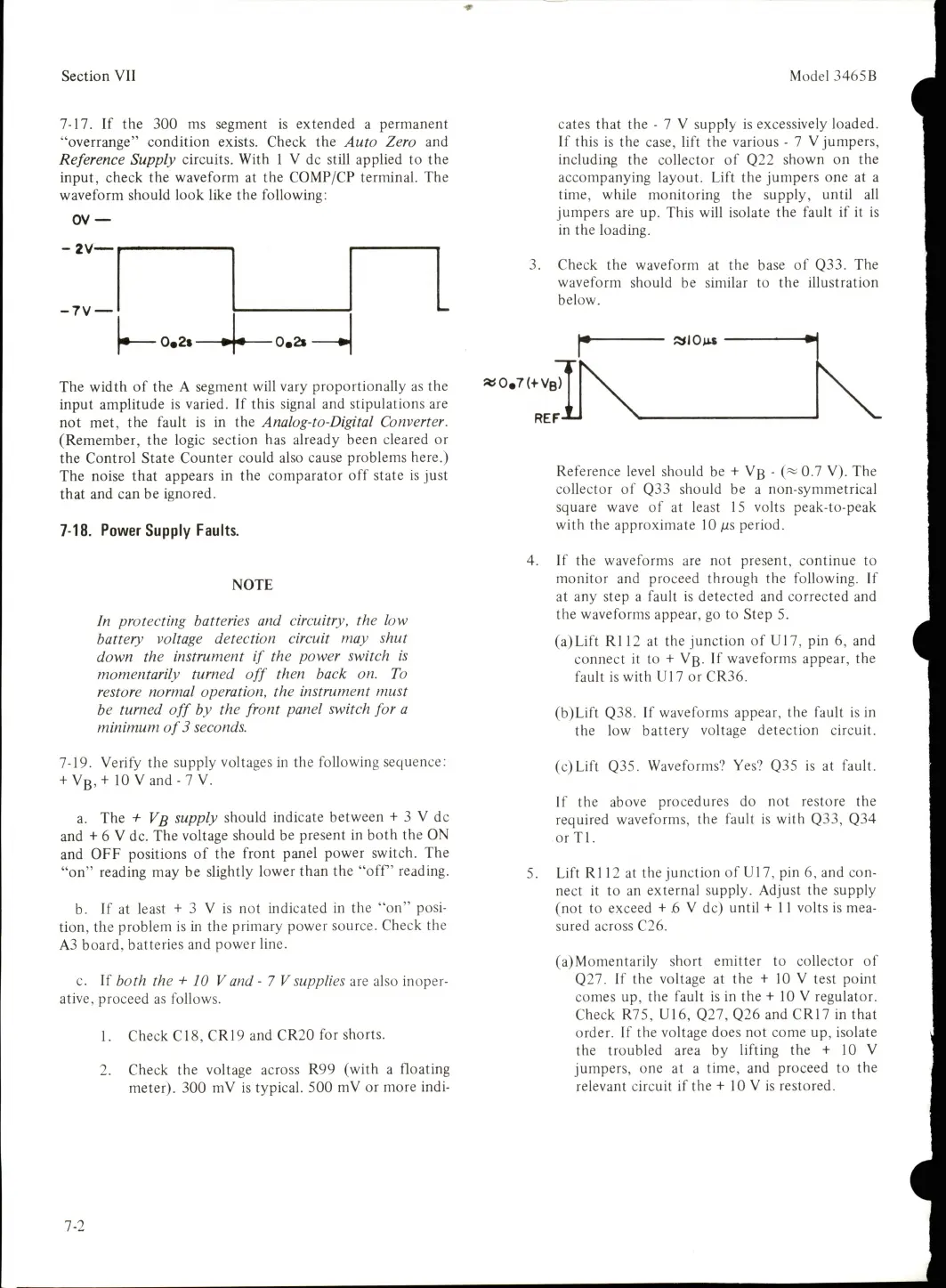
following:
OV
-2V-
_7V
■0«2«-
-O.Zt-
The
width
of
the
A
segment
will
vary
proportionally
as
the
input
amplitude
is
varied.
If
this
signal
and
stipulations
are
not
met,
the
fault
is
in
the
Analog-to-Digital
Converter.
(Remember,
the
logic
section
has
already
been
cleared
or
the
Control
State
Counter
could
also
cause
problems
here.)
The
noise
that
appears
in
the
comparator
off
state
is
just
that
and
can
be
ignored.
7-18.
Power
Supply
Faults.
NOTE
In
protecting
batteries
and
circuitry,
the
low
battery
voltage
detection
circuit
may
shut
down
the
instrument
if
the
power
switch
is
momentarily
turned
off
then
back
on.
To
restore
normal
operation,
the
instrument
must
be
turned
off
by
the
front
panel
switch
for
a
minimum
of
3
seconds.
7-19.
Verify
the
supply
voltages
in
the
following
sequence:
+
Vb,+
10
V
and-7
V.
a.
The
+
Vg
supply
should
indicate
between
-t
3
V
dc
and
-t
6
V
dc.
The
voltage
should
be
present
in
both
the
ON
and
OFF
positions
of
the
front
panel
power
switch.
The
"on"
reading
may
be
slightly
lower
than
the
"off
reading.
b.
If
at
least
-t
3
V
is
not
indicated
in
the
"on"
posi
tion,
the
problem
is
in
the
primary
power
source.
Check
the
A3
board,
batteries
and
power
line.
c.
If
both
the
+
10
Vand
-
7
V
supplies
are
also
inoper
ative,
proceed
as
follows.
1.
Check
C18,
CR19
and
CR20
for
shorts.
2.
Check
the
voltage
across
R99
(with
a
floating
meter).
300
mV
is
typical.
500
mV
or
more
indi-
3.
cates
that
the
-
7
V
supply
is
excessively
loaded.
If
this
is
the
case,
lift
the
various
-
7
V
jumpers,
including
the
collector
of
Q22
shown
on
the
accompanying
layout.
Lift
the
jumpers
one
at
a
time,
while
monitoring
the
supply,
until
all
jumpers
are
up.
This
will
isolate
the
fault
if
it
is
in
the
loading.
Check
the
waveform
at
the
base
of
Q33.
The
waveform
should
be
similar
to
the
illustration
below.
»0,7(+Vb)
Reference
level
should
be
-t
Vb
-
(^
0.7
V).
The
collector
of
Q33
should
be
a
non-symmetrical
square
wave
of
at
least
15
volts
peak-to-peak
with
the
approximate
10
ps
period.
4.
If
the
waveforms
are
not
present,
continue
to
monitor
and
proceed
through
the
following.
If
at
any
step
a
fault
is
detected
and
corrected
and
the
waveforms
appear,
go
to
Step
5.
(a)Lift
R112
at
the
junction
of
U17,
pin
6,
and
connect
it
to
-t
Vb.
If
waveforms
appear,
the
fault
is
with
U17
or
CR36.
(b)Lift
Q38.
If
waveforms
appear,
the
fault
is
in
the
low
battery
voltage
detection
circuit.
(c)Lift
Q35.
Waveforms?
Yes?
Q35
is
at
fault.
If
the
above
procedures
do
not
restore
the
required
waveforms,
the
fault
is
with
Q33,
Q34
orTl.
5.
Lift
R112
at
the
junction
of
U17,
pin
6,
and
con
nect
it
to
an
external
supply.
Adjust
the
supply
(not
to
exceed
-t
.6
V
dc)
until
-t
11
volts
is
mea
sured
across
C26.
(a)Momentarily
short
emitter
to
collector
of
Q27.
If
the
voltage
at
the
-t
10
V
test
point
comes
up, the
fault
is
in
the
-t
10
V
regulator.
Check
R75, U16,
Q27,
Q26
and
CR17
in
that
order.
If
the
voltage
does
not
come
up,
isolate
the
troubled
area
by
lifting
the
-t
10
V
jumpers,
one
at
a
time,
and
proceed
to
the
relevant
circuit
if
the
-t
10
V
is
restored.
7-2

Table of Contents

Related product manuals