EasyManua.ls Logo

HP 3465B - Page 52

HP 3465B
58 pages
Print Icon
To Next Page IconTo Next Page
To Previous Page IconTo Previous Page
Loading...
Model
3465B
Section
VII
7-20.
Signal
Conditioning
Faults.
7-21.
AC/DC
Volts
Common
Fault.
If
the
fault
is
com
mon
only
to
the
ac
and
dc
volt
function,
check
the
input
attenuator
and
associated
switches.
7-22.
AC
Volts/AC
Current
Common
Fault.
The
most
ex
pedient
way
to
check
out
the
impedance
and
ac/dc
con
verters
is
to
trace
the
input
signal
through
with
an
oscillo
scope.
With
I
V
ac
applied
to
the
input
in
the
2
V
ac
range,
the
following
are
normal.
a.
The
waveform
on
U19,
pin
3,
and
C49
should
be
the
same
as
the
input
or
about
3
volts
peak-to-peak.
b.
At
the
ACTP
test
point,
the
amplitude
should
he
about
twice
the
input
or
about
6
volts
peak-to-peak
with
a
dc
offset
of
-I-
1.6
volts.
c.
The
signal
at
the
junction
of
RlOO
and
R118
should
be
a
half
wave
rectification
of
the
signal
seen
in
(B).
d.
The
voltage
across
C38
should
be
about
0.75
volts
dc.
e.
If
one-half
full
scale
readings
are
alright
but
full
scale
is
in
error,
check
C41
for
leakage.
f.
Out-of-spec
readings
could
be
caused
by
leakage
in
the
filter
capacitors
C36,
C37
and
C38.
This
condition
can
be
readily
checked
by
applying
an
external
1
V
dc
at
the
junction
of
RlOO
and
R118
and
verifying
1
V
dc
across
C38.
g.
If
an
inaccuracy
is
unique
to
the
500
V
range,
check
R75.
7-23.
AC/DC
Current
Common
Fault.
Check
AMPS
fuse,
and
check
that
contact
is
being
made
through
the
terminal
fuse
spring
to
the
PC
board.
7-24.
AC
Current.
If
the
fault
is
unique
to
ac
current,
check
R20
and
R39.
7-25.
Ohms.
Short
the
junction
of
C29
and
R78
(Q25A
gate)
to
ground.
Rotating
R69
(10
Mf2
adj.)
through
its
extremes
should
result
in
the
output
(pin
6)
of
U15
to
span
the
voltage
range
of
about
-
2.5
V
dc
to
-i-
10
V
dc.
This
establishes
that
Q25
and
U15
are
functional.
Reset
R69
in
accordance
with
the
prescribed
adjustment
procedure
of
the
manual.
a.
Depress
the
T2
and
20
m
buttons,
and
short
the
input
f2
and
COM
terminals.
If
the
instrument
stops
sampling
or
the
front
panel
count
is
greater
than
±
15
counts,
check
the
ohms
calibration.
b.
If
the
200
n
range
zero
is
out
of
tolerance
3
counts)
check
C31
for
leakage.
c.
If
all
readings
are
progressively
increasing
out
of
spec
as
the
measured
resistance
is
increased,
check
diodes
(par
ticularly
CR15,
CR24,
CR25
and
CR26)
and
capacitors
C29
and
C31
for
leakage.
7-26.
Analog-to-Digital
Converter
Faults.
7-27.
The
Input
Amplifier
was
basically
treated
in
the
general
isolation
section.
If
the
problem
is
attributed
to
the
input
amplifier,
the
fault
can
be
further
localized
as
fol
lows:
a.
Short
the
10
signal
at
the
input
of
U2
to
ground.
(The
instrument
is
now
locked
in
the
run-up
phase.)
Moni
tor
the
voltage
at
the
DCTP
point.
The
dc
level
should
be
essentially
zero with
the
input
shorted
and
should
vary
pro
portionally
to
2
V
as
the
instrument's
input
is
varied
to
full
scale
of
any
particular
range.
If
it
does
not,
the
fault
is
for
ward
of
the
DCTP
point
and
then
proceed
to
Step
b,
otherwise,
go
to
Paragraph
7-29.
b.
Short
the
input
gate
of
Q16
(coming
from
Q20)
to
ground. With
the
instrument
on
the
2
V
range,
check
the
dc
voltage
at
the
DCTP
point.
It
should
he
less
than
1
mV.
If
it
is
not.
short
U1
pins
2
and
3
together.
If
the
voltage
has
not
essentially
zeroed,
check
UI.
If
the
latter
did
zero
the
DCTP
voltage,
check
Q16
and/or
adjust
R50
to
yield
the
desired
less
than
1
mV
offset.
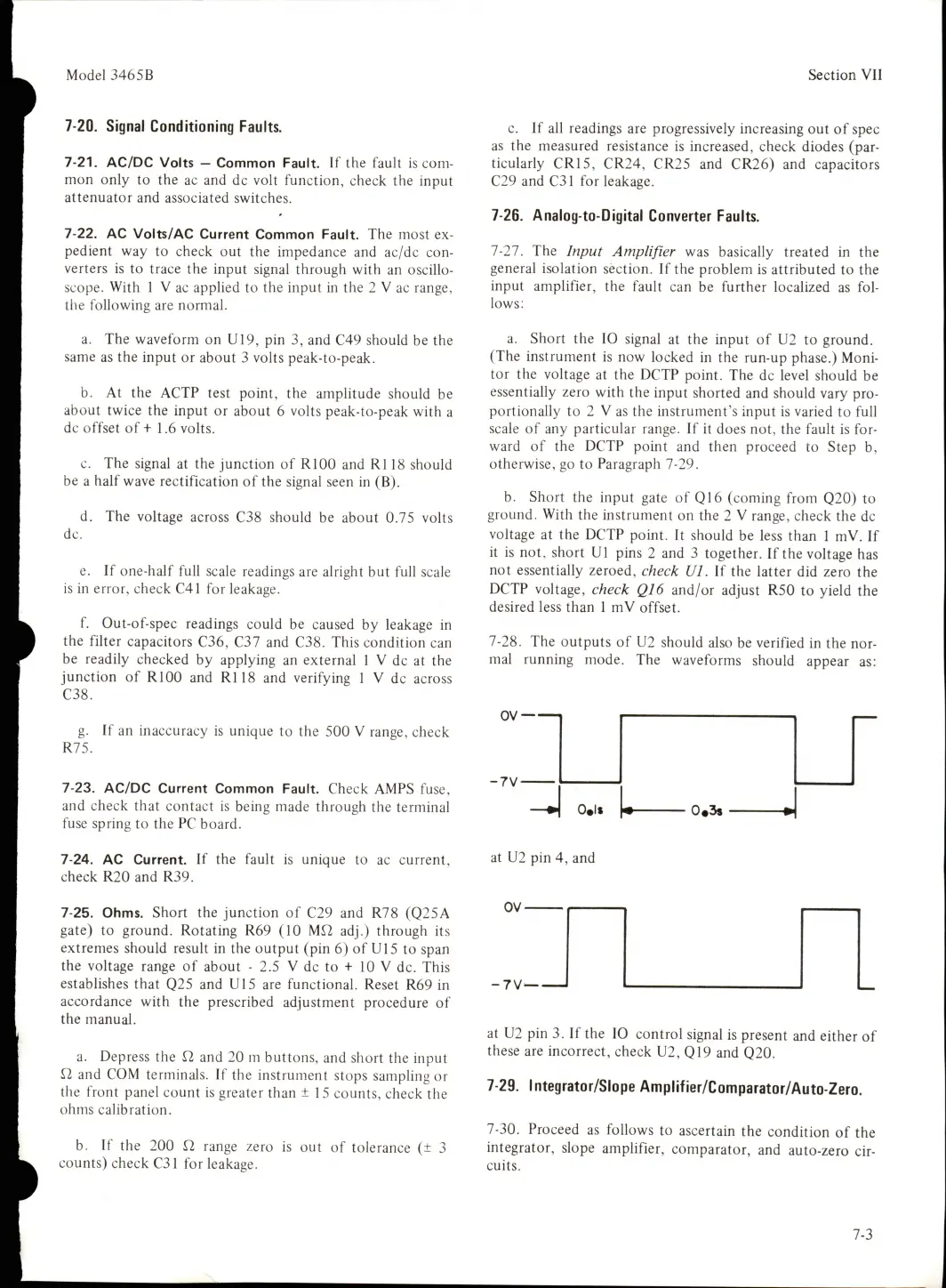
7-28.
The
outputs
of
U2
should
also
be
verified
in
the
nor
mal
running
mode.
The
waveforms
should
appear
as:
-7V-
0»ls
*
0«3»
m
at
U2
pin
4,
and
OV-
-7V^—
at
U2
pin
3.
If
the
10
control
signal
is
present
and
either
of
these
are
incorrect,
check
U2,
Q19
and
Q20.
7-29.
Integrator/Slope
Amplifier/Comparator/Auto-Zero.
7-30.
Proceed
as
follows
to
ascertain
the
condition
of
the
integrator,
slope
amplifier,
comparator,
and
auto-zero
cir
cuits.
7-3

Table of Contents

Related product manuals