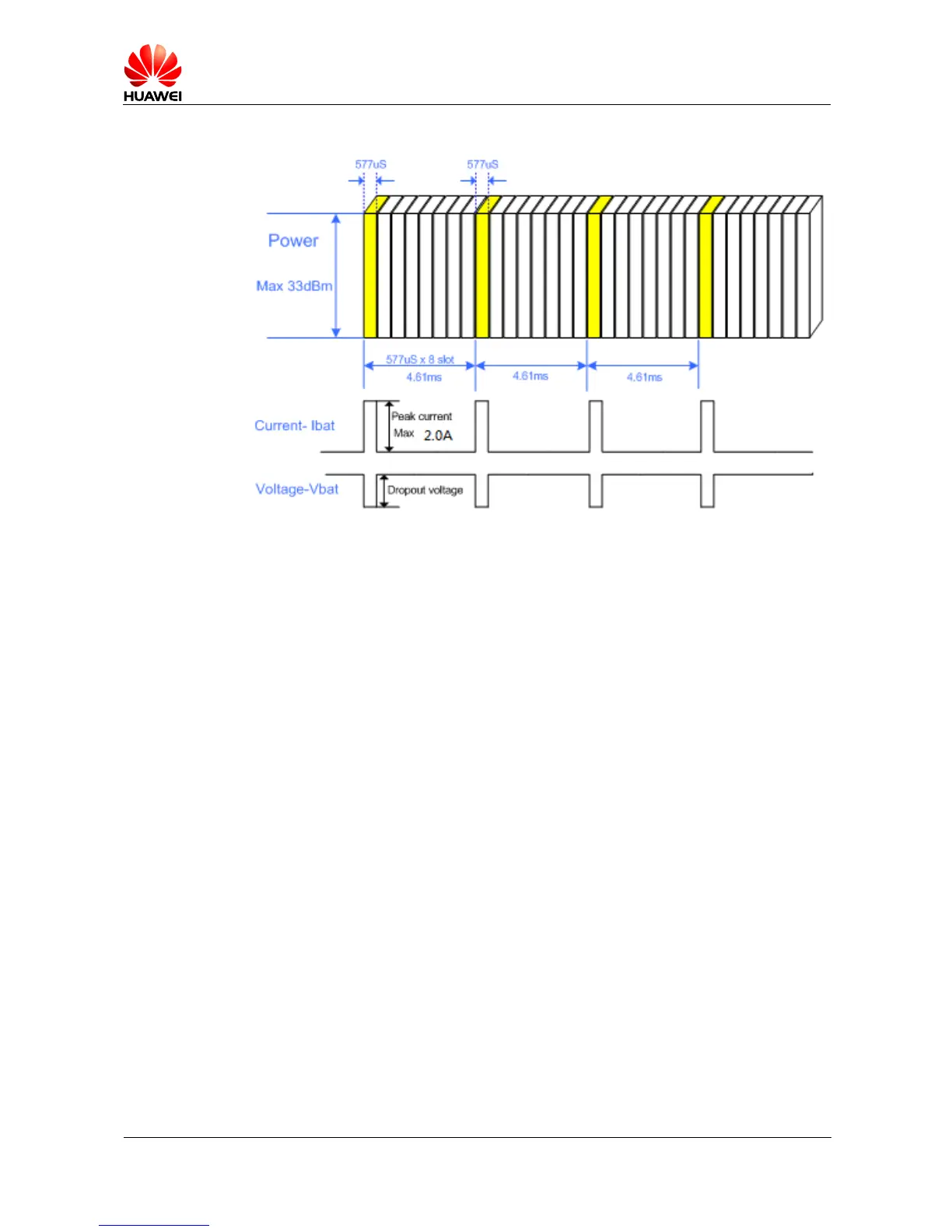
Figure 7-3 Transient power changes
Seen from Figure 7-3, the GMS power amplifier (PA) performs the transmission in the
transmission slots. In case of poor signal reception, the PA transmission power may reach 33
dBm. The transient MS2131 power supply current may reach 2 A and a voltage drop then
occurs.
The following are two reasons accounting for the MS2131 power supply voltage drop:
The transient response function of the power supply cannot meet the requirement for the
2 A transient output within several microseconds.
There is output impedance at the MS2131 power connector, and the currents are large.
When the transmission slot ends, the GSM PA shuts down, the power supply current then
drops, and the voltage resumes. After 4.651 ms, another transmission slot comes, causing a
voltage drop again.
Therefore, the MS2131 operating in 2G mode must have good transient response performance
and small internal resistance to prevent voltage drop. Considering the product cost and that
the MS2131 can operate within a certain range of voltages, the minimum voltage of the power
supply is 3.5 V.
7.4 MS2131 Power Requirements in 3G Mode
In a 3G network, no correlation exists between the transmission power and time.
Figure 7-4 shows the transmission power in a 3G network.










 To Next Page