P/N 3141959_C 2-7
HUSSMANN CORPORATION • BRIDGETON, MO 63044-2483 U.S.A.
FNGSC-A Self Contained Merchandisers
Before Beginning Any Service or Repair:
Use a hand-held propane leak detector (“sniffer”)
to ensure no propane is present in the immediate
area, the inside of the display case and the inside
of the refrigeration system. R-290 is an odorless
refrigerant. Keep the area clear of all customers
and non-essential or unauthorized personnel.
Verify that all repair parts are identical models
to the ones they are replacing. Do not substitute
parts such as motors, switches, relays, heaters,
compressors, power supplies or solenoids.
Failure to do so can result in an explosion,
death, injury and property damage. Parts used
on hydrocarbon cases must meet specic UL
certication for non-incendive or non-sparking
components. Use only Hussmann approved
parts approved through the Hussmann
Performance Parts Website:
https://parts.hussmann.com/
Only Hussmann or factory
trained technicians should
service or repair this R-290
(propane) equipment.
Failure to follow instructions can
result in an explosion, death,
injury and property damage.
Refrigeration lines are under pressure.
Refrigerant must be recovered before
attempting any connection or repair.
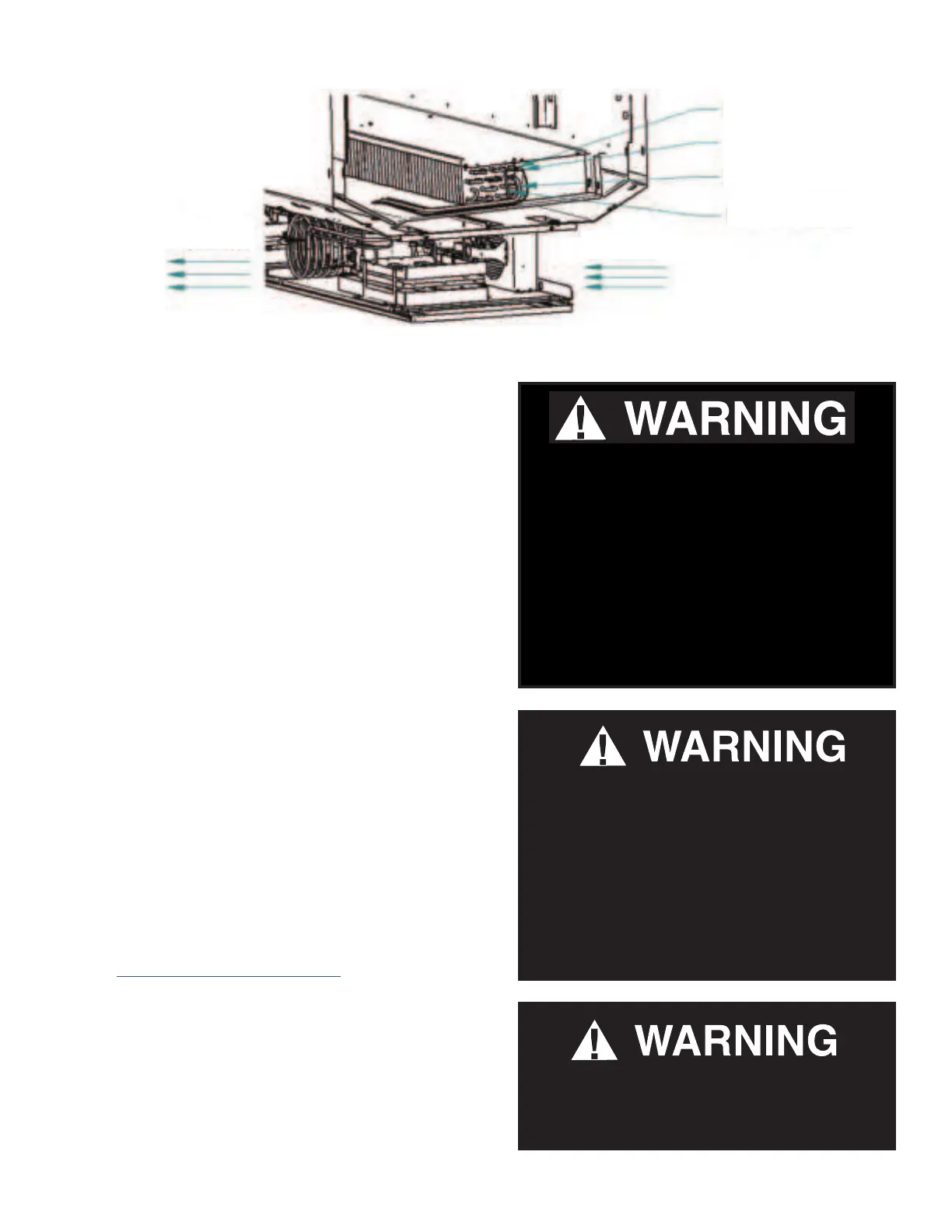
Refrigeration Circuit #2 (right side)
Refrigeration Circuit #2 - Refrigerant ow: Cap
tube is feeding the top section of the coil. Once
the refrigerant passes through the evaporator,
refrigerant goes out to the suction line to the
compressor.
Brazing must not begin before all propane has
been cleared from the immediate area — the
inside of the displays case and the inside of the
refrigeration system.
This refrigeration system uses hot
gas defrost and incorporates a Normal
Closed Solenoid. In order to remove
all the refrigerant for service, the valve
must be held open while the refrigerant
is being evacuated. Failure to remove
all the refrigerant can cause a re or
explosion.
AIR INTAKE
AIR EXHAUST
Hot Gas Line
Hot Gas Tee
Evap Inlet
Evap Outlet



 To Next Page