2-8 ELECTRICAL / REFRIGERATION
P/N 3141959_C U.S. & Canada 1-800-922-1919 • Mexico 1-800-890-2900 • www.hussmann.com
If a leak is detected, follow store safety
procedures. It is the store’s responsibility to have
a written safety procedure in place. The safety
procedure must comply with all applicable codes
such as local re department’s codes.
At minimum, the following actions are required:
• Immediately evacuate all persons from the
store, and contact the local re department to
advise them that a propane leak has occurred.
• Call Hussmann and/or a qualied service
agent and inform them that a propane sensor has
detected the presence of propane.
• Do not let any persons back into the store
until the qualied service technician has arrived
and that technician advises that it is safe to
return to the store.
• The propane gas used in the unit has no odor.
The lack of smell does not indicate a lack of
escaped gas.
• A hand-held propane leak detector
(“sniffer”) should be used before any repair and/
or maintenance is attempted. All repair parts
must be identical models to the ones they are
replacing.
• No open ames, cigarettes or other possible
sources of ignition should be used inside the
building where the units are located until the
qualied service technician and/or local re
department determines that all propane has been
cleared from the area and from the refrigeration
systems.
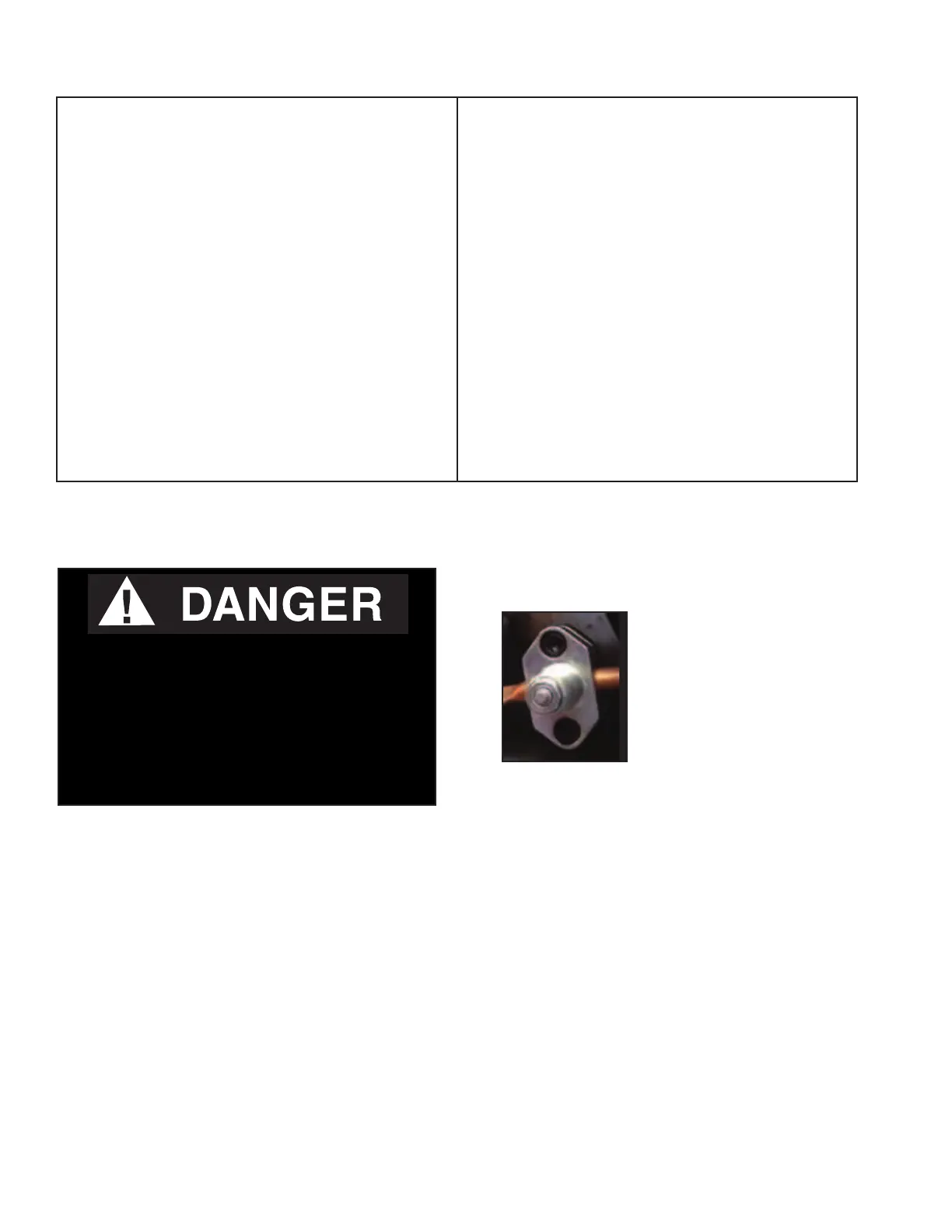
Only Hussmann service technicians or
technicians qualied to handle R-290
(propane) refrigerant should service or
repair this R-290 (propane) equipment
Failure to follow instructions can result
in an explosion, death, injury and
property damage.
refrigeration
line tapping
valve
REPLACING REFRIGERATION SYSTEM
COMPONENTS
STEPS TO RECOVER REFRIGERANT
1. Make sure you are in a well ventilated area before
making any service or repair to the refrigeration
system.
2. Disconnect all power sources from the system.
Some systems may have more than one plug or
power supply.
3. Tap system with line tap valves, attaching gauges to
the high and low sides of the system.
4. Connect hose to an evacuated recovery tank.
Open refrigeration gauges and recovery tank.
5. With the suction valve in vacuum, the refrigerant will
be recovered into the recovery tank.
6. Once recovered, close the tank valve and remove
the guage from the tank and connect nitrogen tank
to the system to purge it with nitrogen.



 To Next Page