
 Need help?
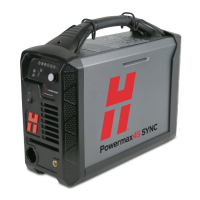
Do you have a question about the Hypertherm SYNC Powermax 85 and is the answer not in the manual?
 General
| Brand | Hypertherm |
|---|---|
| Model | SYNC Powermax 85 |
| Category | Welding System |
| Language | English |
Methods to reduce interference and equipotential bonding practices.
General warranty coverage, conditions, and exclusions for Hypertherm products.
Verifying all necessary system components are present before setup.
Guidelines for material thickness for cutting and piercing operations.
Instructions for connecting the plasma power supply to an electrical source.
Safety requirement and procedure for installing a line-disconnect switch.
Input voltage, current, and fuse requirements for CSA 1-phase models.
Input voltage, current, and fuse requirements for CSA 3-phase models.
Input voltage, current, and fuse requirements for CE/CCC 3-phase models.
Input voltage, current, and fuse requirements for CSA 1-phase models.
Input voltage, current, and fuse requirements for CSA 3-phase models.
Input voltage, current, and fuse requirements for CE/CCC 3-phase models.
Input voltage, current, and fuse requirements for CSA 3-phase models.
Input voltage, current, and fuse requirements for CE/CCC 3-phase models.
Input voltage, current, and fuse requirements for CCC/CE 3-phase models.
Step-by-step guide for installing an appropriate power plug.
Voltage and engine drive requirements for generators used with Powermax65/85 SYNC.
Voltage and engine drive requirements for generators used with Powermax105 SYNC.
Step-by-step instructions for connecting the gas hose to the system.
Safety warnings and procedures for handling high-pressure gas cylinders.
Maximum allowable and recommended gas pressure ranges for optimal performance.
Ensuring the plasma power supply is correctly connected to gas and electrical power.
Procedure for connecting the torch lead to the plasma power supply.
Instructions for correctly connecting the work lead and work clamp.
Step-by-step guide for installing the plasma cutting or gouging cartridge.
How to manually adjust output current and operating mode as needed.
Step-by-step guide for manually setting and adjusting gas pressure.
Identifying when to replace cartridges using fault codes 0-32-n.
Understanding duty cycles and implementing measures to prevent overheating.
Guide to choosing the appropriate cutting cartridge for different applications.
Safety checks and procedures required before firing the torch.
Factors influencing cartridge life and how to extend it.
Guide to choosing the appropriate gouging cartridge for different applications.
Step-by-step instructions for executing gouging operations with the hand torch.
First steps to take when encountering a problem with the system.
Detailed guide to diagnosing and resolving cutting and gouging performance issues.
Explanation of fault code formats and the meaning of each code.
General safety precautions and initial inspection of the power supply and torch.
Cleaning molten metal from cartridges and checking the O-ring for wear.


 To Next Page
