Connections
En-13
■ Speaker Connection Precautions
• (North American models) You can connect
speakers with an impedance of between 6 and 16
ohms. If you use speakers with a lower impedance,
and use the amplifier at high volume levels for a
long period of time, the built-in amp protection circuit
may be activated.
• (Australian models) You can connect speakers
with an impedance of between 4 and 16 ohms. If the
impedance of any of the connected speakers is 4
ohms or more, but less than 6 ohms, be sure to set
the minimum speaker impedance to “4ohms”
(➔ page 53). If you use speakers with a lower
impedance, and use the amplifier at high volume
levels for a long period of time, the built-in protection
circuit may be activated.
• Unnecessarily long, or very thin speaker cables may
affect the sound quality and should be avoided.
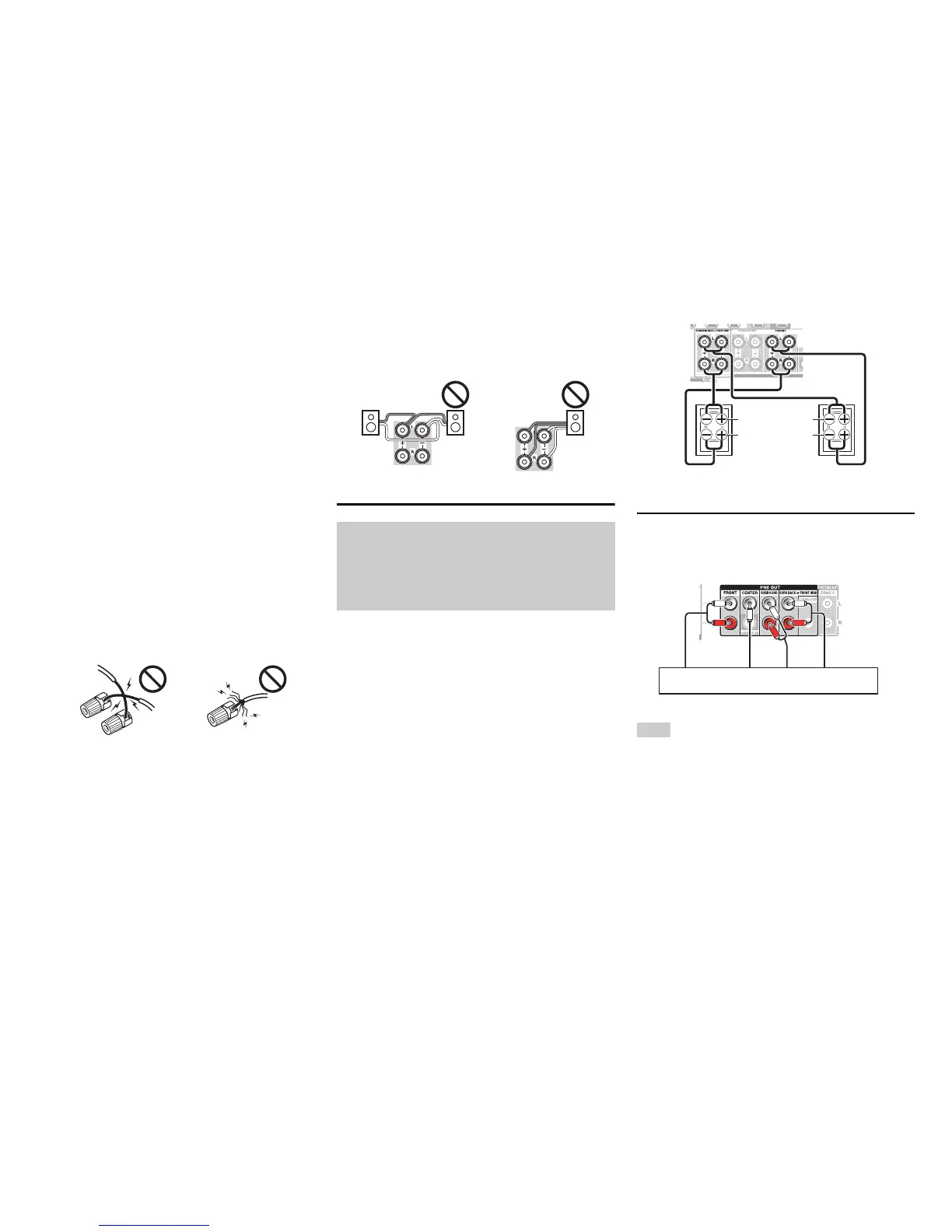
• Be careful not to short the positive and negative
wires. Doing so may damage the AV receiver.
• Make sure the metal core of the wire does not have
contact with the AV receiver’s rear panel. Doing so
may damage the AV receiver.
• Don’t connect more than one cable to each speaker
terminal. Doing so may damage the AV receiver.
• Don’t connect one speaker to several terminals.
Bi-amping the Front Speakers
Bi-amping provides improved bass and treble
performance.
When bi-amping is used, the AV receiver is able to
drive up to a 5.1 speaker system in the main room.
Perform bi-amping connections by using FRONT
terminals and SURROUND BACK or FRONT HIGH
terminals as shown below.
Once you’ve completed the bi-amping connections
and turned on the AV receiver, you must set the
speaker setting to enable bi-amping (➔ page 54).
Connecting a Power Amplifier
You can use the AV receiver as a preamp. Connect
all speaker outputs to the power amplifier. See the
manuals supplied with your amplifier for details.
Note
•Specify “None” for the channel that you don’t want to output
(➔ page 54).
Important:
• When making the bi-amping connections, be sure to
remove the jumper bars that link the speakers’ tweeter
(high) and woofer (low) terminals.
• Bi-amping can be used only with speakers that support
bi-amping. Refer to your speaker manual.
Front right Front left
Woofer (low)
Tweeter (high)
L
R
Power amplifier


 To Next Page