8.10. Output Current Limit
8.10.1. Overload Operation
Optidrive P2 provides the following
150% Output current / 60 Seconds Maximum
200% Output current / 3.75 Seconds Maximum
At low output frequency levels, overload accumulation is faster, to account for the reduced motor cooling effect of the fan.
8.10.2. Overview
Optidrive P2 features both hardware and software protection of the output stage to prevent damage. In addition, an Ixt system is used to
monitor motor overload condition and prevent damage to the motor due to operation for prolonged periods at high load.
I x t protection is software based, using the value for motor rated current programmed in P1-08. An internal accumulator register is used to
estimate the point at which damage may occur to the motor, and operates as follows
Motor Current < P1-08
The accumulator value reduces towards zero. The time required depends on the actual load current as explained further below.
Motor Current = 100% P1-08
The accumulator value remains static.
Motor Current > 100% P1-08 < 150% P1-08
The accumulator value increases at a rate proportional to the overload level, e.g. (Motor Current / Rated current) – 100%. If the overload limit
is reached, the drive will trip, displaying it.trp. to protect the motor.
Motor Current > 150% P1-08
For high current levels, the accumulator operates 16 times faster than for current levels below 150% of P1-08.
Peak over current trip levels are shown in the table below.
8.10.3. Example Operation
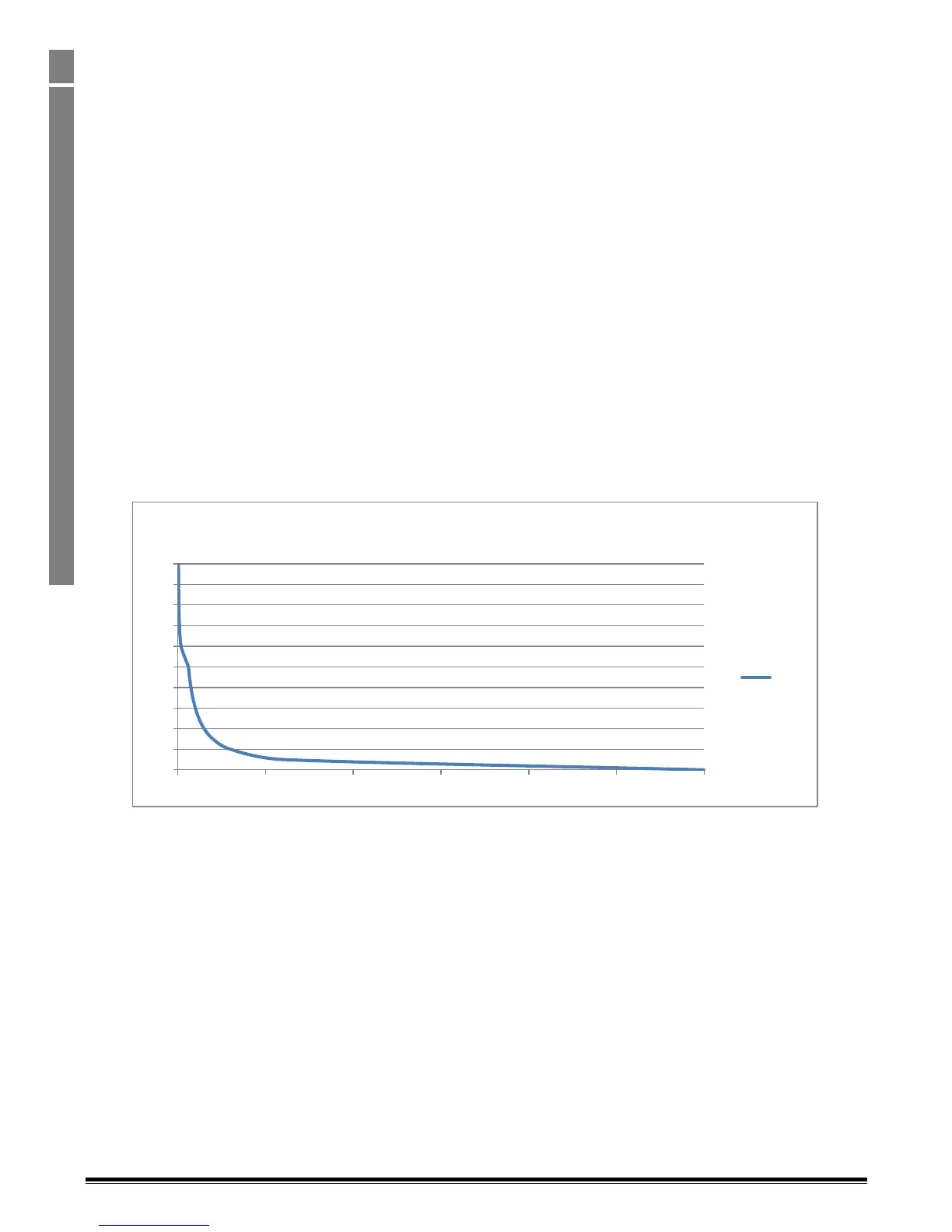
Maximum overload operation is 150% of motor rated current for 60 seconds. As this represents an overload of 50%, the accumulator trip level
is 3000. This means that if the drive operates with 125% load current, the time can be calculated as 3000 / (125 – 100) = 120 Seconds.
Above 150% load, accumulation is 16 times faster, hence for 160% load current, the time is 3000 / 16 / (160 – 150) = 18.75 seconds
8.10.4. Overload Curve



 To Next Page