58
Qubit
™
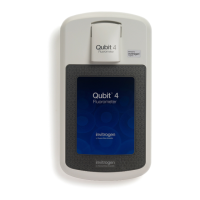
4 Fluorometer User Guide
The Qubit
™
assays were designed to be performed at room temperature (22–28°C),
and temperature fluctuations can influence the accuracy of the assay.
To minimize temperature fluctuations, store all kit reagents at room temperature
and insert all assay tubes into the Qubit
™
4 Fluorometer only for as much time as
it takes for the instrument to measure the fluorescence, because the Qubit
™
4
Fluorometer can raise the temperature of the assay solution significantly, even
over a period of a few minutes. Do not hold the assay tubes in your hand before a
measurement, because holding the tubes warms the solution and results in a low
reading.
Effect of temperature on the Qubit
™
dsDNA BR assay. Qubit
™
dsDNA HS, Qubit
™
ssDNA, Qubit
™
RNA HS, Qubit
™
RNA XR, Qubit
™
RNA IQ, and Qubit
™
protein assays show
similar sensitivities over the same range.
™
Fluorometer
calibration
For each assay, you have the choice to run a new calibration or to use the values
from the previous calibration. As you first use the instrument, you perform a new
calibration each time. As you become familiar with the assays, the instrument,
your pipetting accuracy, and significant temperature fluctuations within your
laboratory, you can determine the level of comfort you have using the calibration
data stored from the last time the instrument was calibrated. Remember also that
the fluorescence signal in the tubes containing the standards and the samples is
stable for not longer than 3 hours. See Figure 1 in “
How the Qubit
™
4 Fluorometer
calculates concentration” (page 57
) for an example of the calibration curve used to
generate the quantitation results.


 To Next Page