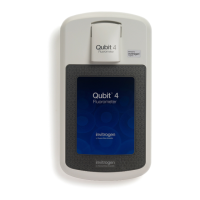
Qubit
™
4 Fluorometer User Guide
55
Appendix A: Troubleshooting
Troubleshooting
The calibration standards included in the Qubit
™
microRNA, Qubit
™
RNA HS,
Qubit
™
RNA XR, Qubit
™
RNA IQ, and Qubit
™
RNA BR Assay Kits are high-
quality RNA standards. The integrity and concentration of these standards is
critical to the optimal performance of the Qubit
™
RNA assays. We highly
recommend treating the rRNA standards as you would any other precious
RNA. Use appropriate RNAse-free handling techniques, including RNAse-
free gloves, pipette tips, and tubes. Keep the tube lids closed whenever
possible; do not press the pipet to the inside wall of the tube when
withdrawing a sample. Return the RNA standards to –80°C as soon as
possible after use.
• Ensure that the assay tubes are at room temperature at the time the reading is
taken. Do not hold assay tubes in your hand and do not leave assay tubes in
the Qubit
™
4 Fluorometer for longer than it takes to read the fluorescence. See
“Assay temperature”, page 58.
• Be careful not to spill sample into the sample chamber. Promptly wipe any
spills.
• The Qubit
™
assays are very sensitive and even small amounts of material
from a previous sample may result in errors. Use a clean 0.5-mL PCR tube for
each reading.
• The tube must be clean and dry on the outside when taking readings.
Moisture and condensation on the tube surface can lead to reading errors.
• Minute bubbles in samples will cause errors in readings. Be sure not to
introduce bubbles into samples. Slight tapping on the tube wall or brief
centrifugation will often help dissipate bubbles.
The sample is out of range. Use a sample that is less concentrated.
• For Qubit
™
quantitation assays, view the
Fluorescence vs. Concentration graph in the
Results screen to confirm that the values for
the samples fall between the values of the
standards (page 27).
• Ensure that the lid is closed while reading
standards and samples.
• Prepare samples and standards according to
the instructions in the Qubit
™
assay kit you
are using.
• Ensure that the assay is performed entirely at
room temperature.


 To Next Page