101
Plumbing System
There are two dierent water systems in your recreation vehicle:
The fresh water system consists of the fresh water holding tank, faucets and connections,
water pump, outside shower assembly (if so equipped), water heater, tub/shower, and
water purication system (if so equipped).
The waste water system consists of the waste water and sewage holding tank(s), drains
and toilet.
Check all ttings, pressure and waste, for leaks before each trip or before vehicle
storage as part of your normal maintenance:
Inspect all faucets, the water purication system (optional) and sink connections
(including drain baskets or lters).
Inspect connections at the water pump and water heater.
At the end of every trip, you should drain any unused water from the fresh water system.
All water contains contaminant and mineral particles that can cause fresh water system
odors. Untreated well water is a major source of water system odors.
The fresh water (potable water) system needs periodic sanitization and winterization
to take care of all the components within the plumbing system and help discourage the
growth of bacteria and other organisms that can contaminate the water supply.
Typically, there are labels axed to the exterior of the recreation vehicle sidewall that
indicate the locations of the water system drains and lls. Be aware some drain valves may
be located inside the vehicle (once the exterior label is found, go inside to nd the drain
corresponding location).
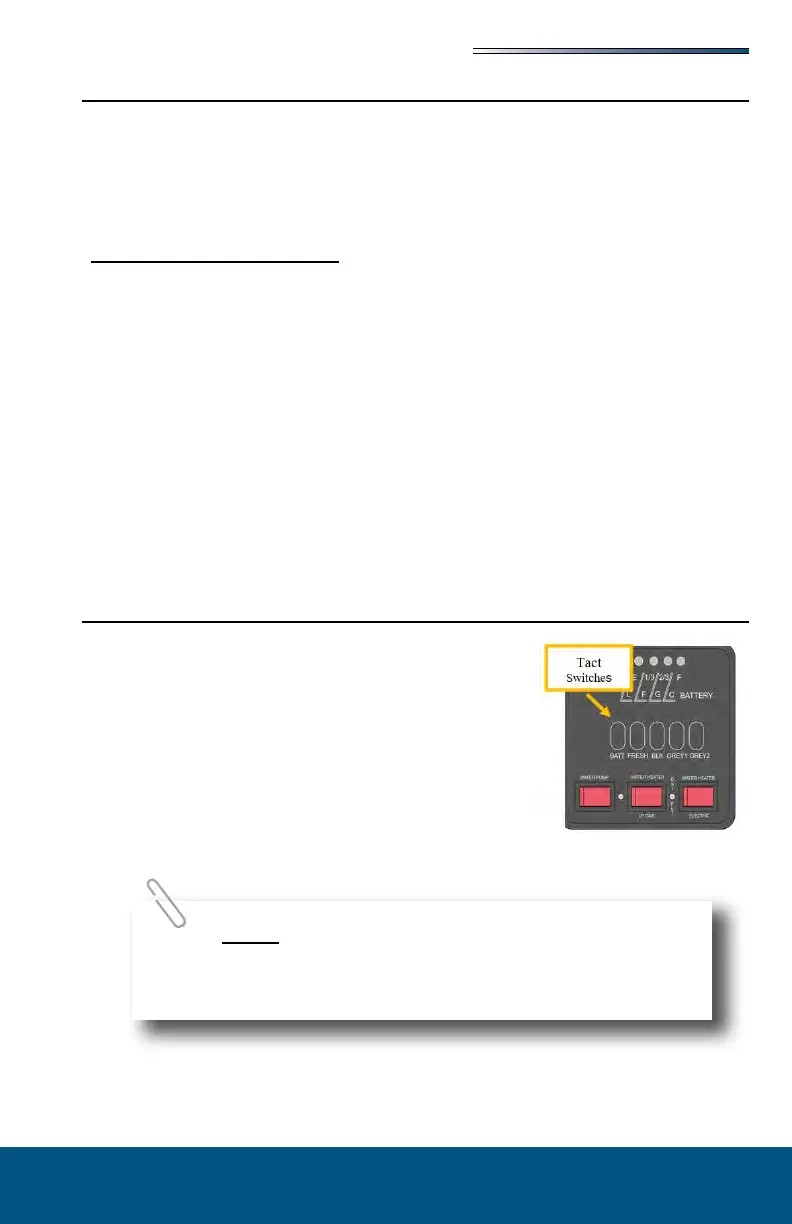
Monitor Panel
Monitor panel locations may vary by model. Typical locations
are on the command center panel, on an interior wall, or on
the exterior utility center.
It allows you to monitor the fresh water, grey water, black
water and auxiliary battery levels. These functions are
controlled using the tact switches. The monitor panel operates
on 12-volt DC power supplied by either the converter or
auxiliary battery. No power is drawn from the battery unless
a switch is pushed or turned ON. Fuses for the monitor panel
are located in the load center. Refer to the manufacturer’s
operators manual for additional information.
If your RV has secondary black or gray tanks, there may
also be an additional tank monitor. located elsewhere in your RV. It is
typically labeled as a convenience center.




 To Next Page