36
Using The Rear Hitch
Towing will aect vehicle handling, durability and fuel economy. Exceeding any of the
listed weight ratings will result in unacceptable overall vehicle performance. Your safety
and satisfaction require proper use of correct equipment.
The factory installed towing hitch on this vehicle is capable of pulling 15,000 pounds of
load (maximum), and a maximum vertical (tongue) weight of 1,500 pounds. A hitch bar
of appropriate strength and steel should be selected to meet the capacities of the towing
receptor.
Always use safety chains between the motor home and the towed trailer or vehicle. Cross
the chains under the tongue and allow for slack when turning corners. Connect the safety
chains to the vehicle frame or hook retainers. Never attach the safety chains to the bumper.
Before descending a steep or long grade when towing a trailer or vehicle, reduce speed and
shift the motor home into a lower gear to control vehicle speed. Avoid frequent or prolonged
brake application, which can cause overheating or brake failure.
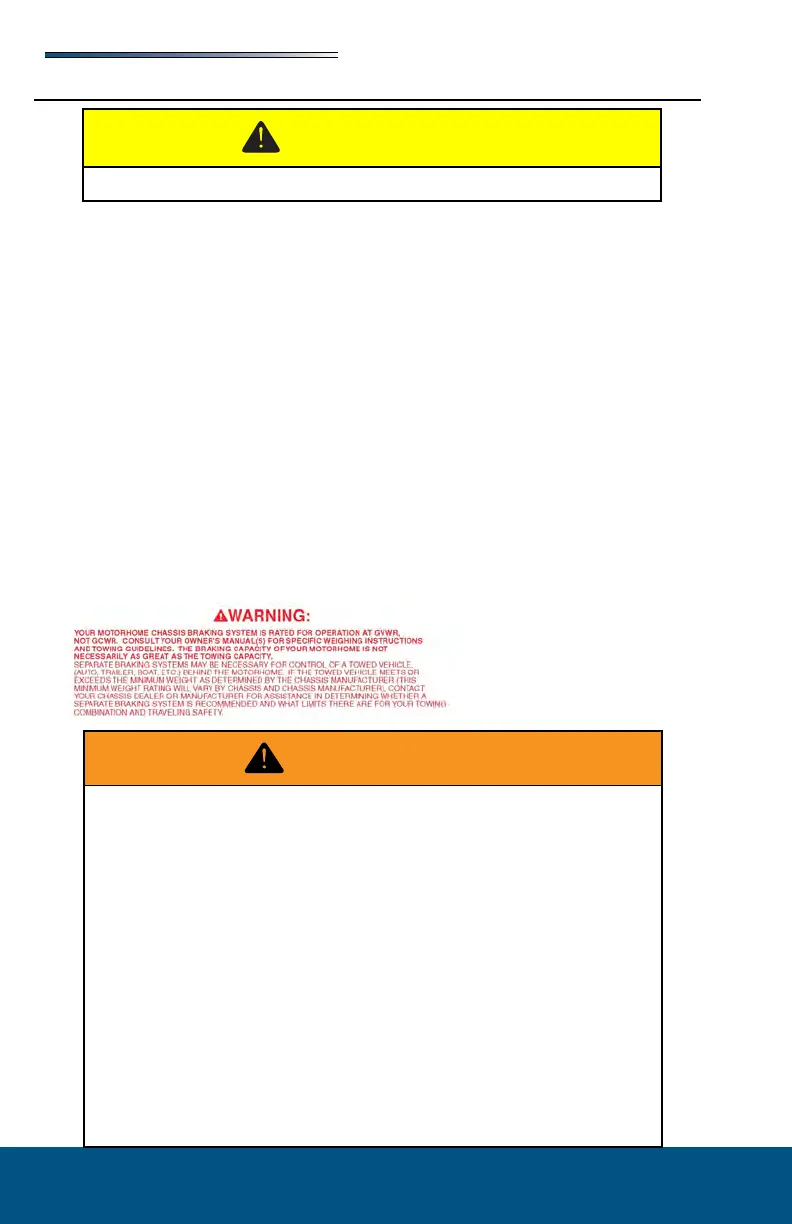
By denition the GCWR is “the maximum total weight rating allowed for a vehicle and any
attachment, such as a trailer or towed vehicle. To determine the total allowable weight for a
towed item, subtract the GVWR from the GCWR.”
Do not install a frame equalizing type hitch on your motor home.
Do not assume that you can tow a
vehicle that happens to be within the capacity of the hitch. By doing so,
you may exceed the total GCWR of the motor home.
Once again, do not assume
that you can tow a trailer or vehicle that happens to be within the vertical
(tongue) weight capacity of the hitch. By doing so, you may exceed the
GVWR and/or GAWR of the motor home.
Any trailer or vehicle being towed by your motor
home must have adequate brakes as required by all state (or province)
and local regulations for towing with your motor home, including areas
you may be traveling through. Failure to follow the towing guidelines
may result in property dama




 To Next Page