10
The surround ensemble of loudspeakers, if properly specied, can easily produce a sound eld that is
uniform throughout the back two-thirds of the house, and level variations can often be held within a range of 2 to 3
dB. Details of surround system specication will be covered in a later section.
When all of the above points are properly addressed, the sound in a cinema can approach that which we
take for granted in a post-production screening facility — which is, after all, how the picture director intended it to
sound. It is only when such details as these have been carefully worked out that the effects intended by the sound
mixer can be appreciated by the viewing audience.
III. ACOUSTICAL CONSIDERATIONS
A. Noise Criterion (NC) Requirements:
The usual sources of noise in a cinema, outside of the
patrons themselves, are air handling and transmission of noise
from the outside. In the case of multiplex installations, there can
be leakage from adjacent cinemas as well. Not much can be done
about a noisy audience, but it is true that at the post-production
stage, mixing engineers take into account certain masking noise
levels which may be encountered in the eld and may even make
the nal mix under simulated noisy conditions (5).
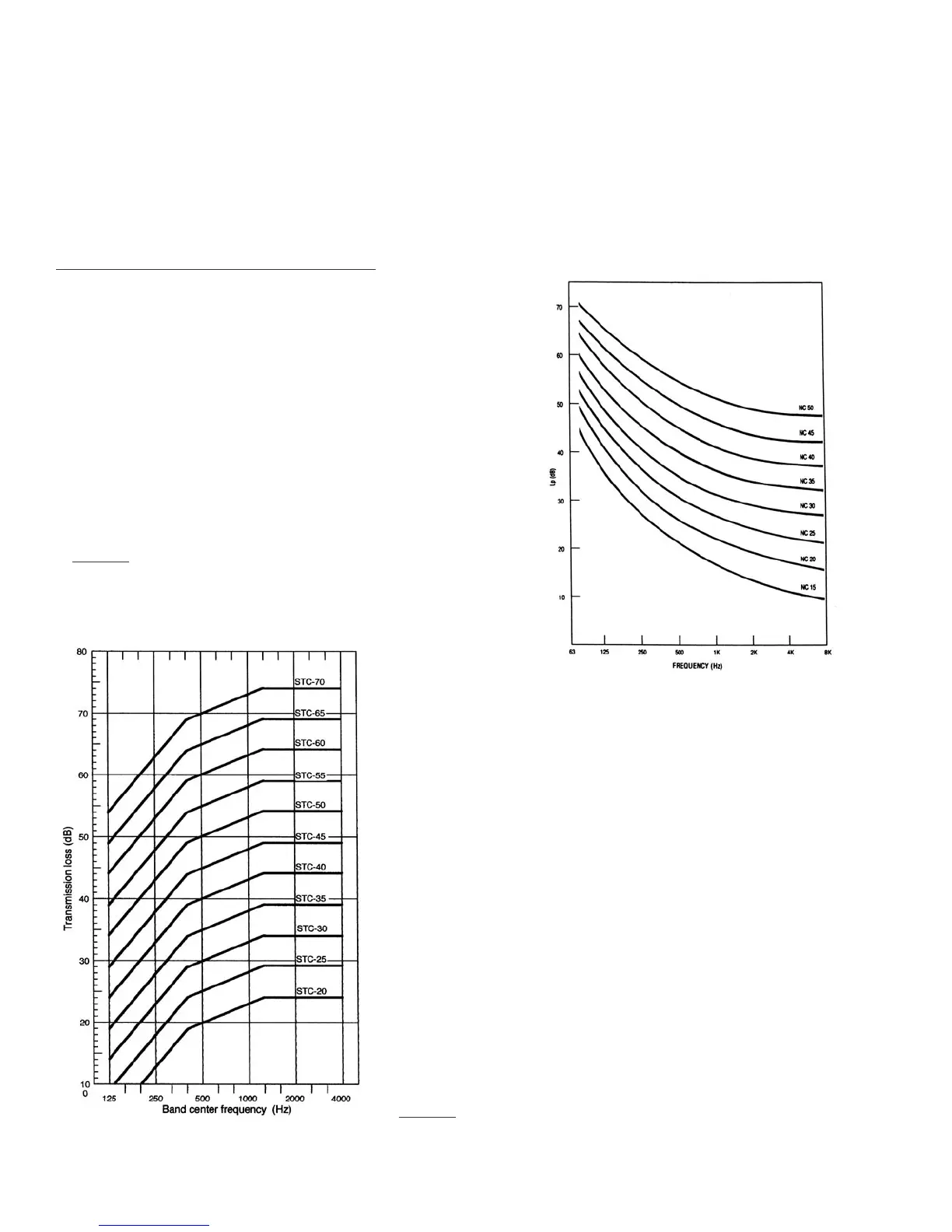
Acoustical engineers make use of what are called Noise
Criterion (NC) curves in attempting to set a noise performance goal
for cinemas. The octave band values of these curves are shown
in Figure 8. In implementing this data, the acoustical designer
settles on a given criterion and then determines the cost and other
factors involved in realizing it. Low-noise air handling requires large
ductwork and is expensive. Even more likely to be a problem is
through-the-wall
isolation from
adjacent cinemas.
The general
recommendation
made by Lucaslm (6)
is that interference from
adjacent cinemas should be audible no more than 1% of the time.
Considering that NC-30 may represent a typical air conditioning
noise level for a cinema, the desired degree of isolation between
adjacent spaces does not represent a nancial hardship in terms
of wall construction. The need for improving NC standards in
cinemas is a natural consequence of better recording technology
and is the only way that the capabilities and benets of digital
sound can be fully appreciated.
As an example of what may be required, let us assume
that the normal maximum levels in a multiplex cinema are 95 dB-
SPL, with levels exceeding this value only about 1% of the time.
It is clear that the isolation from an adjacent cinema must be on
the order of 65 dB if the NC-30 criterion is to be met, and this
will call for a wall structure that will satisfy a Sound Transmission
Class (STC) of 65 dB. There are a number of double wall, or single
concrete block wall, constructions that will satisfy this requirement,
and economic considerations usually take over at this point.
Acoustical engineers and consultants are usually on rm scientic
ground in these matters. Typical standard STC curves are shown
in Figure 9.
Figure 9: Sound Transmission Curves (STC)
Figure 8: Noise Criterion (NC) curves,
octave band data



 To Next Page