8
to frequency. The need for equalization of the compression driver comes as a result of the natural high frequency
roll-off, which occurs in high frequency drivers above about 3.5 kHz. This frequency is known as the mass break
point and is a function of diaphragm mass and various electrical and magnetic constants in the design of all
compression drivers.
When the 4648A or 4638 low-frequency system and the 2360/2446 combination are integrated into a full
range system for cinema use, the -6 dB beamwidth above 500 Hz is smoothly maintained at 90° in the horizontal
plane and 40° in the vertical plane out to 12.5 kHz. At lower frequencies, the system’s coverage broadens,
eventually becoming essentially omnidirectional in the range below 100 Hz.
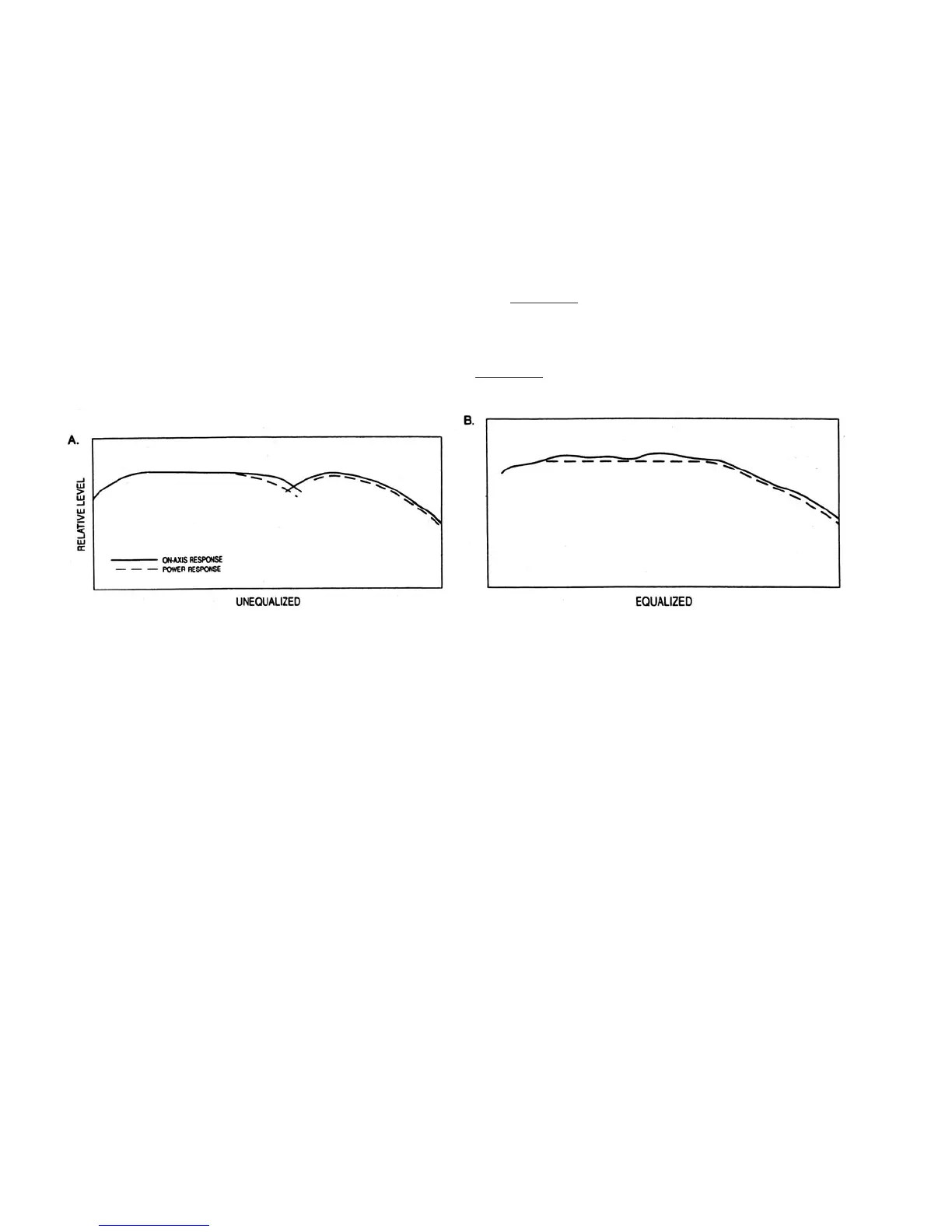
When the system described above is equalized in a typical cinema environment, both direct sound and
reverberant sound can be maintained quite smoothly, as shown in Figure 6A. The system’s reverberant response
is proportional to its power output, or to its power response, and the matching of the system’s on-axis and power
response indicate that the reected sound eld in the cinema will have the same spectral characteristics as the
direct sound from the loudspeaker. When this condition exists, sound reproduction, especially dialog, will sound
extremely natural. The frequency response contour shown in Figure 6B is the so-called X-curve recommended for
cinema equalization, as specied in ISO Document 2969.
JBL pioneered the concept of at power response in the cinema (2, 3). It has become the guiding principle
in much of JBL’s product design, and it has been adopted by the industry at large.
G. Coverage Requirements for Proper Stereo Reproduction:
In the cinema, it is expected that all patrons will be able to appreciate convincing stereo reproduction.
By contrast, standard two-channel stereo in the home environment often imposes strict limitations on where
the listener must sit in order to perceive correct stereo imaging. The factor that makes the big difference in the
cinema is the presence of the center channel. Not only does the center loudspeaker lock dialog into the center
of the screen, it further reduces the amount of common mode information the left and right channels must carry,
thus making it possible for listeners far from the axis of symmetry to hear the three channels with no ambiguity
or tendency for the signal to “collapse” toward the nearer loudspeaker. In the Dolby stereo matrix, the same
convincing effect is largely maintained through gain coefcient manipulation during playback.
Ideally, each patron in the house should be within the nominal horizontal and vertical coverage angles of
all the high-frequency horns. This requirement can usually be met by using horns with a nominal 90° horizontal
dispersion and by toeing in the left and right screen loudspeakers. In very wide houses, the spreading of high
frequencies above approximately 5 kHz, as they pass through the screen at high off-axis angles, actually helps in
providing the desired coverage.
Another desirable condition is maintaining levels as uniformly as possible throughout the house. We have
found that aiming the screen system’s mid and high frequency horns toward the seating area at a point two-
thirds back in the house helps in this regard, by offsetting normal inverse square losses with the on-axis “gain”
of the screen systems. Measurements made at the Goldwyn Theater of the Academy of Motion Picture Arts and
Sciences in Beverly Hills, California, show that, over most of the frequency range, front-to-back levels in the house
are maintained within ± 4 dB.
Figure 6: Cinema equalization of power-at systems. Unequalized system (A);
equalized to match ISO 2969 “X” curve standard (B)



 To Next Page