5
B. Digital Film Formats
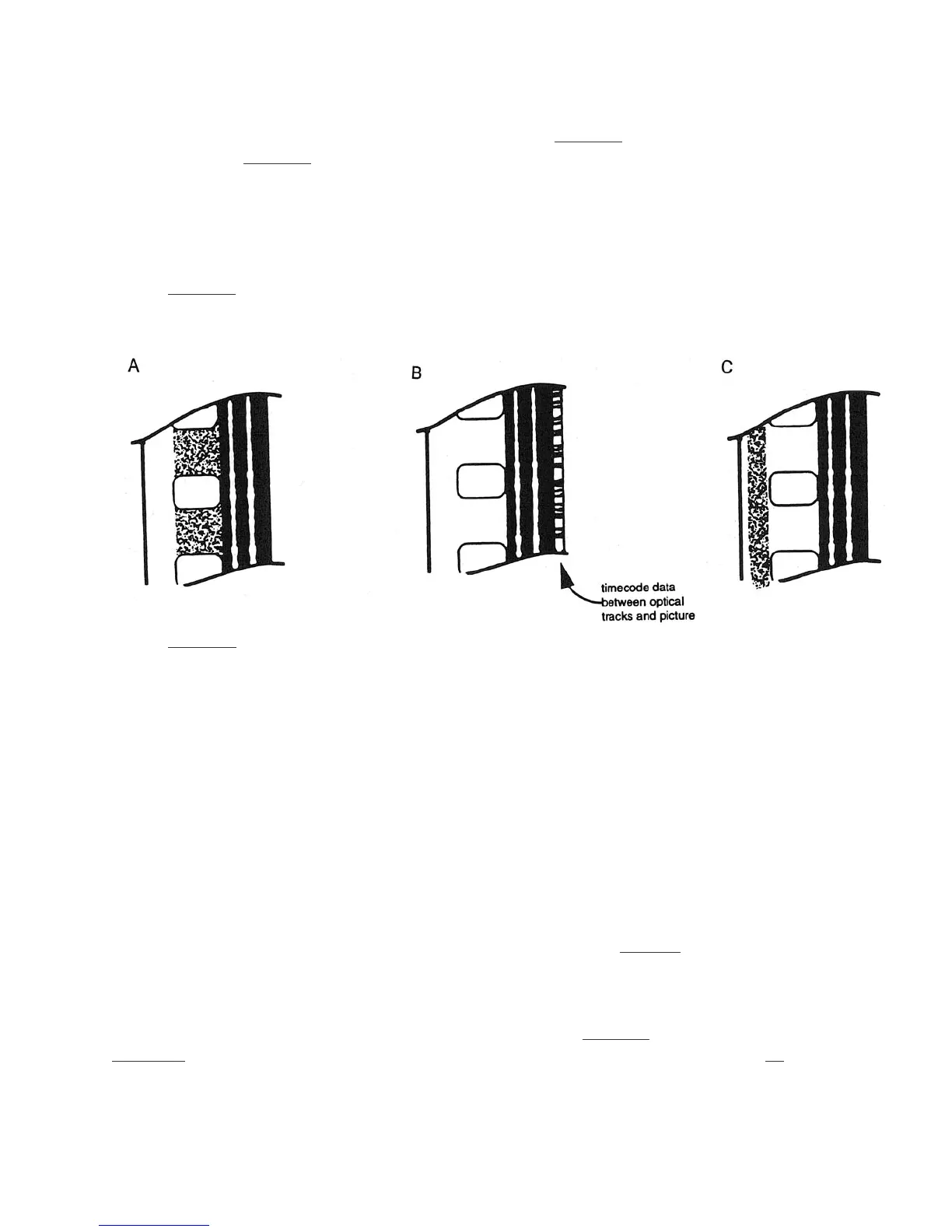
The Dolby SR-D format, introduced in 1992, is shown in Figure 3A. It has exactly the same optical sound
tracks as shown in Figure 2A with the addition of digital information located in the otherwise unused space
between sprocket holes. This new digital format provides the usual three screen channels plus a split surround
pair and a single low frequency (subwoofer) channel that operates below 100 Hz. This is commonly referred to
as a “5.1” channel system and uses an elaborate perceptual encoding process known as AC-3. The Dolby SR-D
format is usually referred to as “Dolby Digital.”
Figure 3B shows the format used in DTS. Here we see only the stereo optical tracks and a sync track for
maintaining control of the associated CD ROM player.
Figure 3C shows the format used in SDDS. In addition to the stereo optical tracks, there are two digital
tracks, one at each edge of the lm.
Like Dolby Digital, DTS and SDDS make use of perceptual encoding methods for reducing the amount
of digital data required for system operation. DTS and SDDS also support the 5.1 channel format used in most
cinemas, but SDDS also supports as many as 5 screen channels for special applications, making a total of eight
channels.
All digital formats discussed here have a fall-back (failsafe) mode in which the analog tracks will be used
in case of failure of the digital portion of the systems.
C. A- and B-Chains:
For convenience in dening responsibilities for system specication and alignment, the playback chain
is customarily broken down into the A-chain and the B-chain, as shown in Figure 4. The A-chain is comprised of
the preampliers (optical or magnetic), light source (optical), magnetic heads, solar cells (optical), associated
equalization (signal de-emphasis), and noise reduction and directional decoding required for at electrical output
at the end of that chain. For digital reproduction, a digital optical reader is used and the digital signal is fed to a
digital-to-analog conversion system. The analog A-chain is shown in Figure 4A, and the digital A-chain is shown at
4B and 4C. The B-chain, including split surround channels and subwoofer channel, is shown at 4D.
The B-chain is comprised of one-third-octave equalization, dividing networks (low- or high-level), power
amplication, and loudspeakers. JBL Professional products are used extensively in the B-chain of the system.





 To Next Page