EasyManua.ls Logo

JBL SG520 - Hum and Noise

JBL SG520
34 pages
Print Icon
To Next Page IconTo Next Page
To Previous Page IconTo Previous Page
Loading...
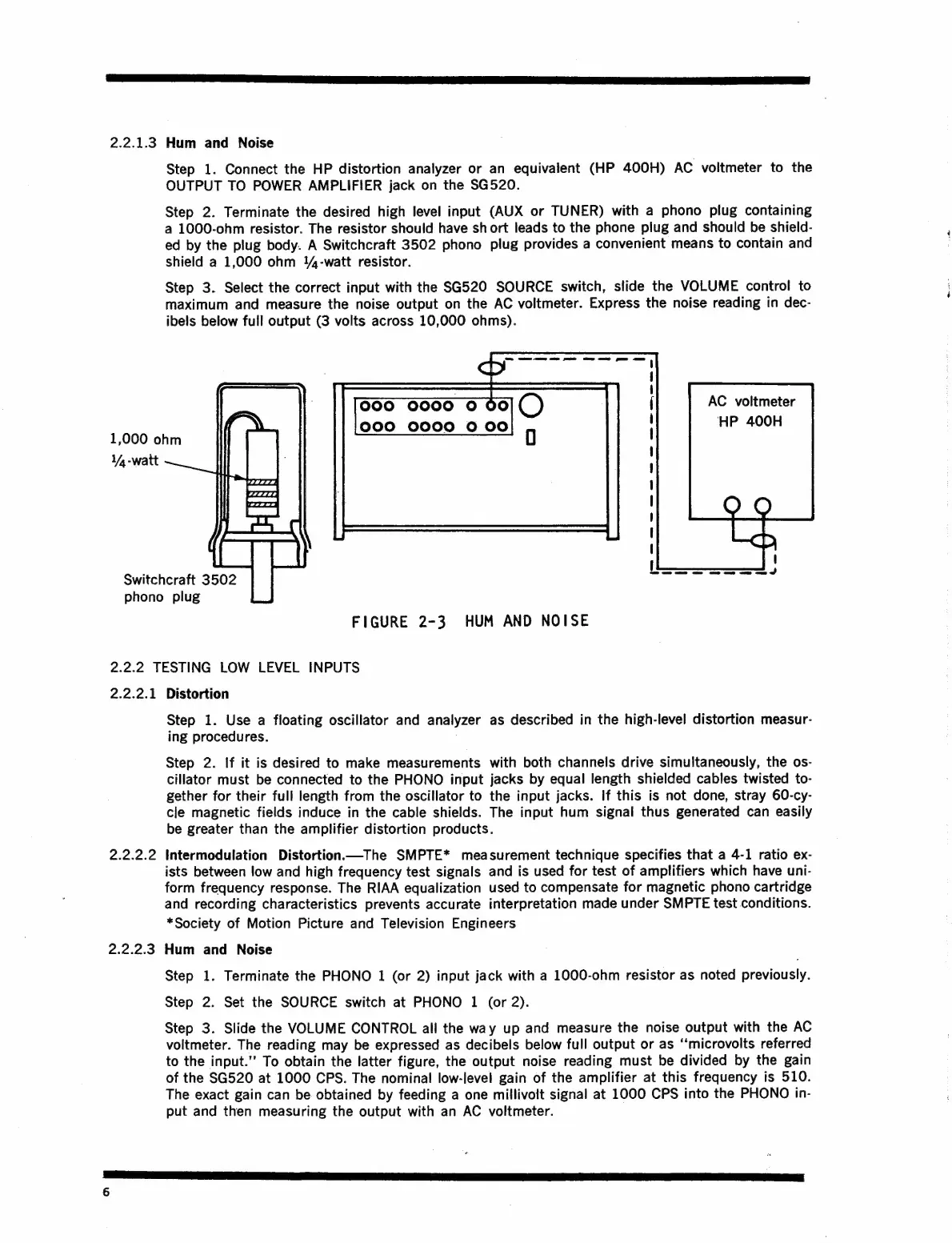
2.2.1.3
Hum
and
Noise
Step
1.
Connect
the
HP
distortion
analyzer
or
an
equivalent
(HP
400H)
AC
voltmeter
to
the
OUTPUT
TO
POWER
AMPLIFIER
jack
on
the
SG520.
Step
2.
Terminate
the
desired
high
level
input
(AUX
or
TUNER)
with
a
phono
plug
containing
a
1000-ohm
resistor.
The
resistor
should
have
short
leads
to
the
phone
plug
and
should
be
shield-
ed
by
the
plug
body.
A
Switchcraft
3502
phono
plug
provides
a
convenient
means
to
contain
and
shield
a
1,000
ohm
14-watt
resistor.
Step
3.
Select
the
correct
input
with
the
SG520
SOURCE
switch,
slide
the
VOLUME
control
to
maximum
and
measure
the
noise
output
on
the
AC
voltmeter.
Express
the
noise
reading
in
dec-
ibels
below
full
output
(3
volts
across
10,000
ohms).
C00
OOOO
O
{
AC
voltmeter
000
0000
O
is
HP
400H
1,000
ohm
1,
-watt
Switchcraft
3502
phono
plug
FIGURE
2-3
HUM
AND
NOISE
2.2.2
TESTING
LOW
LEVEL
INPUTS
2.2.2.1
Distortion
Step
1.
Use
a
floating
oscillator
and
analyzer
as
described
in
the
high-level
distortion
measur-
ing
procedures.
Step
2.
If
it
is
desired
to
make
measurements
with
both
channels
drive
simultaneously,
the
os-
cillator
must
be
connected
to
the
PHONO
input
jacks
by
equal
length
shielded
cables
twisted
to-
gether
for
their
full
length
from
the
oscillator
to
the
input
jacks.
If
this
is
not
done,
stray
60-cy-
cle
magnetic
fields
induce
in
the
cable
shields.
The
input
hum
signal
thus
generated
can
easily
be
greater
than
the
amplifier
distortion
products.
2.2.2.2
Intermodulation
Distortion.—The
SMPTE*
measurement
technique
specifies
that
a
4-1
ratio
ex-
ists
between
low
and
high
frequency
test
signals
and
is
used
for
test
of
amplifiers
which
have
uni-
form
frequency
response.
The
RIAA
equalization
used
to
compensate
for
magnetic
phono
cartridge
and
recording
characteristics
prevents
accurate
interpretation
made
under
SMPTE
test
conditions.
*Society
of
Motion
Picture
and
Television
Engineers
2.2.2.3
Hum
and
Noise
Step
1.
Terminate
the
PHONO
1
(or
2)
input
jack
with
a
1000-ohm
resistor
as
noted
previously.
Step
2.
Set
the
SOURCE
switch
at
PHONO
1
(or
2).
Step
3.
Slide
the
VOLUME
CONTROL
all
the
way
up
and
measure
the
noise
output
with
the
AC
voltmeter.
The
reading
may
be
expressed
as
decibels
below
full
output
or
as
‘‘microvolts
referred
to
the
input.’’
To
obtain
the
latter
figure,
the
output
noise
reading
must
be
divided
by
the
gain
of
the
SG520
at
1000
CPS.
The
nominal
low-level
gain
of
the
amplifier
at
this
frequency
is
510.
The
exact
gain
can
be
obtained
by
feeding
a
one
millivolt
signal
at
1000
CPS
into
the
PHONO
in-
put
and
then
measuring
the
output
with
an
AC
voltmeter.

Related product manuals