EasyManua.ls Logo

JBL SG520 - Overall Circuit

JBL SG520
34 pages
Print Icon
To Next Page IconTo Next Page
To Previous Page IconTo Previous Page
Loading...
Section
3
CIRCUIT
DESCRIPTION
3.1
OVERALL
CIRCUIT.
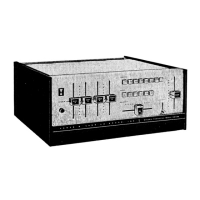
The
SG520
Graphic
Controller
is
a
transistor
stereo
preamplifier
designed
for
maximum
operator
convenience
and
versatility.
The
circuits
are
somewhat
complex
because
of
the
linear-actuated
potentiometers,
illuminated
pushbutton
switches,
and
front
panel
screwdriver
potentiometers
which
provide
this
versatility.
The
stereo
amplifiers
are
also
unique,
use
large
amounts
of
negative
.
feedback
in
each
transistor
stage
for
consistent
gain
performance.
A
special!
circuit
is
the
1000-
CPS
test
oscillator
which
is
used
for
aural
balancing.
The
power
supply
section
provides
—-24
volts
for
the
amplifiers
and
oscillator
and
+24
volts
for
the
F22
accessory.
Each
of
the
circuits
is
described
in.
greater
detail.
For
ease
in
referencing,
all
components
have been
numbered
by
series:
100
series
—-
Channel
A
Amplifier
200
series
Channel
B
Amplifier
300
series
Front
Panel
400
series
—-
1000-Cycle
Oscillator
500
series
Power
Supply
Figure
3-1
is
a
block
diagram
of
the
complete
unit.
See
pageze.
3.2
PREAMPLIFIER
DETAILS.
Each
preamplifier
is
contained
on
an
individual
etched-circuit
board.
The
left
channel
is
desig-
nated
A;
the
right
channel
is
designated
B.
Since
both
circuits
are
the
same,
only
channel
A
will
be
described
here.
The
description
also
applies
to
channel
B
when
the
component
numbers
are
increased
by
100
(for
example,
R105
becomes
R205,
in
channel
8).
3.2.1
Phono
Preamplifier—The
phono
preamplifier
consists
of
three
PNP
transistor
stages,
Q101,
Q102,
and
Q103.
The
preamplifier
is
used
only
with
the
low-level
inputs
for
PHONO
1
(J101),
PHONO
2
(J102)
or
MIC
(J103)
as
selected
by
the
SOURCE
pushbutton
bank.
In
the
TAPE
PLAY,
AUX
FRNT,
AUX
REAR,
TUN
1,
or
TUN
switch
positions,
the
preamplifier
is
bypassed
and
Q104
accepts
the
output
of
high-level
sources.
In
the
low-level
(PH1,
PH2,
or
MIC)
switch
position
a
signal
of
4
millivolts
will
produce
full
amplifier
output.
At
maximum
VOLUME
:
setting,
the
input
sensitivity
is
4
millivolts;
at
reduced
settings,
the
preamplifier
will
not
be
i
overloaded
with
levels
up
to
250
millivolts.
In
both
Q101
and
Q102,
the
amount
of
DC
degener-
.
ation
is
greater
than
AC
degeneration,
because
the
emitter
load
resistance
is
split.
For
example,
Q102
has
a
total
DC
emitter
load
resistance
of
R115
+
R116
=
2.4k.
But
its
AC
load
is
only
240
ohms,
through
AC
bypass
capacitor
C114.
NOTE
The
split-resistance
emitter
load
is
used
in
a
number
of
preamplifier
stages.
When
troubleshooting
stages,
an
open
bypass
capacitor
produces
a
common
symptom:
the
ac
gain
has
dropped
to
the
dc
gain
value.
The
output
of
the
phono
preamplifier
is
taken
from
the
emitter
of
emitter-follower
Q103
(PNP)
and
ac
coupled
through
C117,
through
one
of
the
low-level
(PH1,
PH2,
or
MIC)
selector
switches
SW301,
and
through
the
TAPE
MONITOR
switch
SW30
(OFF
position)
to
the
next
amplifier
stage,
Q104.
The
output
at
the
emitter
of
Q103
is
also
applied
as
negative
feedback
back
to
the
emitter
of
Q101
through
the
networks
for
RIAA,
NARTB,
or
flat
response.
This
network
has
a
fixed
dc
resistance
(which
sets
the
overall
preamplifier
gain),
but
has
lower
reactance
at
high
frequencies.
The
resultant
low-boost
and
high-cut
response
of
the
phono
preamplifier
compen-
sates
for
the
typical
magnetic
pickup
response
curve
(figure
3-2)
in
either
the
RIAA
or
NARTB
recording
equalization
method.
The
flat
response
network
is
used
only
for
the
microphone
input.
Actually,
the
‘‘flat’’
network
has
a
small
amount
of
high-frequency
de-emphasis
(C112)
which
insures
amplifier
stability
and
suppresses
high-frequency
response
beyond
the
audio
spectrum.
3.2.2
Emitter
Follower
Stage
Q104.—Transistor
Q104
(PNP)
receives
its
input
signal
from
either
of
two
sources
through
SW301:
(1)
direct
from
the
TAPE
PLAY,
TUNER,
or
AUX
jacks,
or
(2)
out-
put
of
the
phono
preamplifier,
Q103.
In
either
case,
the
nominal
input
level
is
250
millivolts.
The
Q104
emitter
output
has
a
dc
load
is
(R130),
the
ac
load
is
BALANCE
potentiometer,
R304.
The
emitter
follower
effectively
isolates
the
BALANCE
potentiometer
from
the
input.

Related product manuals