28
Useful Functions
11
Changing the Keyboard’s Split Point
The Split Mode function divides the keyboard into two parts (MANUAL
I, MANUAL II), allowing each part to be played with the MANUAL I and
MANUAL II division. See "Playing the MANUAL I and II Divisions in Separate
Keyboard Parts (SPLIT)" (p. 22).
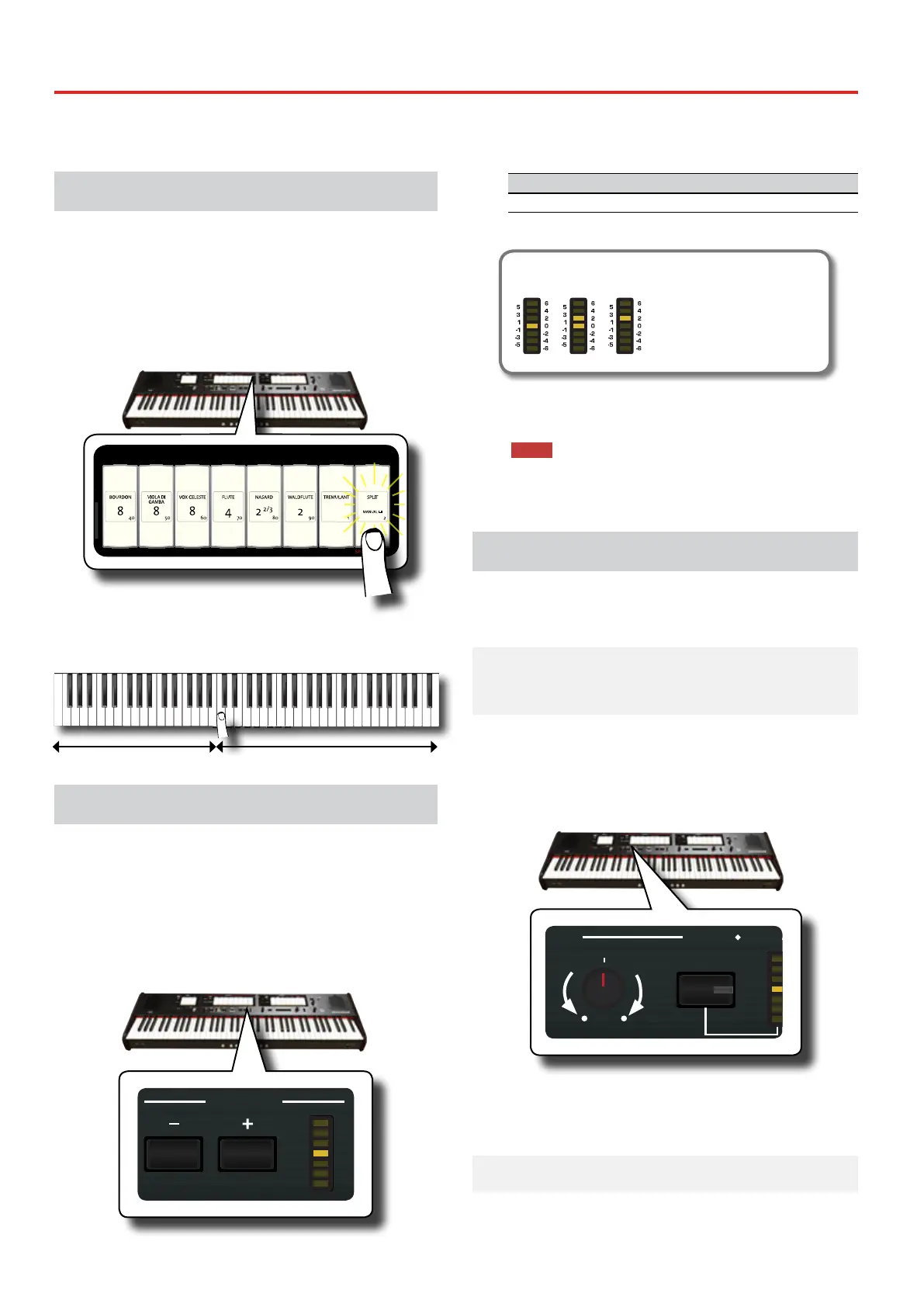
The split point is initially set at the F#4 key by default. Here’s how to
change the split point in case you want to change the factory setting:
1. Press and hold the [SPLIT] tilt tab until it's indicator
ashes.
PRESETFINE
466
444
442
440
432
415
392
EQUAL
PYTHAGOREAN
MEANTONE
YOUNG II
KIRNBERGER III
VALLOTTI
WERCKMEISTER III
SCALE
TRANSPOSE
6
4
2
0
-2
-4
-6
5
3
1
-1
-3
-5
ENHANCER
CHORD
STRINGS
PIANO HARPSICHORD
CHOIR
BOURDON 8
GEDACT 8
BOURDON 8
HOHLFLÖTE 8
VIOLA DI GAMBA 8
SALICIONAL 8
SALICIONAL 8
QUINTATÖN 8
VOX CELESTE 8
VOIX CELESTES II
VOIX CELESTES II
BLOCKFLÖTE 4
ROHRFLUTE 4
CHIMNEY FLUTE 4
FLÛTE OCTAVIANTE 4
QUINTE 2 2/3
NASARD 2 2/3
VIOLA 4
NAZARD 2 2/3
WALDFLÖTE 2
WALDFLUTE 2
BLOCK FLUTE 2
OCTAVIN 2
QUINTE 1 1/3
AMERICAN
ENGLISH
FRENCH
GERMAN
MANUAL I
TUNING TEMPERAMENT
SPLIT POIN T
2. Set the split point by simply pressing the corresponding
key on the keyboard. The key you pressed is the rst key
of the MANUAL II.
MANUAL I MANUAL II
Transposing the Pitch of the Keyboard
The Transpose setting allows the pitch of your ONE keyboard to be raised
or lowered in semi-tone steps.
This is particularly useful when accompanying instruments tuned for
dierent keys, or when a singer sings in a key dierent than the original
music.
1. Use the [-] and [+] TRANSPOSE buttons to shift the pitch
of keyboard notes upward or downward by up to +6/-6
semitones
.
PRESETFINE
466
444
442
440
432
415
392
EQUAL
PYTHAGOREAN
MEANTONE
YOUNG II
KIRNBERGER III
VALLOTTI
WERCKMEISTER III
SCALE
TRANSPOSE
6
4
2
0
-2
-4
-6
5
3
1
-1
-3
-5
ENHANCER
CHORD
STRINGS
PIANO HARPSICHORD
CHOIR
BOURDON 8
GEDACT 8
BOURDON 8
HOHLFLÖTE 8
VIOLA DI GAMBA 8
SALICIONAL 8
SALICIONAL 8
QUINTATÖN 8
VOX CELESTE 8
VOIX CELESTES II
VOIX CELESTES II
BLOCKFLÖTE 4
ROHRFLUTE 4
CHIMNEY FLUTE 4
FLÛTE OCTAVIANTE 4
QUINTE 2 2/3
NASARD 2 2/3
VIOLA 4
NAZARD 2 2/3
WALDFLÖTE 2
WALDFLUTE 2
BLOCK FLUTE 2
OCTAVIN 2
QUINTE 1 1/3
AMERICAN
ENGLISH
FRENCH
GERMAN
MANUAL I
TUNING TEMPERAMENT
SPLIT POINT
“Transpose” setting
-6 ~ 0 ~ +6 (semitone units)
The TRANSPOSE LED meter shown the transposition value.
TRANSPOSE INDICATOR
0 1 2
As you can see, the
transposition values exceeds
the number of lights. For this
reason the odd values will be
indicated by using two
indicators lit .
2. If you press the [-] and [+] TRANSPOSE buttons together,
the transpose setting will return to “0”.
NOTE
See "Working with Memory Pistons" (p. 33) to save your
settings. If you don’t save them, your changes are lost when you
switch o the ONE.
Tuning and Temperament
In this section you can modify the pitch of the instrument and change the
scale (tuning system) of the keyboard from standard equal temperament
to another tuning that is more suitable for playing classical pieces, etc.
Matching the Pitch of another Instrument
(TUNING)
There may be times when you accompany acoustic instruments that are
dicult or impossible to tune. As you will see below, matching the tune of
another instrument is easy for the ONE.
1. Turn the [FINE] knob in the "TUNING TEMPERAMENT"
section.
PRESETFINE
466
444
442
440
432
415
392
EQUAL
PYTHAGOREAN
MEANTONE
YOUNG II
KIRNBERGER III
VALLOTTI
WERCKMEISTER III
SCALE
TRANSPOSE
6
4
2
0
-2
-4
-6
5
3
1
-1
-3
-5
ENHANCER
CHORD
STRINGS
PIANO HARPSICHORD
CHOIR
BOURDON 8
GEDACT 8
BOURDON 8
HOHLFLÖTE 8
VIOLA DI GAMBA 8
SALICIONAL 8
SALICIONAL 8
QUINTATÖN 8
VOX CELESTE 8
VOIX CELESTES II
VOIX CELESTES II
BLOCKFLÖTE 4
ROHRFLUTE 4
CHIMNEY FLUTE 4
FLÛTE OCTAVIANTE 4
QUINTE 2 2/3
NASARD 2 2/3
VIOLA 4
NAZARD 2 2/3
WALDFLÖTE 2
WALDFLUTE 2
BLOCK FLUTE 2
OCTAVIN 2
QUINTE 1 1/3
AMERICAN
ENGLISH
FRENCH
GERMAN
MANUAL I
TUNING TEMPERAMENT
SPLIT POINT
#
b
Turn the knob clockwise to raise the overall pitch, or
counterclockwise to lower it.
You can adjust this in a range of ±100 cents (approximately a
semitone) centered on the selected pitch
Using the Tuning Preset
For many years, there was no pitch standard across Europe. The frequency
of A was dierent from country to country. For example, in parts of France
could range from A = 392 Hz, in Germany A 465 Hz . Organs were often


 To Next Page