Need help?
Do you have a question about the JUMO diraTRON 104 and is the answer not in the manual?
General safety precautions and warning symbol explanations.
Specifies the intended application and potential misuse of the device.
Lists device types, versions, and options with their corresponding order codes.
Provides a general overview of the controller series and its features.
Covers general installation precautions, mounting site, and climatic conditions.
Shows dimensional drawings for various device types and panel cut-out details.
Details the process for mounting devices on a DIN rail using special elements.
Explains the procedure for mounting devices in a panel cut-out.
Covers personnel requirements, cable handling, and electrical safety during installation.
Details connection terminals and their functions for specific device types.
Describes the connection diagram for analog inputs.
Details analog output configurations for different device types.
Illustrates galvanic isolation for various inputs and outputs.
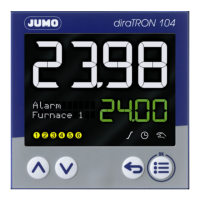
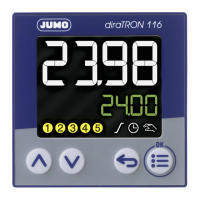
Explains the device's display, buttons, and activity symbols.
Details how to operate the device in manual mode and its automatic behavior.
Explains navigation through the main menu and sub-menus.
Details how to view device name, software version, and VDN version.
Explains how to create and manage programs, including sections, setpoints, and durations.
Describes how to simulate program progression for setpoint steps and ramps.
Lists parameters within parameter blocks, including control structure and proportional band.
Explains different controller types (two-state, three-state, etc.) and their behaviors.
Describes device version identification and connection diagram creation.
Explains selectors for analog and digital signals, programs, ramps, timers, and flags.
Details configuration for the universal analog input, including signal type and linearization.
Explains how to correct measured analog input values by adjusting the characteristic line gradient.
Introduces controller configuration and behavior after power on.
Covers parameters and methods for autotuning the controller.
Explains control loop monitoring parameters and its function.
Describes configuration for ramp function, including slope and tolerance band.
Explains configuration for fixed-setpoint and program controller modes.
Describes timer function configuration and behavior after power on.
Introduces limit value monitoring functions and configuration parameters.
Illustrates limit values in relation to setpoint and fixed limits.
Describes configuration for RS485 interface and Modbus RTU protocol.
Explains how to create and use custom applications with ST code.
Describes configuration of up to four digital control signals.
Describes how to link analog/binary values using configurable formulae.
Details creating custom linearization using formulas or grid points.
Corrects measured analog input values by adjusting the characteristic line gradient.
Describes activating additional functions (extra codes) via the setup program.
Explains hardware/software status, calibration constants, and testing analog I/O.
Selects additional process values for display in the online data window.
Selects readable and writable process values for visualization and recording.
Configures channel properties (color, line type, scaling) for line chart visualization.
Provides technical data for thermocouples, RTD probes, and resistance/potentiometers.
Details technical specifications for analog output voltage, current, and accuracy.
Lists voltage supply, electrical safety, power consumption, and connection details.
Covers ambient temperature, site altitude, and climatic/mechanical influences.
Lists approval marks, test facilities, and inspection basis.
 General
| Display | LCD |
|---|---|
| Protection type | IP65 |
| Operating temperature range | -10 to +60 °C |
| Product type | Controller |
| Type | Controller |
| Input | Thermocouple, RTD |
| Output | Relay, Analog |
| Control type | PID |
| Power Supply | 24 V AC/DC |
| Housing | Plastic |
| Input channels | 1 |

 To Next Page