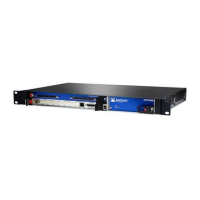
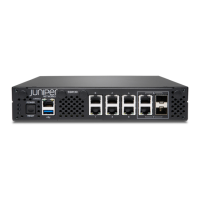
The Juniper Networks SSR130 is a network appliance designed to provide secure and resilient WAN connectivity, functioning as a Session Smart Router (SSR). This device is integrated into the Juniper Mist AI cloud portal, allowing for streamlined onboarding and management. It is primarily used for establishing and managing WAN connections, delivering applications over a LAN network segment, and implementing traffic steering and application policies.
Function Description
The SSR130's core function is to act as a Session Smart Router, running FIPS 140-2 Level 1 compliant software. This software enables the device to manage network sessions intelligently, ensuring secure and resilient wide area network (WAN) connectivity. It integrates with the Juniper Mist AI cloud portal, which serves as a centralized management platform for configuration, monitoring, and provisioning. The device supports zero-touch provisioning (ZTP), simplifying deployment by automatically receiving its configuration from the Mist cloud once connected to the internet.
The SSR130 is designed to facilitate the delivery of applications across a WAN. Users define networks and applications within the Mist portal, and the SSR130 then uses these definitions to route traffic efficiently. A key aspect of its functionality is the ability to create and apply WAN Edge templates. These templates consolidate network, application, and policy configurations, providing a reusable and consistent setup for multiple SSR130 devices across an organization. This templated approach ensures uniformity and reduces manual configuration effort.
Traffic steering is another critical function, allowing administrators to define how different types of traffic are routed. This includes specifying paths for applications to be sent directly out of a local WAN interface, enabling optimized performance and control over network flows. Application policies tie together networks and applications, dictating how the SSR130 uses its WAN and LAN connections to serve users. For instance, an application policy can be configured to direct internet traffic from a specific LAN network through a defined traffic steering policy.
The device also provides network services such as DHCP (Dynamic Host Configuration Protocol) to endpoints on the LAN network. This means it can assign IP addresses, gateways, and DNS servers to client devices connected to the local network segment, simplifying network management for connected devices.
Usage Features
The SSR130 is designed for ease of use and flexible deployment, leveraging the Juniper Mist AI cloud portal for most operational tasks.
- Cloud-Managed Onboarding: The device supports two primary methods for onboarding into the Mist portal: scanning a QR code using the MistAI app or manually entering a claim code. This flexibility allows for quick and efficient device registration, whether for a single device via mobile or multiple devices via a computer. Once claimed, the device is added to the organization's WAN Edge inventory.
- Zero-Touch Provisioning (ZTP): After onboarding, the SSR130 can be provisioned with ZTP. This feature automatically pulls the configuration from the Mist cloud, eliminating the need for manual, on-site configuration. The device uses a default WAN port (port 0) to contact Mist for ZTP, requiring only an Ethernet WAN link with DHCP address assignment and internet connectivity.
- Centralized Configuration with Templates: Configuration is primarily managed through WAN Edge templates in the Mist portal. These templates allow administrators to define WAN and LAN ports, network segments, IP configurations (including DHCP settings), and application definitions. This templated approach ensures consistent configurations across multiple devices and sites, simplifying large-scale deployments.
- Network and Application Definition: Users can define specific network subnets and applications within the Mist portal. For example, a LAN network segment can be defined with its IP address, prefix length, and VLAN ID. Applications, such as "Internet," can be defined with IP address spaces (e.g., 0.0.0.0/0) to control how they are accessed over the WAN.
- Traffic Steering Policies: The device supports the creation of traffic steering policies, which dictate how traffic is routed. These policies can specify paths (e.g., WAN interfaces) for different applications, allowing for granular control over network traffic flow and optimization.
- Application Policies: Application policies link defined networks, applications, and traffic steering policies. This feature enables administrators to specify which applications from which networks should use a particular traffic steering path, ensuring that network resources are utilized effectively according to business requirements.
- DHCP Server Functionality: The SSR130 can act as a DHCP server for its connected LAN, providing IP addresses, gateway information, and DNS server details to client devices. This simplifies network setup for endpoints and ensures seamless connectivity.
- Site Assignment: Once a template is created and configured, it can be assigned to a specific site. The SSR130 device itself is then assigned to that site, linking the physical device to its logical configuration within the Mist portal. This step pushes the template-driven configuration to the device, making it operational.
- Mist-Managed vs. Conductor-Managed: The device supports both Mist-managed and conductor-managed configurations. For Mist-managed routers (SSR Software version 6.x and greater), the "Manage configuration with Mist" checkbox is enabled. For conductor-managed routers (version 5.4.x and greater), this checkbox should not be selected, indicating that configuration is handled by a separate conductor.
Maintenance Features
Maintenance and monitoring of the SSR130 are primarily facilitated through the Juniper Mist AI cloud portal, offering insights and tools for ongoing operation.
- Cloud-Based Monitoring: After the SSR130 is connected to the Mist cloud and configured, the portal provides real-time monitoring capabilities. Administrators can view device status, network events, and telemetry data from the WAN Edges menu. This allows for proactive identification and resolution of issues.
- Telemetry and Analytics: The device sends telemetry data to the Mist cloud, which populates insights pages. Marvis, Juniper's AI-driven virtual network assistant, analyzes this data to provide actionable insights and help troubleshoot network problems. This AI-driven approach simplifies network management and maintenance by highlighting potential issues and suggesting solutions.
- Event Tracking: The Mist portal allows users to watch events as the device completes ZTP and applies its configuration. This provides transparency into the provisioning process and helps verify successful deployment.
- Documentation and Resources: Juniper provides comprehensive documentation, including the SSR130 Hardware Installation Guide, which details physical installation procedures such as rack, wall, or surface mounting, LTE antenna installation, SIM card installation, and power connection. This ensures proper physical setup and ongoing hardware maintenance.
- Software Updates and Release Notes: Users can stay informed about new features, changes, known issues, and resolved issues by consulting the SSR Release Notes. This helps in planning software updates and understanding the impact of new versions.
- Training and Learning Resources: Juniper offers various training resources, including videos and a learning portal, to help users expand their knowledge of SSR software. These resources cover topics such as Virtual Router Redundancy Protocol, BFD for Traditional Routing, Configuration Concurrency, and Service Route Redundancy and Vectors, enabling administrators to effectively manage and maintain their SSR130 devices.
- GUI and PCLI for Conductor-Managed Devices: For conductor-managed devices, additional views for Cloud Telemetry are configurable through the SSR GUI (Graphical User Interface) and PCLI (Platform Command Line Interface), offering more direct control and detailed diagnostics for specific deployment scenarios.

 Need help?
 General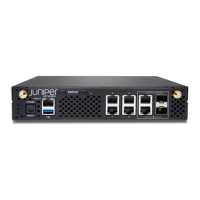


 To Next Page
