62
Amateur packet-radio activity in the US is typically on VHF, on 2 meters, with
145.010 MHz being the most common packet-radio frequency. The most common
baud is 1200.
To monitor communications from nearby stations (after you have tuned in to an
appropriate frequency):
Step 1. Set MONITOR to ON (if it is not already ON).
Step 2. Disconnect from any other station (or mailbox).
Step 3. As packets are received, you will see them displayed on your screen. A
typical received packet might look like this:
NØKN>KBØNYK:
Hi Mike. How are you today?
The first line is the header line, and shows the callsigns of the stations talking
and the following line(s) are the actual message that was sent. In the
example, NØKN is the transmitting station, and KBØNYK is the receiving
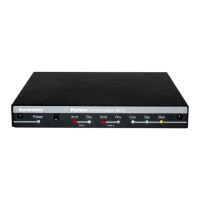
station. You may see the RCV LED light at times, indicating a signal is being
received, but nothing displays on your screen. This is normal and may be the
result of the settings of the monitoring commands, which are discussed in
detail in the KPC-3 Plus Command Reference.
As you monitor, you will begin to learn about other packet stations in your area and then
you will probably want to try to connect to one of them.
Communicate Directly with a Nearby Station
Now you are ready to carry on a two-way conversation with another station. Here we
will see exactly what you need to do to connect to and converse with another station.
Let‘s say that you decide to connect to KBØNYK. The steps needed are as follows:
Step 1. First, be sure you have the KPC-3 Plus in command mode. To do this, type
<Ctrl+C> and then press return. You should see a command prompt (cmd:).
Step 2. Now you use the CONNECT command. To connect to KBØNYK, you would
simply type CONNECT KBØNYK and press return, just as you did in the
sample connect to your mailbox.
In some cases you may need to use a relay station (called a digipeater) to contact
another station. This is similar to using a voice repeater when the station you want to
talk to is out of simplex range. To connect to a station using digipeaters, you still use
the CONNECT command, but you must also specify the callsigns (or aliases) of the
digipeaters that must be used. For instance, if you need to use two digipeaters with
callsigns of WØXI and NØGRG in order to connect to KBØNYK, you would give the
connect command as ―CONNECT KBØNYK VIA WØXI,NØGRG‖



 To Next Page