Need help?
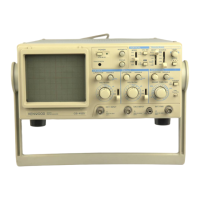
Do you have a question about the Kenwood CS-4125 and is the answer not in the manual?
Detailed safety guidelines and precautions for operating the oscilloscope.
Detailed description of front panel controls and indicators for operation.
Description of rear panel connectors and settings for connectivity.
Instructions for using the oscilloscope's adjustable handle for positioning.
Information about the included probe, its specifications, and usage.
Guidance on operating the oscilloscope for single-channel waveform display.
Instructions for displaying and analyzing two waveforms simultaneously.
How to use external signals to synchronize the sweep.
Using the power line signal as a trigger source for stable display.
Magnifying a portion of the waveform for detailed time analysis.
Operating the oscilloscope in X-Y mode for phase and frequency analysis.
Procedure for measuring voltage levels between specific points on a signal.
Technique to eliminate unwanted signal components for clearer display.
Method for measuring DC voltage components using the oscilloscope.
Techniques for accurate measurement of low-frequency signals.
Best practices for measuring high-frequency signals with minimal distortion.
How to measure time intervals between events on a waveform.
Calculating signal frequency by measuring the period of one cycle.
Procedure for replacing blown fuses to restore oscilloscope operation.
Instructions for adjusting the unit for different line voltage settings.
 General
| Channels | 2 |
|---|---|
| Trigger Modes | Auto, Normal, TV |
| Trigger Source | CH1, CH2, Line, Ext |
| Max Input Voltage | 400 V (DC + AC peak) |
| Display | CRT |
| Type | Analog Oscilloscope |
| Time Base | 0.2 µs/div to 0.5 s/div |
| Input Impedance | 1 MΩ // 25 pF |
| CRT | 6-inch with internal graticule |
| Acceleration Voltage | 2 kV |
| Power Supply | AC 100/120/220/240 V, 50/60 Hz |

 To Next Page