EasyManua.ls Logo

Kenwood CS-5200 Series - Measuring Pulse J I T T E R

Kenwood CS-5200 Series
57 pages
To Next Page IconTo Next Page
To Previous Page IconTo Previous Page
Loading...
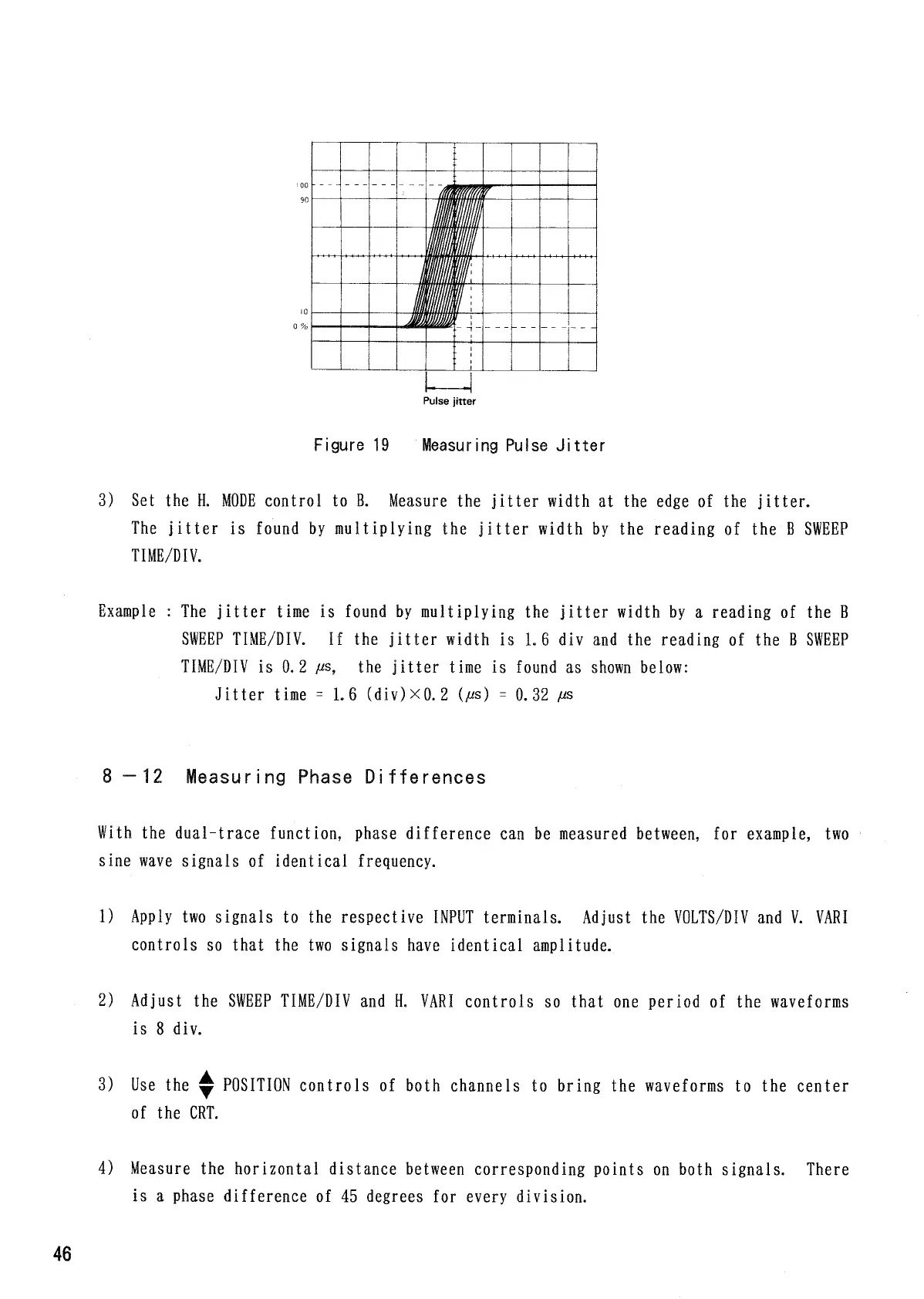
Pulse
jitter
3)
Set the H.
MODE
control
to B.
Measure
the
jitter
width
at the
edge
of the
jitter.
The
jitter
is
found
by
multiplying
the
j
itter
width
by the
reading
of the B SWEEP
TIME/DIV.
Example
: The
j
itter
time
is
found
by
multiplying
the
j
itter
width
by a
reading
of the B
SWEEP
TIME/DIV.
If the
jitter
width
is 1.6 div and the
reading
of the B SWEEP
TIME/DIV
is
0.
2
jus,
the
jitter
time
is
found
as
shown
below:
Jitter
time
= 1.6
(div)xQ.2 (jus)
=
0.
32
jus
8
12 Measur
i
ng
Phase
Di
fferences
With
the
dual-trace function,
phase
difference
can be
measured between,
for
example,
two
sine
wave
signals
of
identical
frequency.
1)
Apply
two
signals
to the
respective
INPUT
terminals.
Adjust
the
VOLTS/DIV
and V.
VARI
controls
so
that
the two
signals
have
identical
amplitude.
2)
Adjust
the SWEEP
TIME/DIV
and H.
VARI
controls
so
that
one
period
of the
waveforms
is
8
div.
3)
Use the y
POSITION
controls
of
both
channels
to
bring
the
waveforms
to the
center
of
the CRT.
4)
Measure
the
horizontal distance
between
corresponding
points
on
both
signals.
There
is
a
phase
difference
of 45
degrees
for
every
division.
Figure
19
Measuring
Pulse
Jitter
46

Related product manuals