2 Making Measurements
32 Keysight E-Series E9300 Operating and Service Guide
Measuring Spread Spectrum and Multitone Signals
To achieve high data transfer rates within a given bandwidth, many transmission
schemes are based around phase and amplitude (I and Q) modulation. These
include CDMA, W-CDMA and digital television. These signals are characterized by
their appearance on a spectrum analyzer display — a high amplitude noise-like
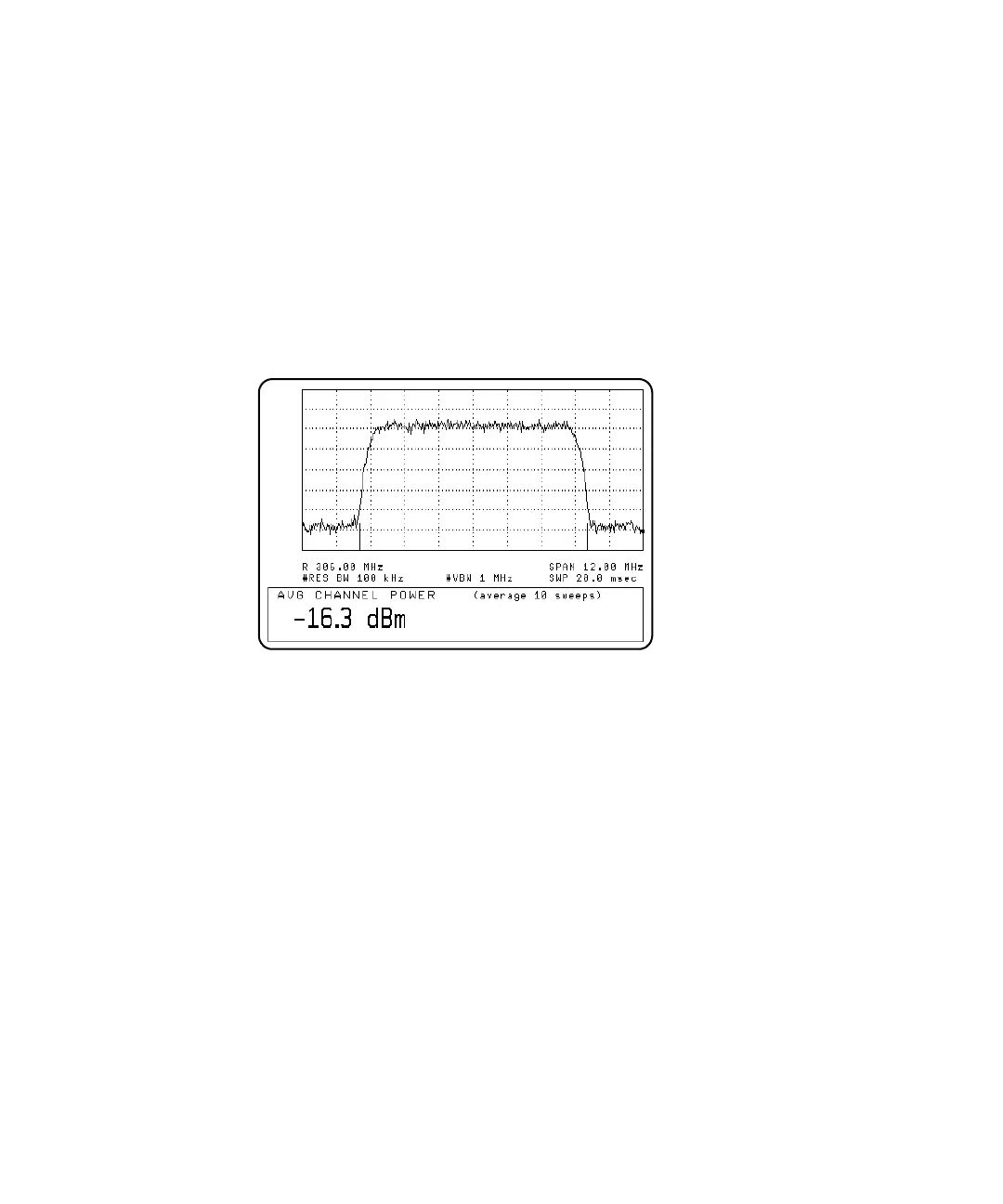
signal of bandwidths up to 20 MHz. An 8 MHz bandwidth digital television signal
is shown in Figure 2-2.
Figure 2-2 Example of an 8 MHz bandwidth digital television signal
Prior to the Keysight E-Series E9300 power sensors, average power measurement
over a wide dynamic range of these signals required either tuned/swept signal
analyzer methods or a dual channel power meter connected to power sensors,
pads and a power splitter.
The diode pair/attenuator/diode pair architecture of the Keysight E-Series E9300
power sensors is ideally suited to the average power measurement of these
signals. The sensors have wide dynamic range (80 dB max, sensor dependent) and
are bandwidth independent.
Some signal modulation formats such as orthogonal-frequency-division
multiplexing (OFDM) and CDMA have large crest factors. The Keysight E-Series
E9300/1/4A power sensors can measure +20 dBm average power even in the
presence of +13 dB peaks as long as the peak pulse duration is less than 10
microseconds. For high power applications, such as base-station testing the
E9300/1B and E9300/1H are recommended.



 To Next Page