Kübler Group 5 Commissioning and Operation
HB Profibus Interface - R67068.0002 - 01 EN - 17
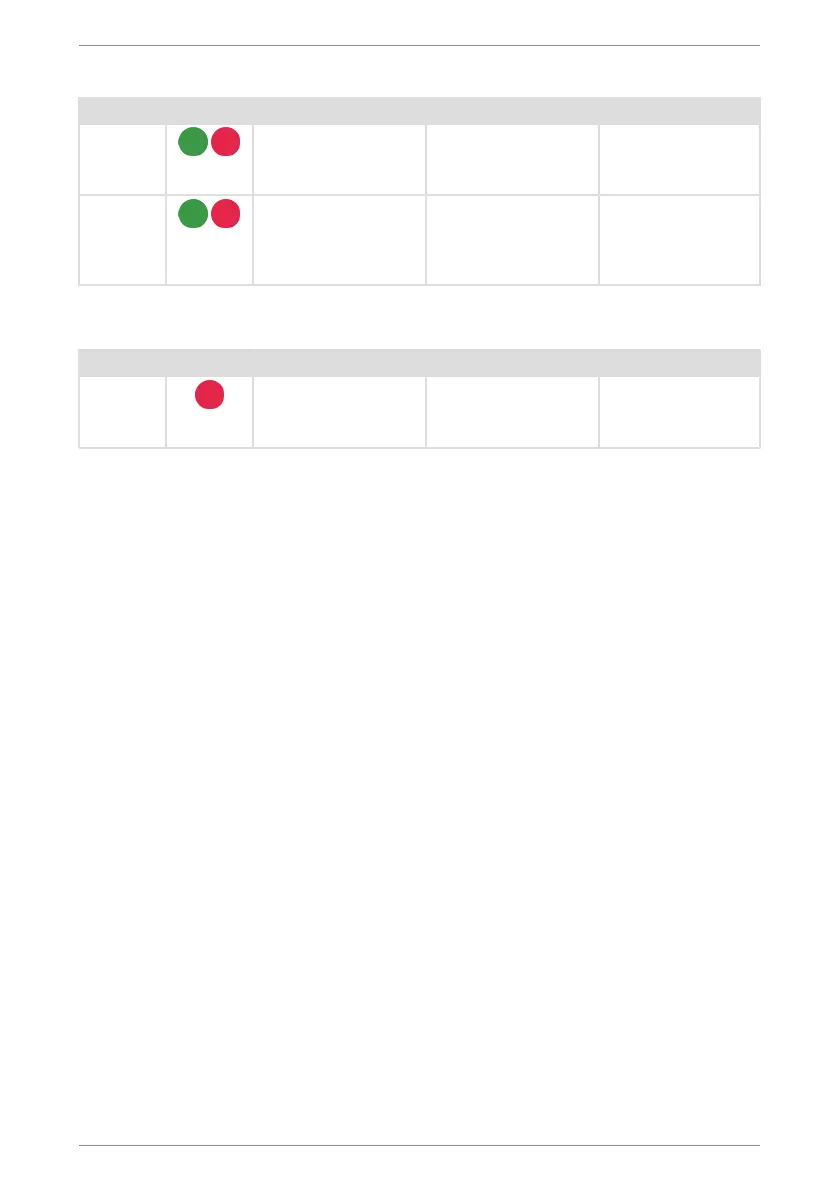
Error display after powering
Display LED Meaning Error cause Addition
PWR
+Diag
flashing
Red LED flashing
1 x briefly
Pause 1.6 sec.
Data connection with
sensor faulty
Sensor faulty
Device must be sent
back to manufacturer
for check
PWR
+Diag
flashing
Red LED flashing
2 x briefly
Pause 1.6 sec.
Wrong
node address
Profibus short-circuit
Termination faulty
Check Profibus
General RESET - Switching the device on while pressing the SET key
Display LED Meaning Error cause Addition
PWR
+Diag
flashing
Short flashing of
the red LED
Diagnostic mode Device ready for dia-
gnostic
5.2 Quick Start Guide
5.2.1 Default Settings
Before a PROFIBUSDP system can be started up, all connected participants, including the
master system, must be assigned unique bus addresses. Only this way will an unambiguous
addressing be ensured on the bus. The addresses of the stations must first be assigned via the
bus.
The physical system settings then follow through the parameters set of the master. Besides the
master bus address, this set includes e. g. the baud rate, the timeout times and the number of
transmission repetitions. In addition to the master parameters set, a slave parameters set must
be saved for every slave to be activated. A data set contains the parameter assignment and
configuration data of the slave and the address pointer for the logical storage of the I/O data.
When the parameter sets are present, the master system begins to start up the slaves one after
the other, either upon user request or automatically.
The first so-called diagnostic cycles show which slave is present on the bus. Only the slaves
that send a proper feedback during the diagnostic cycle are subsequently parameterized during
the parameterizing cycles with the corresponding data stored in the master. After error-free exe-
cution, the configuration cycles compare the required configuration stored in the master with the
actual configuration of the slaves. After the last diagnostic cycle, every slave that did not detect
any error during the comparison is ready for operation.
Each of these slaves is automatically integrated by the master in the operating data exchange.
For diagnostic purposes, the master provides a diagnostic buffer for every slave. This buffer can
be read out by the user for other purposes. To make diagnostic easier, a group diagnostic field
is kept simultaneously. This field shows bit by bit whether it holds diagnostic data for a slave or
not.
The following parameters are factory-set:


 To Next Page