103
Tires
Before each tow, be sure the tire pressure is at the
value indicated on the Certification/VIN label.
Tire pressure must be checked while the tire is cold.
Do not check the tire pressure immediately after
towing the trailer. Allow at least three hours for a tire
to cool, if the trailer has been towed for as much as
one mile. Replace the tire before towing the trailer if
the tire treads have less than 1/16 inch depth or the
telltale bands are visible.
A bubble, cut or bulge in a side wall can result in a
tire blowout. Inspect both side walls of each tire for
any bubble, cut or bulge; and replace a damaged tire
before towing the trailer.
WARNING
Worn, damaged or under-inflated tires can
cause loss of control, injury and damage.
Check tires before each tow.
Wheel Rims
If the trailer has been struck, or impacted, on or near
the wheels, or if the trailer has struck a curb, inspect
the rims for damage (i.e. being out of round); and
replace any damaged wheel. Inspect the wheels for
damage every year, even if no obvious impact has
occurred.
Never install aftermarket wheels or lug nuts on
your trailer. Use only original equipment wheels and
lugs nuts. Aftermarket wheels and lug nuts may not
meet the load carrying requirements, pressure capac-
ity and offset as the original equipment.
Wheel Bearings
A loose, worn or damaged wheel bearing is the most
common cause of brakes that grab.
To check your bearings, jack trailer and check wheels
for side-to-side looseness. If the wheels are loose, or
spin with a wobble, the bearings must be serviced or
replaced.
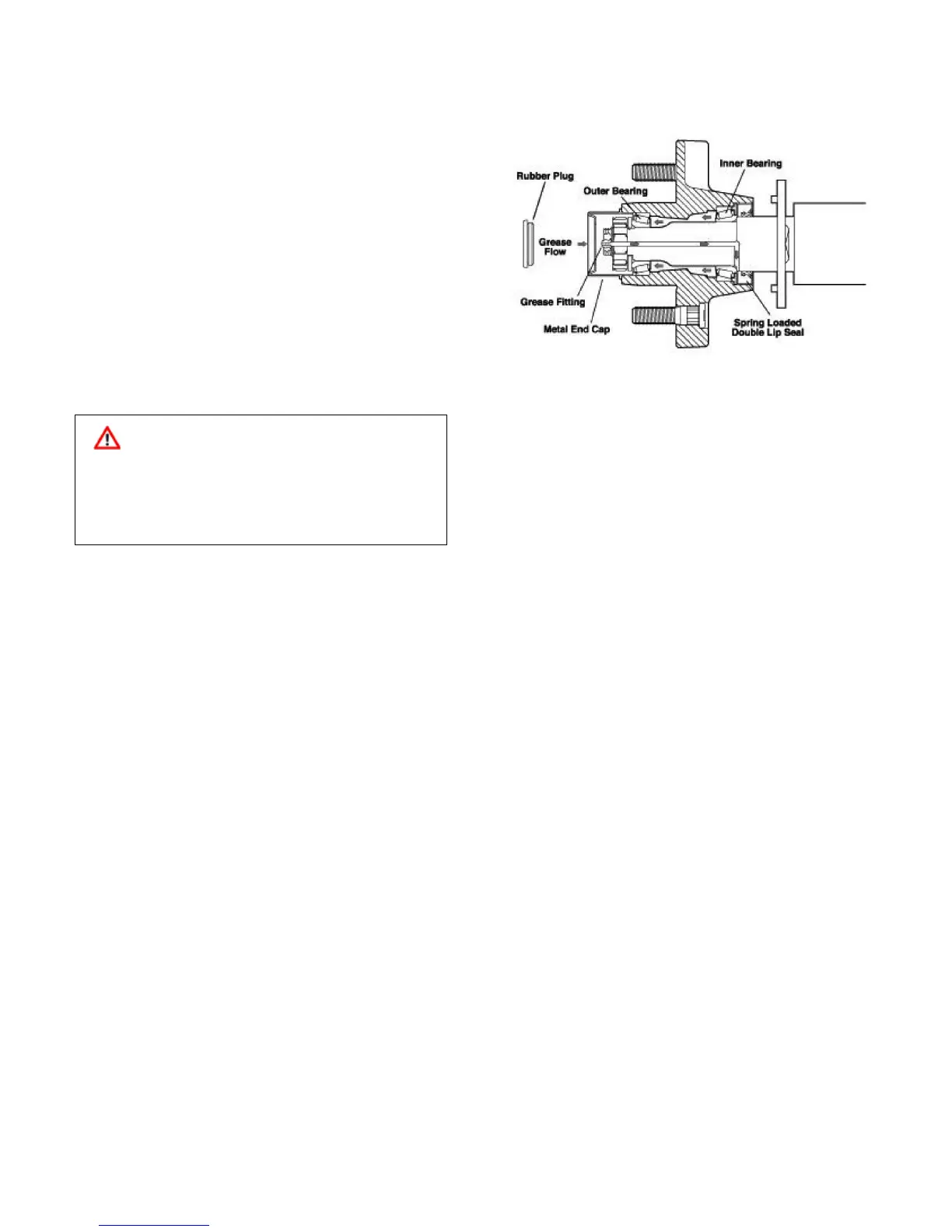
Your trailer is equipped with grease fitting lubricated
bearings.
Grease Fitting Lubricated Bearings
Bearings should be lubricated every 12 months or
12,000 miles, whichever occurs first.
• Removetherubberplugfromthehubend.
• Placeastandardgreasegunontothegrease
fitting. Make sure the grease gun nozzle is fully
seated on the fitting.
• Pumpgreaseintothefittingwhilerotatingbegin
to flow back out to the cap around the grease
gun nozzle.
• Stopwhennewgreaseisobserved.
• Wipeoffexcessandinstallrubberplug.
Lug Nuts
Lug nuts are prone to loosen right after a wheel is
mounted to a hub. When driving on a remounted the
first 10, 25 and 50 miles of driving and before each
tow thereafter.
Lug Nut Tightening (Torque)
Being sure wheel mounting nuts (lug nuts) on trailer
wheels are tight and properly torqued is an impor-
tant responsibility that trailer owners and users need
to be familiar with and practice. Inadequate and/or
inappropriate wheel nut torque (tightness) is a major
reason that lug nuts loosen in service. Loose lug nuts
can rapidly lead to a wheel separation with potentially
serious safety consequences.
• Becertainyouhaveaclearunderstandingof
the specific wheel maintenance responsibili-
ties your vehicle manufacturer requires/rec-
ommends you, as the owner, must perform in
order to insure your wheel equipment is safely
maintained. Check the lug nut tightness the first
10, 25 and 50 miles of driving and before each
tow thereafter. Refer to the owner’s manual and
speak with your dealer if you have any ques-
tions about proper tightening practices.



 To Next Page