42
Couple Trailer to the Tow Vehicle
• Usingthejack,lowerthetrailertongueuntil
the coupler fully engages the hitch ball. If the
coupler does not line up with the hitch ball,
adjust the position of the tow vehicle.
• Engagethecouplerlockingmechanism.In
the engaged position, the locking mechanism
securely holds the coupler to the hitch ball.
• Insertapinorlockthroughtheholeinthelock-
ing mechanism.
• Besurethecouplerisallthewayonthehitch
ball and the locking mechanism is engaged. A
properly engaged locking mechanism will allow
the coupler to raise the rear of the tow vehicle.
Using the trailer jack, test to see that you can
raise the rear of the tow vehicle by 1 inch, after
the coupler is locked to the hitch.
WARNING
The tongue jack can be damaged by over-
loading. Do not use the tongue jack to raise
the tow vehicle more than 1 inch.
If the coupler cannot be secured to the hitch ball,
do not tow the trailer. Call Lance Customer Service
at 661-949-3322 or your Lance Trailer dealer for
assistance.
Lower the trailer so that its entire tongue weight is
held by the hitch, and continue retracting the jack to
its fully retracted position.
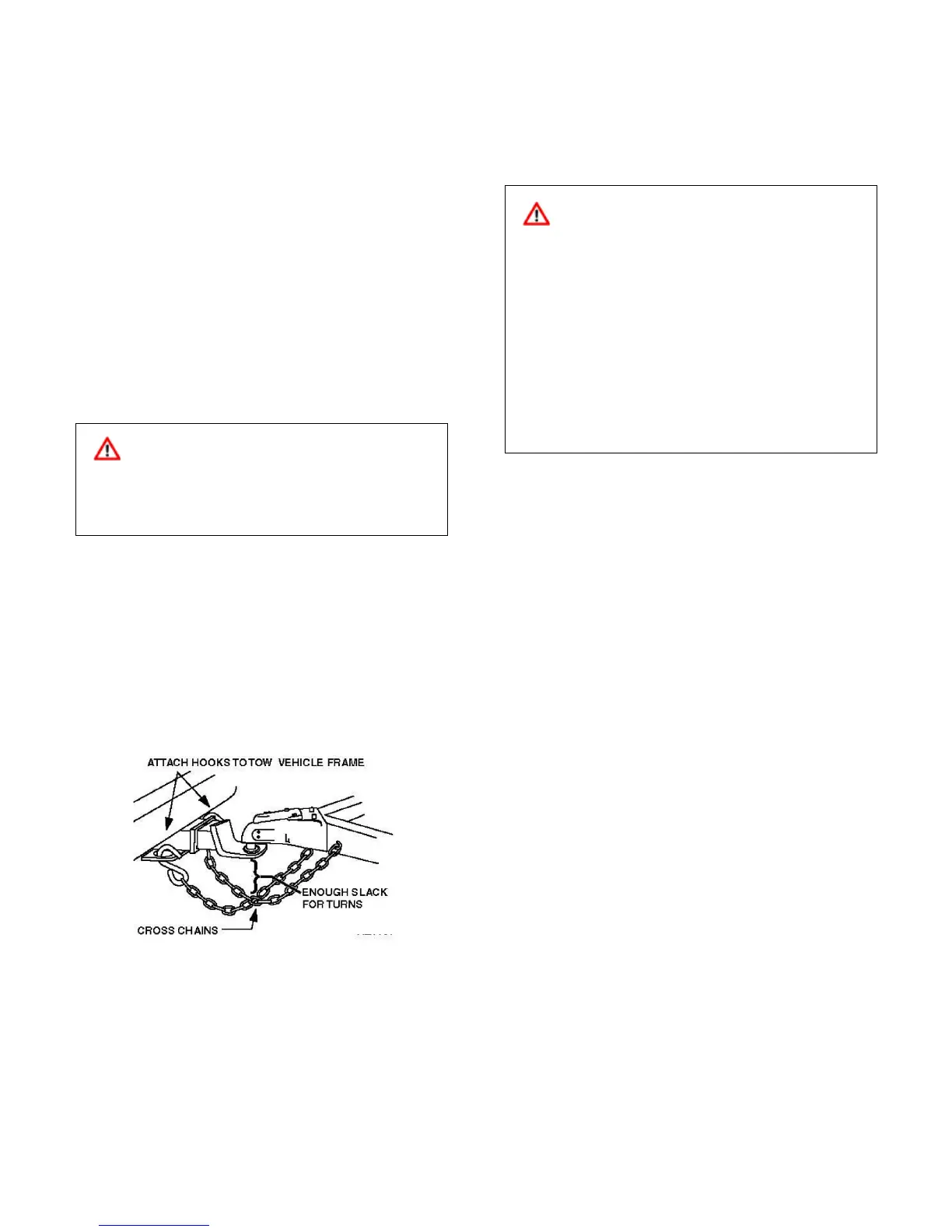
Attaching the Safety Chains
• Visuallyinspectthesafetychainsandhooksfor
wear or damage. Replace worn or damaged
safety chains and hooks before towing.
• Rigthesafetychainssothatthey:
• Cris-crossunderneaththecouplersoifthe
trailer uncouples, the safety chains can hold the
tongue up above the road.
• Looparoundaframememberofthetowvehicle
or to holes provided in the hitch system (but, do
not attach them to an interchangeable part of
the hitch assembly)
• Attachhooksupfromunderneaththehole(do
not just drop into hole); and
• Provideenoughslacktopermittightturns,but
not be close to the road surface to drag.
WARNING
Incorrect rigging of the safety chains can
result in loss of control of the trailer and tow
vehicle, leading to death or serious injury, if
the trailer uncouples from the tow vehicle.
Chains must:
• Fastentoframeoftowvehicle,nottohitch
or ball.
• Crossunderneathhitchandcouplerwith
minimum slack to permit turning and to
hold tongue up, if the trailer comes loose.
BRAKES
The electric brakes on your trailer are similar to the
drum brakes on many automobiles. The basic differ-
ence is that your automotive brakes are actuated by
hydraulic pressure while your electric trailer brakes
are actuated by an electromagnet.
When electrical current is fed into the system from
your tow vehicle’s brake controller, it flows through
the electromagnets in the brakes. The electro-
magnets are energized and are attracted to the
rotating surface of the brake drum which moves the
actuating levers in the direction that the drums are
turning.
The resulting force causes the actuating cam block at
the brake show end of the lever to push the primary
brake show out against the inside surface of the
brake drum. The force generated by the primary
show acting through the adjuster moves the second-
ary show out into contact with the brake drum.
Increasing the current flow to the electromagnet
causes the magnet to grip the armature surface of the
brake drum more firmly. This results in increasing the
pressure against the shoes and brake drums until the
desired stop is accomplished.
Your trailer brakes are designed to work in synchroni-
zation with your tow vehicle brakes. Never use
your tow vehicle or trailer brakes alone to stop the
combined load.
Your tow vehicle brake controller must be set up
according to the manufacturer’s recommendations
to ensure proper synchronization between the tow
vehicle and the trailer. Additionally, you may have to



 To Next Page