41
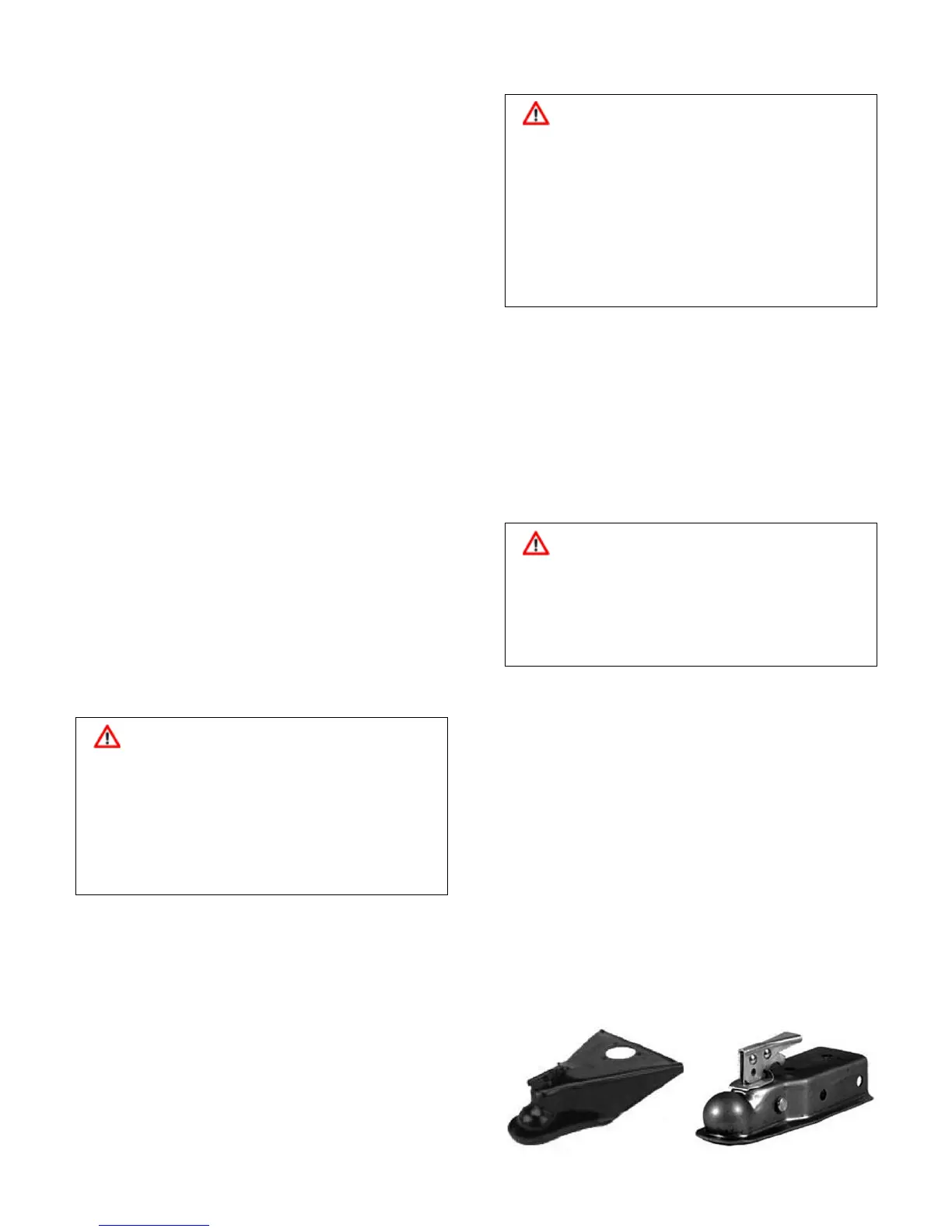
Be sure the Ball Hitch coupler is suitable for the
size and weight of the trailer. The load rating of the
coupler and the necessary ball size (2” or 2 5/16”) are
listed on the trailer tongue. You must provide a hitch
and ball for your tow vehicle, where the load rating
of the hitch and ball is equal to or greater than that
of your trailer. Also, the ball size must be the same
as the coupler size. If the hitch ball is too small, too
large, is underrated, is loose or is worn, the trailer
can come loose from the tow vehicle, and may cause
death or serious injury.
THE TOW VEHICLE, HITCH AND BALL MUST HAVE
A RATED TOWING CAPACITY EQUAL TO OR GREAT-
ER THAN THE TRAILER GROSS VEHICLE WEIGHT
RATING (GVWR).
IT IS ESSENTIAL THAT THE HITCH BALL BE OF THE
SAME SIZE AS THE COUPLER.
IF THE HITCH BALL IS TOO SMALL, IS UNDER-
RATED, IS LOOSE OR IS WORN, THE TRAILER CAN
COME LOOSE FROM THE TOW VEHICLE, RESULT-
ING IN DEATH OR SERIOUS INJURY.
The ball size and load rating (capacity) are marked
on the ball; hitch capacity is marked on the hitch.
Before Coupling the Trailer to the Tow Vehicle
• Besurethesizeandratingofhitchballmatch
the size and rating of the coupler. Hitch balls
and couplers are marked with their size and
rating.
WARNING
Coupler-to-hitch mismatch can result in un-
coupling, leading to death or serious injury.
Make sure the hitch and ball are rated for the
trailer coupling.
Makesurethehitch[ballsize]matchesthe
coupler.
• Wipethehitchballcleanandinspectitvisually
and by feel for flat spots, cracks and pits.
WARNING
A worn, cracked or corroded hitch ball can
fail while towing, and may result in death or
serious injury.
Check the hitch ball for wear, corrosion and
cracks before coupling the trailer.
Replace worn, corroded or cracked hitch ball
before coupling the trailer.
• Rocktheballtomakesureitistighttothehitch,
and visually check that the hitch ball nut is solid
against the lock washer and hitch frame.
• Wipetheinsideandoutsideofthecouplerclean
and inspect it visually for cracks and deforma-
tions; feel the inside of the coupler for worn
spots and pits.
• Besurethecoupleristighttothetongueofthe
trailer. All coupler fasteners must be visibly solid
against the trailer frame.
WARNING
A loose hitch ball nut can result in un-
coupling, leading to death or serious injury.
Make sure the hitch ball is tight to the hitch
before coupling the trailer.
Prepare the Coupler and Hitch
• Lubricatethehitchballandtheinsideofthe
coupler with a thin layer of automotive bearing
grease. Using the jack, raise the coupler above
the ball height.
• Openthecouplerlockingmechanism.Ball
couplers have a locking mechanism with an in-
ternal moving piece (ball clamp) and an outside
handle, wheel, or latch.
• Intheopenorreleasedposition,the
coupler is able to drop fully onto the
hitch ball.
• Seethecouplerinstructionsfordetailsof
placing the coupler in the open or released
position.
• Slowlybackupthetowvehiclesothatthehitch
ball is near or aligned under the coupler.



 To Next Page