LANCOM GS-1224
쮿 Chapter 4: Operation of Web- based Management
25
EN
쮿 VLAN Mode:
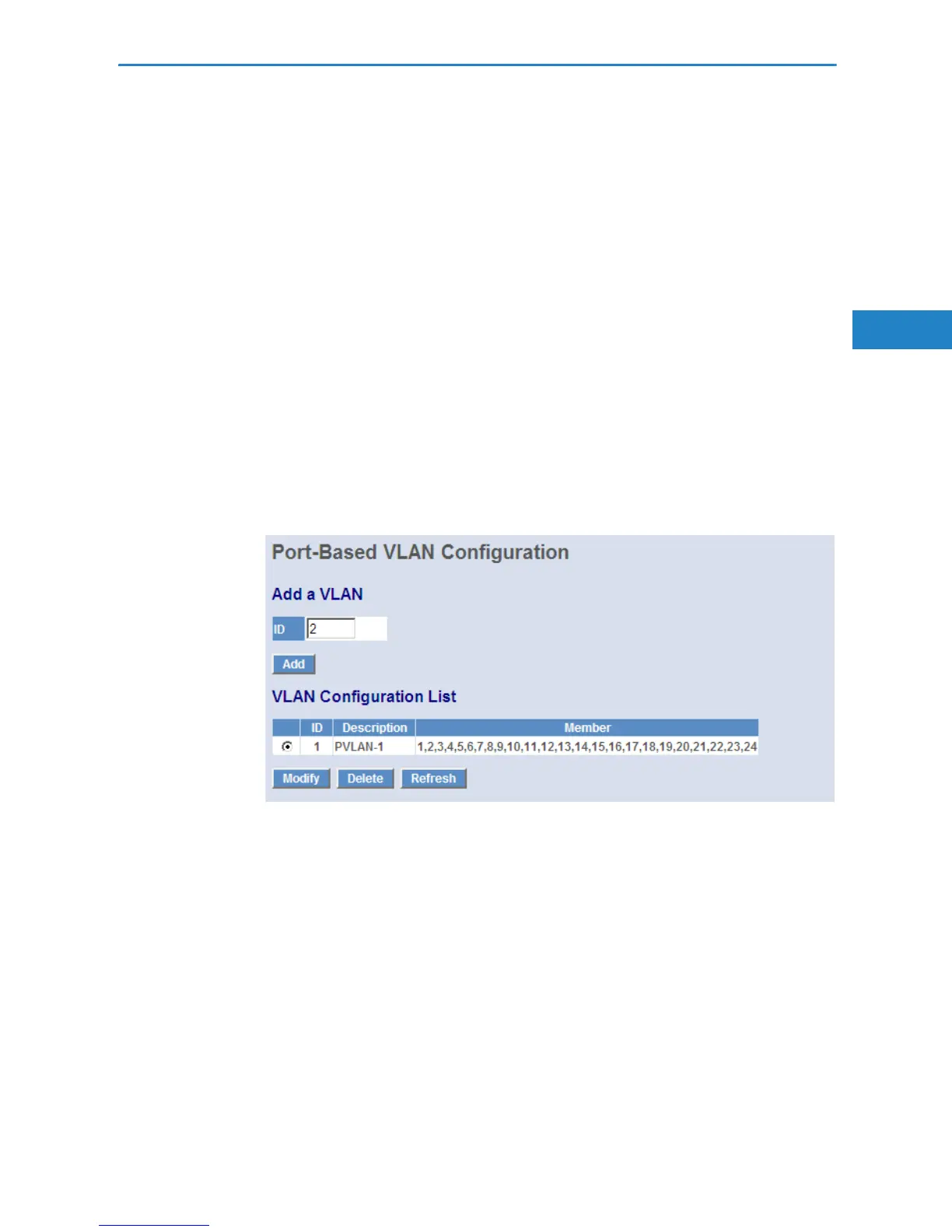
왏 Port-based:
A port-based VLAN defines its members by port. Any packet coming
in or going out from any port of a port-based VLAN will be accepted.
No filtering criterion applies in a port-based VLAN, the only criterion
is the physical connection to a member port. For example in a port-
based VLAN with the member ports 1, 2, 3 and 4, the ports 1, 2, 3
and 4 can communicate with each other, but port 5 can not commu-
nicate with them. Each port-based VLAN is identified with an ID (1 to
4094) and you can capture further information about the VLAN in a
description. This switch supports up to maximal 24 port-based
VLANs.
As soon as the VLAN mode is set on “port-based”, the display auto-
matically changes to the configuration of the port-based VLAN
groups.
왏 Tag-based:
A tag-based VLAN identifies its member by VLAN-ID. If there are any
more rules in ingress or egress filtering lists, this rules determines if
the packet will be forwarded or not. The switch supports standard of
802.1q.
Each tag-based VLAN you set up must get a VLAN name and VLAN
ID. A valid VLAN ID is 1 up to 4094. You can create up to 24 Tag VLAN
groups.
As soon as the VLAN mode is set on “tag-based”, the setting double-
tag mode will be offered. If the double-tag mode is activated all
packets (tagged or untagged) will get a VLAN tag. Packets which have
already an “inner” tag will get in addition an “outer” tag. Internet ser-


 To Next Page