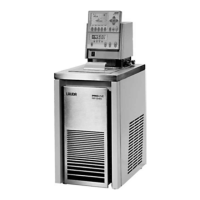
Proline Low-temperature Thermostats
YACE0072 / 21.08.07 Unit description 15
4 Unit description
4.1 Environmental conditions
The operation of the thermostats is only allowed under the following conditions as specified in
DIN EN 61010-2-010:2003 and DIN EN 61010-1:2001:
− Indoor use.
− Altitude up to 2000 m above sea level.
− Foundation must be dense, even, non-slippery and non-flammable.
− Keep clear distance Ì 6.1 Assembly and siting.
−
Ambient temperatures
range Ì 11 Technical data.
Use only within this range for an undistur
bed operation.
− Mains supply voltage fluctuations Ì 11 Technical data.
− Relative
humidity Ì 11 Technical data.
− Transient over voltage according to Insta
llation Categories (Over voltage Categories) II.
− Pollution degree: 2.
4.2 Types of unit
The type designation of the Proline Low-Temperature Thermostats comprises the prefix R (to
designate the refrigeration machine), a P for Proline, the bath volume in liters and the lowest bath
temperature (guide figure without arithmetic sign).
Units in Command version are marked with a “C” at the end of the model description.
Examples: RP 855 is a low-temperature thermostat with 8-liter bath and -55 °C min. temperature.
RP 1845 is a low-temperature thermostat with 18-liter bath and -45 °C min. temperature.
4.3 VarioFlex pump
All units are fitted with a VarioFlex pump with an 8-stage variable drive. The pump power can
therefore be optimally matched to the relevant task: High pump pressure when, for example, long
hoses pass to external loads or circulation is to be provided for a large bath. Low pressure when the
heat input into the bath must be low.
As a delivery/ suction pump, the VarioFlex pump enables the very effective supply of pressure-
sensitive glass reactors, which have a minimum permissible pressure rating.
Furthermore, open vessels can be operated when a constant level controller (accessory LCZ 0660) is
used.
At the right-hand side and at the back of the unit outflow and inflow nozzles are fitted for external
loads. This means that up to two external loads can be directly connected without a distributor.
Connections, which are not required, must be closed off with the supplied caps and union nuts.
A bypass valve can subdivide the total volume flow variably between the bath (internally) and the
connected load (externally). Consequently, no "pump short circuit" is needed. If no load is connected
to the pump connector, the bypass valve must be set to the “internal” position for the best bath
circulation.
In the heating range, the VarioFlex pump operates up to viscosity values of 150 mm²/s. In the closed-
loop control mode 50 mm²/s should not be exceeded. The temperature control is the best with
30 mm²/s and lower viscosity.
With small bath coolers (e.g. RP 845) power level 1 to 3 is practicable.



 To Next Page