37
If the objective aperture is larger than the
threshold value listed above of 0.75, you will get
an image similar to brightfield. This will also
happen if the condenser is greatly decentered.
Oblique illumination
To obtain a relief-like contrast: push DF slide
(CL/PH condenser; 7.7) in part way or rotate
condenser disc (7.3) slightly out of the DF
position (open aperture diaphragm).
Assembly of polarizers*
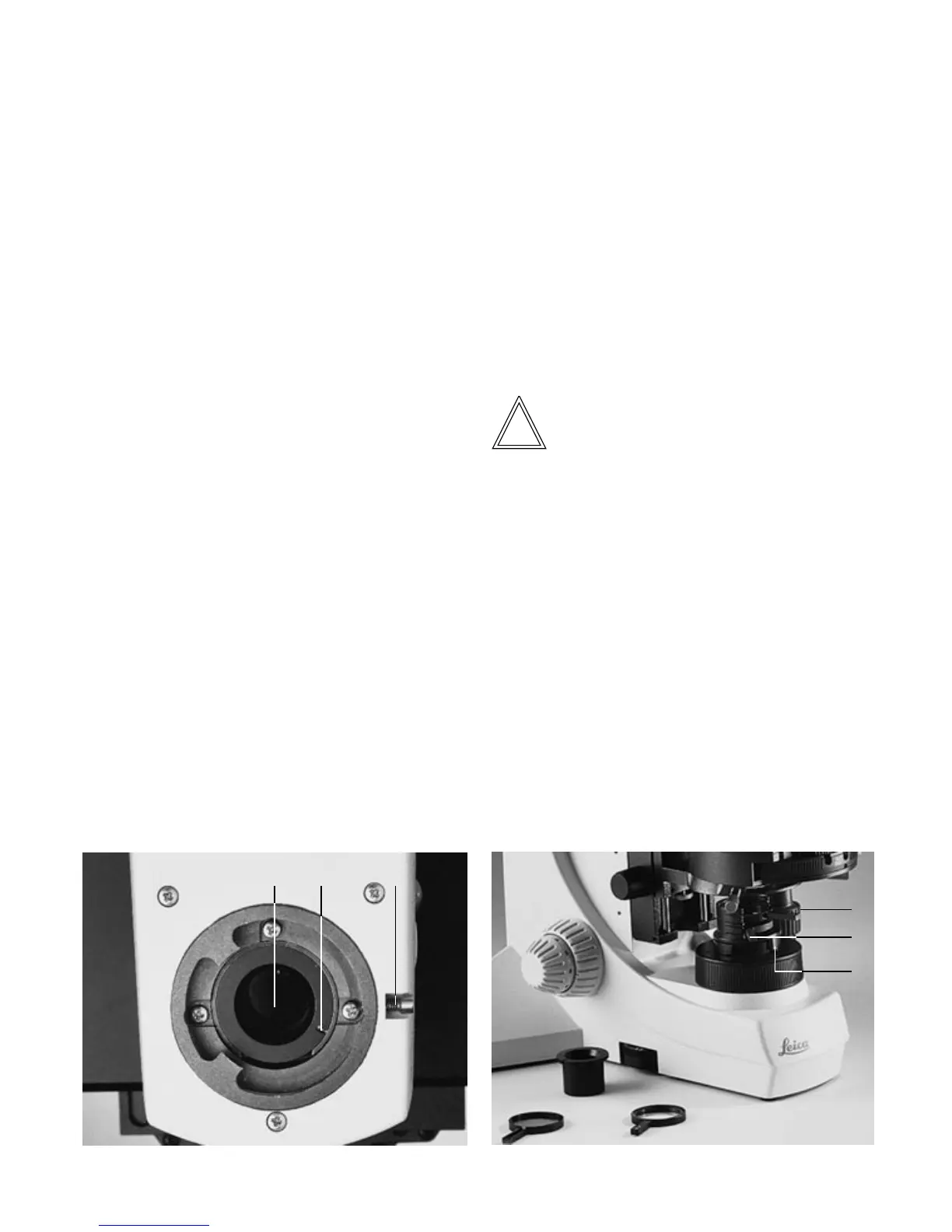
Analyser: Disassemble the tube or intermediate
module (27.3) and put the analyser (28.1) in the
microscope (via the objective nosepiece) (27.1),
the orientation groove must latch into the
orientation pin (27.2).
An intermediate tube Pol* with engageable and
disengageable analyser and Bertrand lens is
also available as an option.
!
Polarizer: Mount the filter holder (28.4) instead
of the filter magazine (Fig. 11). Push the polarizer
(28.3) into the lower opening.
Attention:
Always use the polarizer with the labelled side
upwards, as otherwise the integrated heat
protection filter is ineffective and the special
polarizer will become useless (discolouring!).
As an alternative, a polarizer is available which
is secured underneath the condenser.*
Condenser: The standard condensers CL/PH and
UCL 0.90/1.25 OIL S1 are not suitable for
polarization, as there may be major lens strain.
The Pol condenser CLP/PH 0.85 S1 or UCLP 0.85
S1 is required. Apart from the lettering, it looks
just like the standard condensers from the
outside.
Fig. 27 Assembly of analyser
1 Analyser (cf Fig. 28.1), 2 Orientation pin and groove, 3 Champ
screw for tube or intermediate system
Fig. 28
1 Analyser, 2 λ or λ/4 compensator, 3 Polarizer, 4 Filter holder
1 2 3
1
32
2
3
4


 To Next Page