VARIABLY SPACED HALF-BLIND DOVETAIL PROCEDURES
34
Chapter 9 Super Jig-12-18-24 User Guide
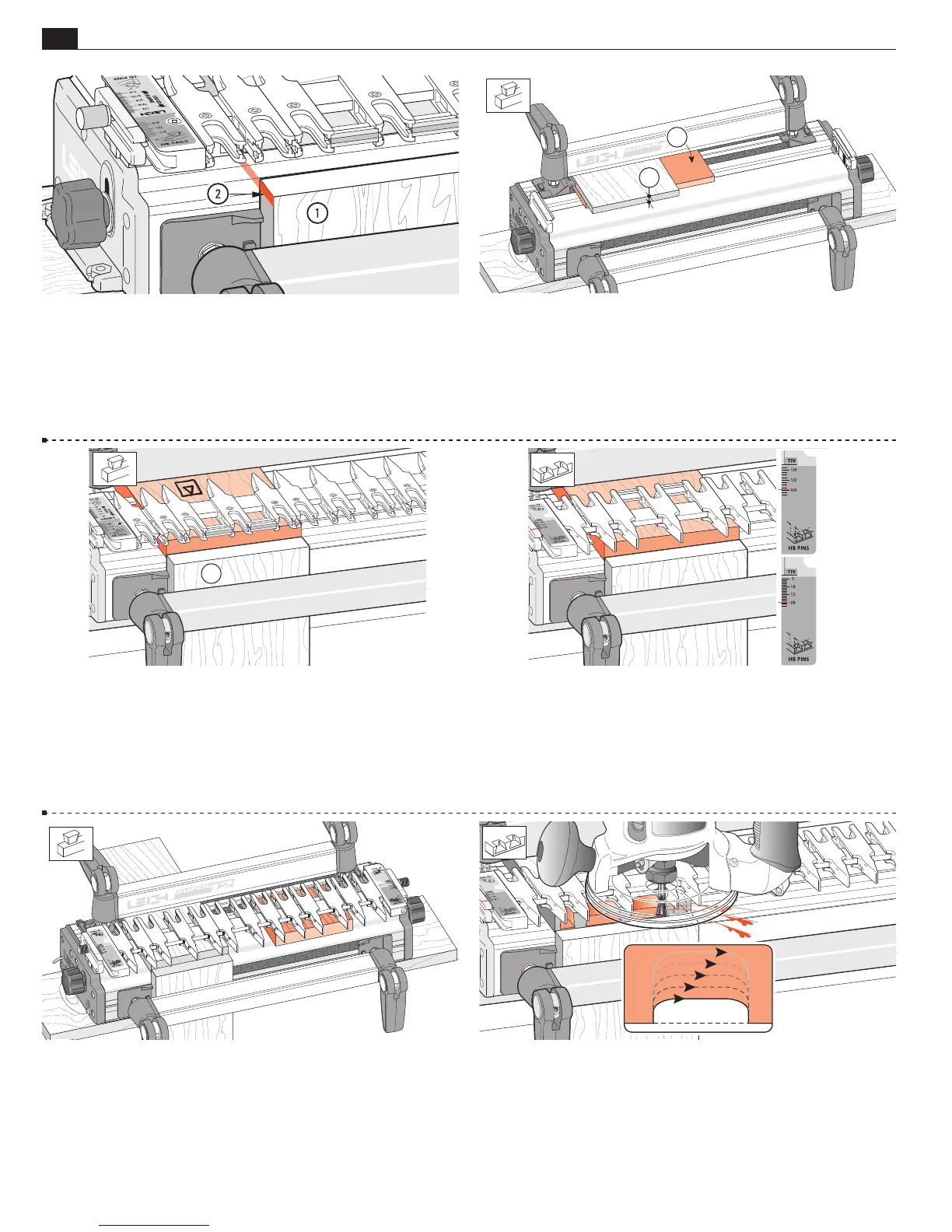
9-20 Clamp a scrap board
in the front of the jig so that the
top edge of the scrap board projects above the top face of the jig
by about
1
⁄8"[3mm]
. This will keep the scrap piece below the
path of the bit when routing the pin board.
Remove the spacer board from the rear clamp.
9-21 If you're mounting Thin Pin Boards:
Minimum recommended pin board thickness is
1
⁄2"[13mm].
Remember, No.128-8 bits rout at
3
⁄8"[9,5mm] deep. If you rout
a pin board less than minimum thickness
, you need to pack
the board up from the jig body. We suggest a piece of
1
⁄4" to
3
⁄8"[6
to 9mm] plywood for this purpose
.
2
1
9-22 Flush Drawers Place a test pin board in the left rear clamp
against the side stop, its front end edge flush to the vertical board,
the inside face
i
of the drawer front away from the jig body. The
pin board is now positioned with the edge to be routed flush with
the jig’s front face, correctly registered for the scale readings. For
rabbeted drawer fronts, see Chapter 11.
1
9-23 Rotate the finger assembly to
h
HB PINS mode. Set
the HB pins scale equal to tail board thickness (i.e., same setting as
tails: this example,
3
⁄4"[20mm]). HB pins and HB tail scales are
always set to tail board thickness. Make sure the finger assembly
is flush and level on the pin board. The guidefingers must touch
the pin board or depth of cut will vary, causing poor joint fit.
9-24 If you have difficulty leveling the finger assembly on a nar-
row workpiece, place a board the same thickness as the pin board
under the other end of the finger assembly, but not in the rear
clamp.
9-25
Rout out the waste between the pins. Rout each space
from left to right. Do not back-rout on end grain.
If the bit enters on the right side of the opening there will be
a very strong pull to the left, so… rout each opening in at least
three or four passes, left to right.


 To Next Page