Page 1
www.licor.com/bio
Chapter 1
Installation and Safety Information
Safety Considerations
Laser Safety
The Center for Devices and Radiological Health (CDRH) was established in October 1982, by the U.S. Food and Drug
Administration (FDA) to protect the public health in the fields of medical devices and radiological health.
Manufacturers of products subject to performance standards under the Radiation Control for Health and Safety Act of
1968 are required to furnish various reports to the CDRH.
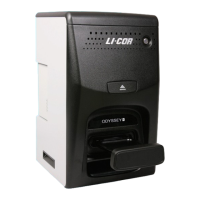
The Odyssey
®
Fc Imager is certified as a Class I laser product. This means that hazardous laser radiation is not emitted
outside the instrument. Radiation emitted inside the Odyssey Fc is confined within protective housings and external cov-
ers. A series of safety interlocks ensures that the laser beam cannot escape during any phase of user operation.
One laser emits at 785nm and the other one at 685-690nm. The 785nm laser has a peak power rating of
1.2 watt. The 685-690nm laser has a peak power rating of 0.5 watt. The lasers emit visible and invisible laser radiation -
direct exposure to either beam may cause eye damage. Laser radiation from each laser uniformly illuminates the tar-
get area only, which is marked in the imaging tray (Figure 2-6) that fits in the imaging drawer. There is no emission of
laser radiation outside the instrument under normal conditions.
The CDRH implemented regulations for laser products on August 1, 1976 (CDRH radiation performance standard 21,
Code of Federal Regulations Chapter 1, Subchapter J). Compliance for products marketed in the United States is manda-
tory. The label that must be attached to laser products marketed in the United States is Figure 1-1 and is located on the
rear panel of the Odyssey Fc (Figure 1-2), indicating compliance with CDRH regulations.
WARNING: Use of controls or adjustments or performance of procedures other than those specified herein may result
in hazardous radiation exposure.


 To Next Page