33/76
EN
8. MAINTENANCE
8.1. SAFETY NOTES FOR MAINTENANCE
NOTE!
• Maintenance may only be performed by suciently qualified, trained and authorized individuals (see sec-
tion 2.4)
8.2. MAINTENANCE PLAN
The following sections describe the maintenance works that must be performed to ensure the optimum and
trouble-free operation of the regulator.
If regular inspections reveal increased wear, the requisite maintenance intervals must be shortened to reflect
the actual wear and tear.
NOTE!
• Please contact the manufacturer if you have any questions relating to maintenance works and intervals.
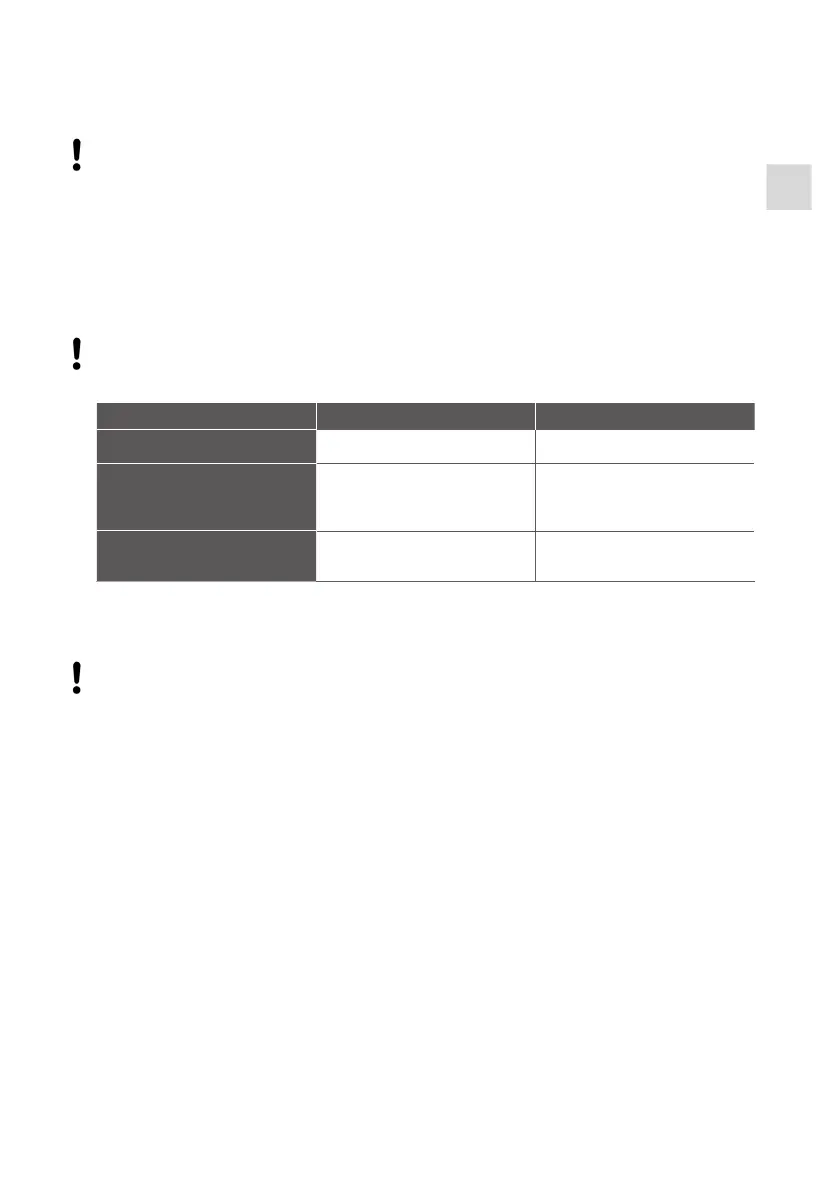
Interval Maintenance work Personal
Weekly Check all components visually Competent Person (TRBS 1203)
Every year Checking function & tightness,
check for all safety relevant com-
ponents
Competent Person (TRBS 1203)
Every 10 years General overhaul and replace-
ment of all wearing parts
Competent Person (TRBS 1203)
8.3. MAINTENANCE WORK
8.3.1. CLEANING
NOTE!
• All cleaning agents must be compatible with the materials of the installed component.
8.3.2. REQUIREMENTS FOR MAINTENANCE
CHECK BEFORE MAINTENANCE START, IF:
• Gas supply is disconnected and safe
• Manifold is depressurized
• Pressure regulator is depressurized
• Valves are closed
• No process gas inside component.
• System is purged and filled with inert gas.
8.3.3. NECESSARY MAINTENANCE
• Check accuracy of pressure gauges
• Manifold, pressure regulator, valve and gauges: check condition, function and labeling
• Check labelling
• Check for corrosion
• Check function
• Pressure test with 1-times working pressure for 12 hours
• Worn and defective components must be changed immediately from authorized qualified company
• Valve is designed according to ISO 10297, including type test with cycle test from up to 2000 cycles.
Change inner parts after 2000 cycles, change must be done from authorized qualified company
• If there are any leakages or too much corrosion at the manifold/ pressure regulator or valve, component
must be replaced with all connections by an authorized company
• After the changing of components or tubes, pressure and leakage test must be done again and be proto-
colled


 To Next Page