LTC2983
65
2983fc
For more information www.linear.com/LTC2983
CUSTOM THERMISTORS
In addition to digitizing standard thermistors, the
LTC2983 can also digitize custom thermistors (thermistor
type=0b11011, see Table 51). Custom sensor data (mini-
mum of three, maximum of 64 pairs) reside sequentially
in memory and are arranged in blocks of six bytes of
monotonically increasing tabular data Ω vs temperature
(see Table 72).
Custom Thermistor Table Example
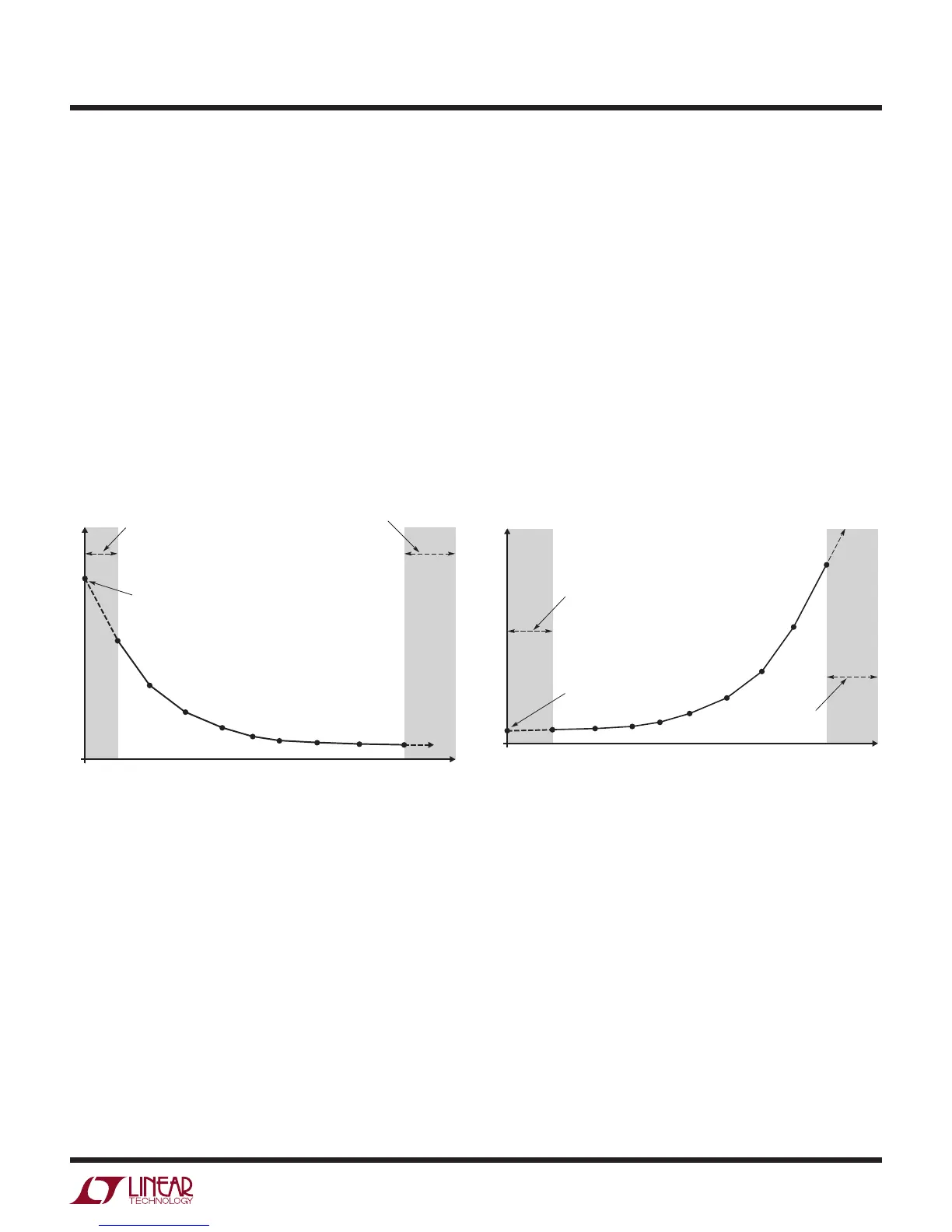
In this example, a simplified thermistor NTC (negative tem-
perature coefficient) curve is implemented (see Figure 40).
Points P1 to P9 represent the normal operating range of
the custom thermistor. Resistance readings above point
P9 result in a soft fault and the reported temperature is
a linear extrapolation using a slope determined by points
P8 and P9 (the final two table entries). Resistance read-
ings below point P1 are also reported as soft faults. The
temperature reported is the extrapolation between point
P1 and P0, where P0 is the sensor output temperature
at 0Ω (This point must be 0Ω for proper interpolation
below point p1).
In addition to NTC type thermistors, it is also possible to
implement PTC (positive temperature coefficient) type
thermistors (see Figure 41). In both cases, table entries
start at the minimum resistance and end at the maximum
resistance value.
Figure 40. Custom NTC Thermistor Example (Ω vs Kelvin)
Figure 41. Custom PTC Thermistor Example (Ω vs Kelvin)
2983 F40
p9
p8
p7
p6
p5
p4
p3
NOTE:
P0 SHOULD BE THE
EXTRAPOLATION
POINT TO 0Ω
RESISTANCE (Ω)
TEMPERATURE (K)
p2
p1
0
0
p0
RESISTANCE < p1
SENSOR UNDER-RANGE
SOFT FAULT CONDITION
RESISTANCE > p9
SENSOR OVER-RANGE
SOFT FAULT CONDITION
2983 F41
p9
p8
p7
p6
p5
p4
p3
NOTE:
P0 SHOULD BE THE
EXTRAPOLATION
POINT TO 0Ω
RESISTANCE (Ω)
TEMPERATURE (K)
p2
p1
0
0
p0
RESISTANCE < p1
SENSOR UNDER-RANGE
SOFT FAULT CONDITION
RESISTANCE > p9
SENSOR OVER-RANGE
SOFT FAULT CONDITION



 To Next Page