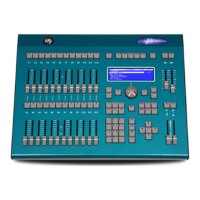
Piccolo 50 from 82
www.lt-light.com
1. Selection of the channel #
at FF (level edition is
optional)
2. Each time that [NEXT] is
pressed, the system searches the
next: #+1, #+2…
(the number appear in the
command line)
3. When [ENTER] is pressed the
channel in the command line (i.e.
#+2) is selected for change.
Now it is possible to repeat steps
2 & 3 as many times as desired.
*Piccolo Scan has dedicated [NEXT] key
Example: Select the channels 35, 37 & 39, and edit them at FF.
[CHANNEL][3] [5] [ENTER] Select channel 35
[NEXT][NEXT] [ENTER] Now 37
[NEXT][NEXT] [ENTER] And then 39
[@][@] set all selected channels to FF
28. COPY FUNCTION
[4_B]COPY allows you to copy (or exchange) groups, cues, effects, macros or pages, one by one
or in ranges. Some examples copying cues:
Copy cue 1 to cue 8:
[CUE] [1] [4_B]COPY [8] [ENTER]
Copy cues from 800 to 999 in the cues from 100 to 299:
[CUE] [8][0][0] [TRHU] [9][9][9] [4_B]COPY [1][0][0] [ENTER]
Too, it’s possible to copy edition values for channels and fixtures. Example:
Copy the values in edition from fixture 1 to the fixture 2:
[FIXTURE] [1] [4_B]COPY [2] [ENTER]
29. DELETING DATA
It is important not to mix the commands for delete with the commands to empty the Submasters and
the Crossfader ([DELETE][S#], [DELETE][FL.MT] & [DELETE][ASSIGN]). Commands to
empty do not delete data of the memory.
29.1. DELETING CUES & GROUPS
To delete cues & groups from the data memory:
Delete a cue or a group: [CUE][#][DELETE]
[GRP][#][DELETE]
Delete a range of cues or groups: [CUE][#] [THRU][#][DELETE]
[GRP][#] [THRU][#][DELETE]



 To Next Page