exposure unit master frame The assembly used to secure the screen during the exposure time.
flash mode The condition in which a print station (or print stations) will operate as a flash cure station.
flash panel The infra-red panel, powered by electricity, used to create heat to cure inks on a garment.
film register pin bar A flat metal strip with three (3) machined dowel pins used to secure pre-punched plas-
tic carrier sheets for the placing of film positives or art work.
flip-up front screen holder The “C” shaped channel attached to a mechanism with a pivot point that will
allow the operator to swing the holder upward.
flood bar A metal blade with a specific contour used to spread the ink across the image area in a screen.
flow control valve The valve used to control the flow rate of a fluid (compressed air), which will increase or
decrease the displacement speed of a pneumatic cylinder.
frame A structure composed of parts fitted and joined together which will serve as the perimeter of a screen and
support structure of the screen fabric or mesh.
frame holder assembly The mechanism used to secure a screen onto the print head of the machine.
front/rear toggle switch An electrical switch device used to determine if the print carriage will stop in the
front or rear position of the print station at the completion of the print stroke operation.
front screen holder The “C” shaped channel used to clamp the screen once placed in the print head.
front stop The position at which the print carriage will stop towards the outside of the machine.
fuse holder The device for securing a fuse in place in an electrical circuit, which will have provision for electri-
cal connection to a circuit.
head/print carriage The assembly to which the flood bar and squeegee are mounted.
imprint area The surface on which it is desired to print.
improper screen tension The absence of sufficient force used to produce elongation or extension of the
screen fabric or mesh secured to a screen.
inboard speed The speed at which the print carriage moves from the outside of the machine towards the cen-
ter.
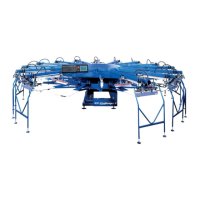
indexer The mechanism used to make the carousel rotate one station over.
indexer base The bottom structure of the machine consisting of printing pallets with supoort arms to which
garments are placed.
index cam follower A roller type bearing employed in the index drive mechanisim.
index delay The interval of time that the machine will wait before initiation of the next operating or index cycle.
index fork (clevis) A machined metal “U” shaped fixture designed to engage the index cam-follower bearings.
independent print The activation of a single print head so that it performs a print cycle.
index on proximity switch The sensor which detects the location of the carousel by sensing the proximity
of the index cam-follower bearings.
index table The rotating part on the machine, to which the pallets are attached to. (Also referred to as the
“carousel”).
indicator A device which draws the attention of the Operator to a specific control area, alerting the Operator to
the current condition of a control element.
infra-red heat panel A flat rectangular piece forming a part of a surface powered by electricity, used to cre-
ate heat to cure inks on a garment.
ink build-up The accumulation of several layers of ink on the bottom surface of a screen or the printing sur-
face.
ink deposit The amount of ink left on the printing surface after the print cycle.
®


 To Next Page
 Loading...