i-HP Industrial inverter air/water heat pumps with axial fans
22
11 MAINTENANCE AND PERIODICAL CONTROLS
If the temperature drops below 0°C there is serious danger of frost: add a mixture of water and glycol in the plant,
otherwise drain the hydraulic circuits of the plant and of the heat pump.
WARNING: if the ambient temperature becomes lower than -20°C (value that is permitted only on i-HP LT series),
in case the unit is turned off and powered down also for short periods, it’s compulsory to drain the plant and the
hydraulic circuit of the unit by the mixture of water and glycol. Otherwise, the circulator may be irreversibly
damaged.
WARNING: the operation, although it was transient, with water temperatures below +5°C is not guaranteed on the
basis of the limits set out in Paragraph 20.4. Before you turn the unit on after a long off period, make sure that the
temperature of the mixture of water and glycol is higher than or at least equal to +5°C.
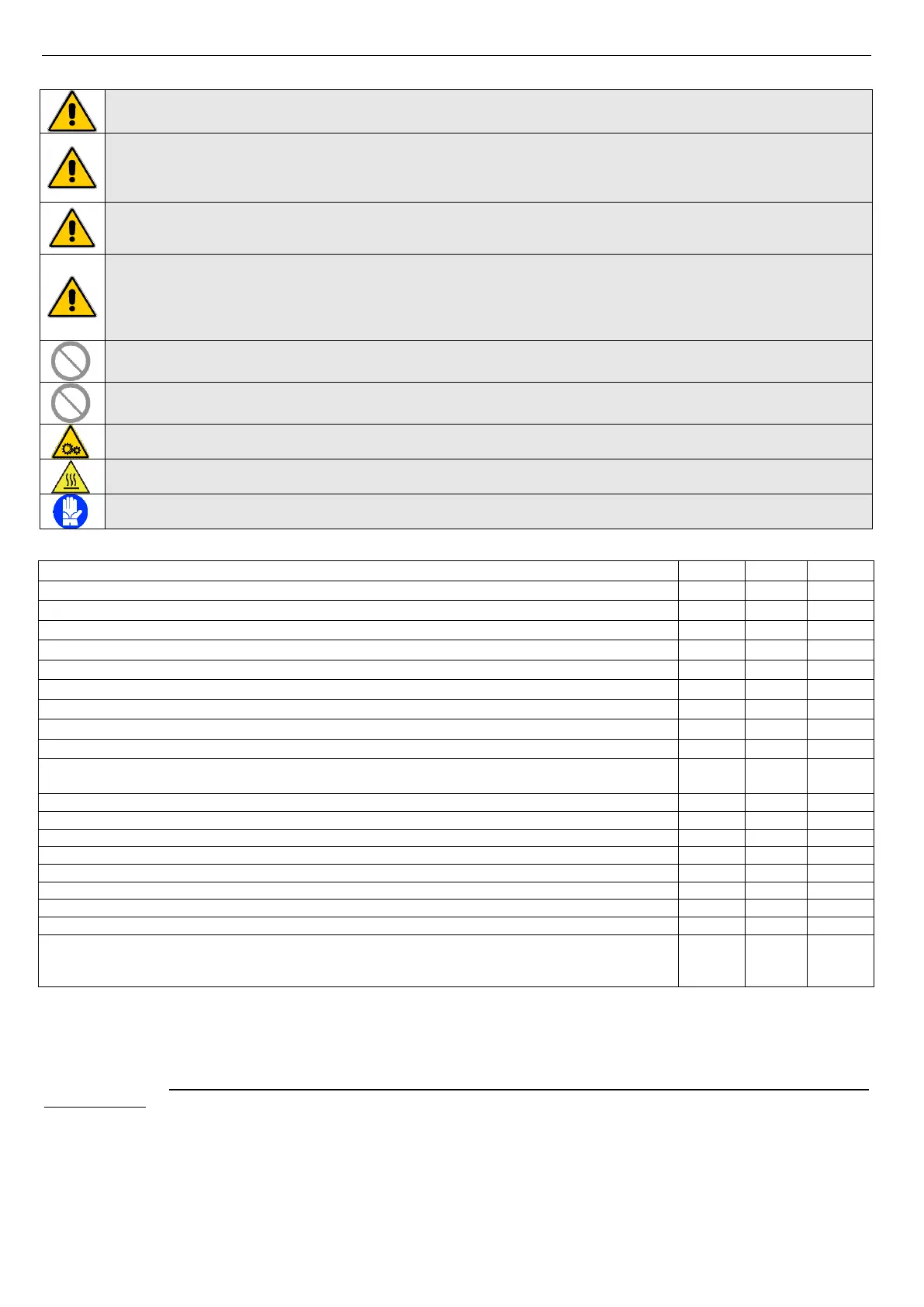
WARNING: All the operations described in this chapter HAVE TO BE CARRIED OUT BY TRAINED STAFF ONLY. Before
any operation or before entering the inner components of the unit, be sure that the power supply is disconnected.
The compressor’s heads and discharge pipes are usually at high temperature levels. Be very careful when operating
in their surroundings. Aluminium coil fins are very sharp and can cause serious wounds. Be very careful when
operating in near them. After maintenance operations, re-install the cover panels, and fix them by means of screws.
The refrigerant circuits must not be filled with different gas other than that indicated on the nameplate. The use of a
different refrigerant can cause severe damage to the compressor.
It’s forbidden to use oils other than those specified in this manual. The use of different oil can cause serious damage
to the compressor.
WARNING: MOVING PARTS, RISK OF DEATH.
Disconnect the power supply and ensure that the fan is stopped before opening the front panel.
The temperatures of heads and exhaust piping of the compressor are usually high.
Pay attention to the surfaces of the driver boards heat sinks (see Chapter 23), which can become very hot.
Be careful when working near condensing coils.
The aluminum fins are very sharp and can cause serious injuries.
It is a good rule to carry out periodic checks in order to verify the proper operation of the unit.
Charging the water circuit.
Presence of bubbles in the water circuit.
Check if the safety and control devices work correctly
Check if there is oil leakage from compressor.
Check if there is water leakage from the hydraulic circuit.
Check the proper working of the flow switches.
Check that the crankcase electric heaters are properly supplied and functioning.
Clean the metallic filters of the hydraulic circuit.
Clean the finned coil by means of compressed air or water jet.
Check if all the terminals on the electric board as well as on the terminals of the compressor are
properly fixed.
Check the tightening of water connections.
Check the tightening and the balancing of the fan blades.
If the voltage is correct.
Check the Correct absorption.
Check the refrigerant charge.
Check the operating pressure, and superheat and sub-cooling
Check of the efficiency of circulation pump.
Check the expansion tank.
If the unit should be out of service for a long period, discharge water from the piping and from heat
exchanger. This operation is necessary if, during seasonal stoppages, ambient temperature is
expected to go down below the freezing point of the employed fluid.
11.1 ENVIRONMENTAL PROTECTION
According to the norms dealing with the use of depleting stratospheric ozone substances, it is forbidden to disperse refrigerants
fluids in the atmosphere. They have to be collected and delivered to the seller or to proper gathering points at the end of their
operating life. Refrigerant R410A is mentioned among controlled substances and for this reason it has to be subjected to the
mentioned norms. A particular care is recommended during service operations in order to reduce as much as possible any
refrigerant loss.
12 DISPOSAL OF THE UNIT
Once the unit comes to the end of its life cycle and needs to be removed or replaced, the following operations are recommended:
• the refrigerant has to be recovered by trained people and sent to proper collecting centre;
• compressors’ lubricating oil has to be collected and sent to proper collecting centre;
• the frame and the various components, if not serviceable any longer, have to be dismantled and divided according to their
nature, particularly copper and aluminium, which are present in conspicuous quantity in the unit. These operations allow easy
material recover and recycling process, thus reducing the environmental impact.



 To Next Page