- 13 -
BONNET GRANDE CUISINE
Rue des Frères Lumière - Z.I Mitry Compans
77292 MITRY MORY Cedex
18 RECOMMENDED AND FRONT LINE SPARE PARTS
1 way 1 x 10 L/min solenoid valve
Drive shaft gasket + wear ring
Complete mounted sensor sub-assembly of oven generator
2 way 2 x 10 L/min solenoid valve
3 way 3 x 10 L/min solenoid valve
3 way 2 x 10 L/min + 1 x 5 L/min solenoid valve
Sub assembly - Gas valve without safety enclosure
After sales kit 9kW element 340 dia + seal
After sales kit 15kW element 500 dia + seal
After sales kit 9kW element 430 dia + seal
After sales kit 7.5kW immersion heater 380 long
After sales kit 6kW immersion heater 380 long
After sales kit 24kW immersion heater 570 long
After sales kit 17.7kW immersion heater 570 long
After sales kit 8kW immersion heater 380 long
4 way solenoid valve, 2 x 10 L/min + 2 x 5 L/min
Three-pole 25A 230V 50/60 Hz contactor
Three-pole 32A 230V 50/60 Hz contactor
Three-pole 40A 230V 50/60 Hz contactor
Three-pole 50A 230V 50/60 Hz contactor
Three-pole 80A 230V 50/60 Hz contactor
Ultra fast fuse 0.2A 250V 5 x 20
PT100 sensor, diameter 4, 350 in length
2 points PT 100 regulating sensor
1 point regulation probe, PT 100
LN2 fixed centrifugal fan 7000rpm
Reducing gear with centre return spring, 85 degrees
Switching regulator 15V 15W RS 15-15
FastPAD 2 max power assembly
FastPAD 2 Mini relay connection
FastPAD 2 Max UL relay connection
Motorised valve 3/4 230V 50/60 Hz female
Inlet/outlet 1 way solenoid valve, 10 L/min
10.2 x 15 diameter 2 mm thick metal-asbestos plastic gasket
Heating element + immersion heater gasket
BONNET GRANDE CUISINE
Rue des Frères Lumière - Z.I Mitry Compans
77292 MITRY MORY Cedex
19 RECOMMENDATIONS
These appliances are for professional use, only appropriately trained personnel should use them.
These appliances are intended to be used for commercial applications, for example in kitchens of restaurants, canteens, hospitals and in
commercial enterprises such as bakeries, butcheries, etc., but not for continuous mass production of food.
These appliances must be installed with sufficient ventilation to prevent the formation of an excessive concentration of substances harmful for
health within the premises in which they are installed.
The rate of new air required for combustion is 2m3/h per kW of heating power.
Never block the condensate exhaust flue, because the pressure could rise in the appliance and pose a risk of explosion.
If an error message appears consult the list of error messages and follow the ADVICE given
When cleaning high pressure jets or lances should never be used.
NEVER start the oven WITHOUT HAVING POSITIONED AND LOCKED the ventilation duct.
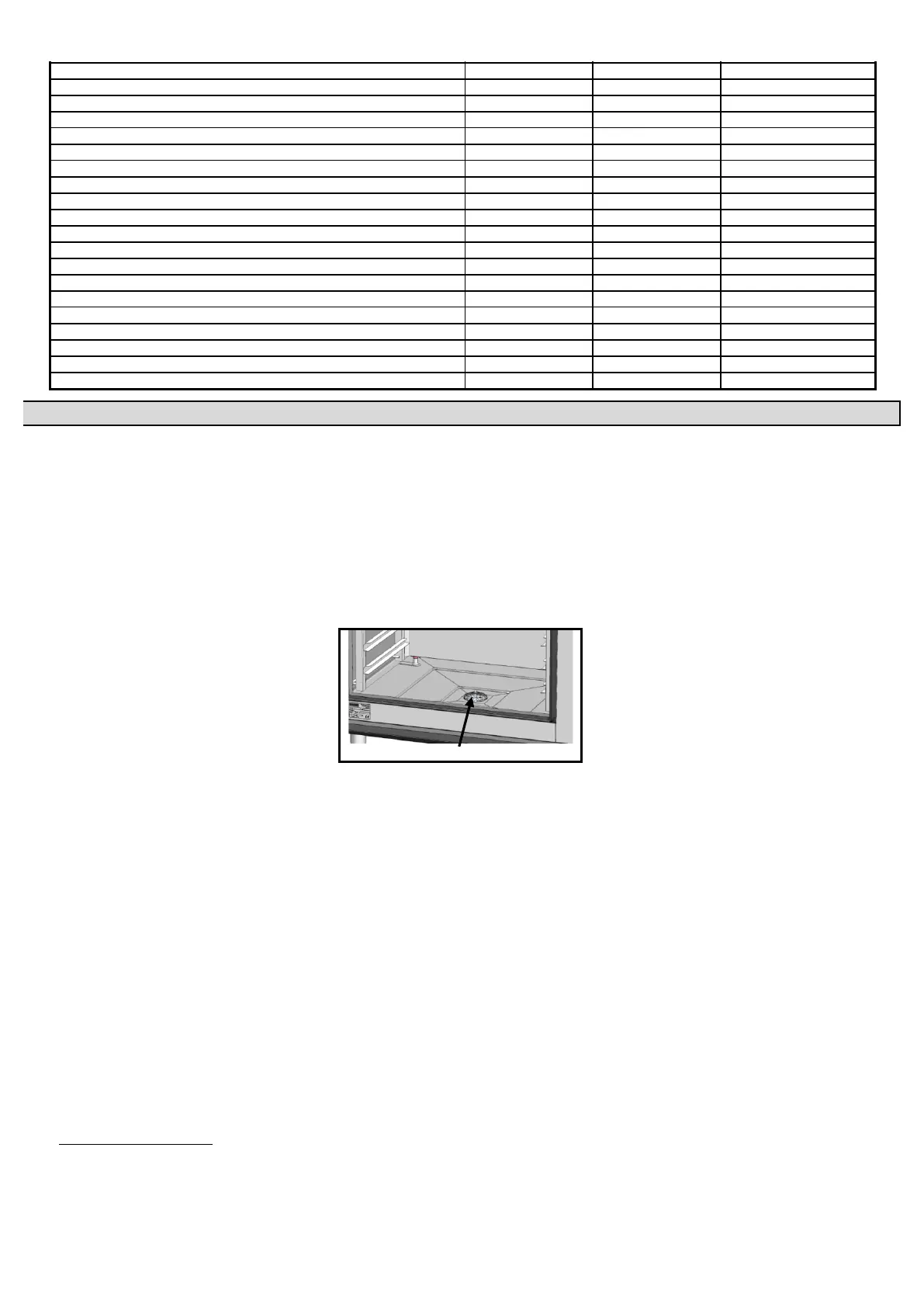
Do not remove the ventilation duct and the drain grid located in the oven. If this grid is missing do not start the oven.
Always use a qualified technician to install the equipment and if necessary change the oven from one gas to another.
IMPORTANT: Please be aware that when cooking dishes prepared with alcohol (coq au vin, pears in wine, etc.…). Vapour saturated with
alcohol may when heated cause an explosion in the oven and due to the sealed door, create a momentary overpressure which may cause an
irreversible deformation of the panels. This risk is further increased when the user adds alcohol to the products near the end of the cooking cycle
and closes the door to complete cooking.
The appliance must be isolated electrically during cleaning or maintenance and when replacing parts.
For long term reliability and safety it is advisable to have the unit serviced by suitably qualified technicians (Dismantling of burners,
inspection and cleaning of venturis, cleaning jets, adjustment of air rings, cleaning vents, checking for possible leaks, checking control elements,
regulating and safety accessories…).
The oven must be meticulously maintained on a DAILY basis (see the “Maintenance” chapter). In particular, the fans, heating elements
and internal surfaces must be kept clean grease and mineral deposits must not be allowed to accumulate.
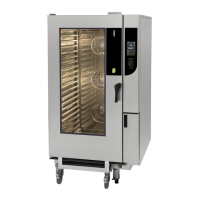
Preheating (20 level ovens): Whatever the cooking mode, these ovens are designed to be preheated with the trolley in place. See «practical use
advice ».
Using a trolley or preheating plate (optional) is compulsory for automatic cleaning of 20 level ovens.
Never place the probe behind the ventilation duct (the probe may deteriorate in proximity to the elements or gas exchange.
NEVER APPLY ANY CLEANING PRODUCT WHEN THE OVEN IS HOT, AT ANYTHING OVER 60°C THE SURFACE WILL BE
IRREPARABLY DAMAGED.
Do not open the oven door during a cleaning cycle.
Combination ovens should be cleaned with specific products which can resist temperature of up to 70°C. An inappropriate cleaning or descaling
product may have a slightly corrosive effect.
The detergent chemical risk should not exceed 3 in accordance with EN 1717 (Toxicological information FDS: LD50 > 200mg/kg).
We strongly recommend the use of cleaning products supplied by the manufacturer to ensure good results and optimize the service
life of its components.
Except for the UK market: No detergent product is recommended or supplied. Any detergent used with this appliance must have been verified to
represent no greater risk than Fluid Category 3. If the detergent used represents a Fluid Category risk greater than Fluid Category 3 alternative
backflow protection to the double check valve supplied with the appliance will be required immediately upstream of the appliance. The backflow
protection used must be appropriate to the risk posed by the detergent.
In order to ensure optimum cleaning results without the risk of chemical attack we recommend using our cleaning chemical BK101. Other
products can be used. Generally cleaning products that are compatible with our ovens should:
- have a composition based on potassium hydroxide with a concentration < 25%, WITHOUT sodium hydroxide
- be suitable for use at a temperature of 60°C.
- include anticorrosion agents
¨ For maximum efficiency of the descaling product without damaging the material and components of the oven, you should use an appropriate
descaler. The use of certain acids has an irreversible destructive effect that may cause significant damage. The descaling product must contain
corrosion inhibitors to prevent metal attack. It must also comply with legal requirements, in particular for material intended to come into contact
with foodstuffs.
Chemical products containing nitric acid are strictly prohibited. Recommended composition:
- Phosphoric acid <50%
- Corrosion inhibitor
¨ The automatic cleaning system is exclusively designed to achieve an introduction of cleaning and degreasing chemical. Never use a descaling
agent. This would damage the hydraulic system of the oven irreversibly.
¨ Under no circumstances should the oven be cleaned with grills or containers in situ.
¨ The core probe socket and USB port are fitted with silicone protective covers.
- Always put the protective cover in place (lowered to protect connections) whenever the socket is not in use.
- Never “clean” connections with a water hose or a sponge. (If the silicone cover is used and put back in place after use,
no maintenance is necessary).
¨ The manufacturer certifies that the packaging meets the provision 94/62/CE (relating to packaging and packaging waste of 20.12.94) and
requests that the final installer (or user) observes the rules relating to the removal of the packaging (recycling or reuse).


 To Next Page
 Loading...